
A joint initiative by



 Published on 2026-01-13Updated on 2026-01-13
On winter mornings, as the morning express from Howrah to Jhargram crosses Kharagpur and chugs on towards Jhargram, nothing can prepare one for the sudden change in temperature, the sharpness of the cold and the way the morning air stings. Winters in Jhargram arrive without notice — the nights after Durga Puja in late September are suddenly fresher, crisper, cooler. October urges you to switch off fans at night. Early on in November, you reach out for the heavy mink blanket that you bought yourself from Gariahat, wondering at the audacity of Kolkata shops to even stock up on heavy blankets. By the middle of November, whispers arise in the town — “Have you heard? The shiulis are here. I have seen the pots on the trees… Gur is being sold…”
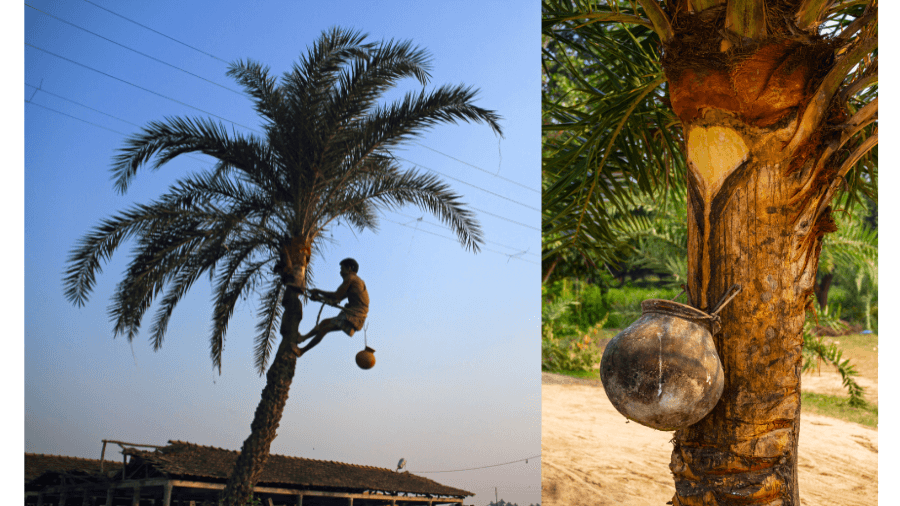
Shiulis climb the tall date palm trees and attach clay pots which collect the sap. (Shutterstock)
Jhargram is one of the newly-minted districts on the map of West Bengal, carved out of West Midnapore (Paschim Medinipur) in 2017. Though subdivided by rivers, pincodes, blocks and subdivisions, the larger culture of Midnapore celebrates winters the same way — with the local production of gur (date palm jaggery), whose demand far exceeds the supply in Bengal during winters, integral as it is to the food culture of the state.
The region of Midnapore is famous for its production of gur, due to an abundance of palm trees and sunny but cold winters that are ideal for the production of the khejur ras or date palm sap. Shiulis (not to be confused with the autumnal flower that blooms in Bengal) are the skilled workers who risk injury and life to climb up on palm trees. They insert split bamboo stalks through which the date palm sap makes its way, drop by drop, to the clay pots that are tied to the trees. It takes a full night for the pot to fill — and a minimum of six to ten such pots to form a mere kilogram of jaggery! Shaped into solid discs, the date-palm jaggery eventually makes its way to the homes and markets of Bengal throughout the months of December, January and even February.
In rural homes of Jhargram, the procurement of the freshest gur is mandatory for the festival of Tusu Puja, culminating in Makar Sankranti — harvest festivals which celebrate the winter bounty.
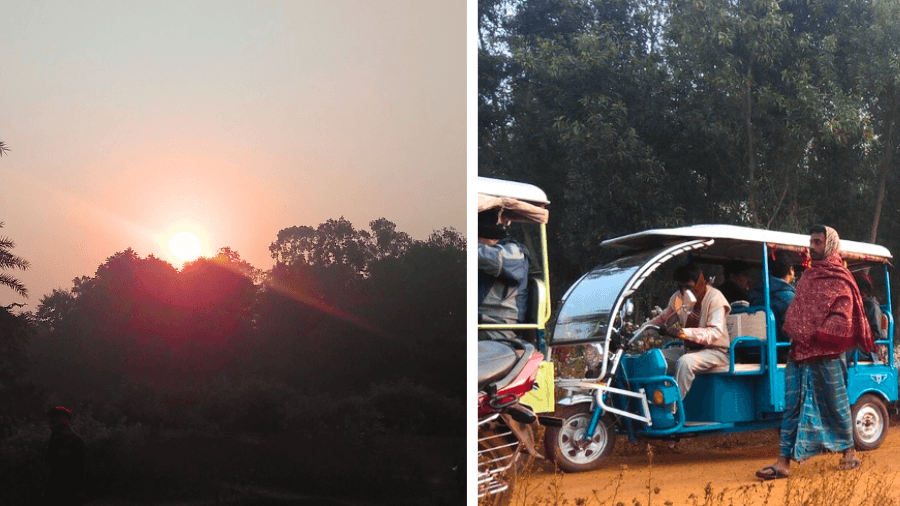
The early morning sun and the trusty totos. (All pictures by Daisy Majumdar)
It all started with a passing “Jabi? Chol jai.” (Want to go? Let’s go). A desire to taste winter at its source — the freshest khejur ras, elusive and fleeting, found only in palm-dotted lands where the sap ferments fast and refuses to travel or gets transformed into gur — making the journey seemed a great way to taste Bengal winter in its purest form.
Though the main town is rapidly urbanising and expanding its boundaries, a 20-minute drive will take you into the true landscape of Jhargram — metalled roads flanked on both sides by sal trees which change their hues seasonally, expansive brown lands with some shrubbery, fields turned golden with the mustard flower, and cabbage, brinjal and bitter-gourd patches that occasionally give way to a sudden crop of the brightest yellow sunflowers, dancing in the wintry sun.
Ask your local auto or e-rickshaw (locally called toto) driver and he will commit to taking you to a reliable spot where the shiulis have set up base. A day is fixed, and the time to set off for your first cup of khejur ras is set at an unearthly 5am — even before the sun has fully committed to its daily duty of rising.
The shock of the alarm buzzing at 4.30am is only superseded by the gasp that you unconsciously let out when you splash your face with the icy tap water soon after. Wrapping yourself up in every possible form of winterwear is mandatory — take that mink blanket along, if possible — because for the next 45 minutes, you are going to travel in a vehicle which is open on all sides, save the roof.
Before you have quite managed to pack yourself into that final layer, your toto driver is ready and waiting. So, you set off — in semi-darkness, when the early gatherers are on their way and the last of the night watchmen are readying to head home. In some time, you reach one of the open, brown fields at Dubrajpur or Kadam Kanan. The air is biting and sharp, the sun hasn't risen yet but the fields are abuzz with activity.
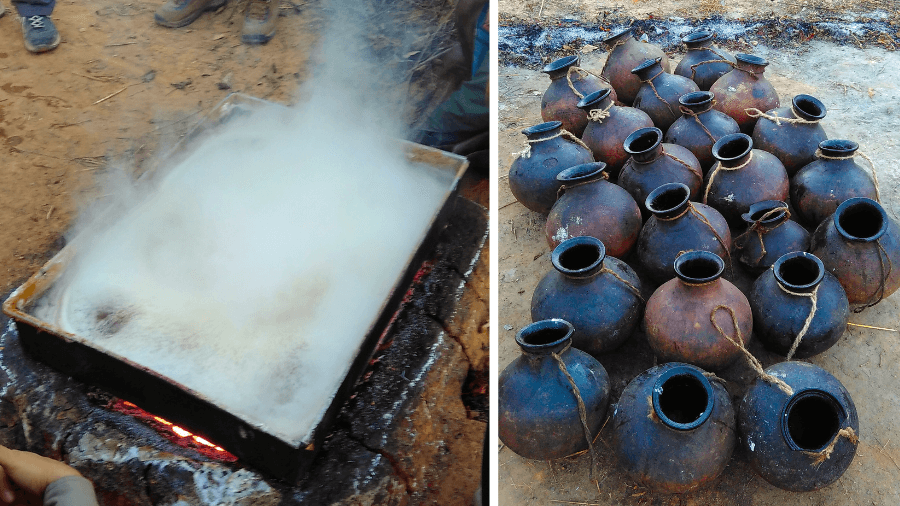
The steaming metal trays and the clay pots which collect the sap.
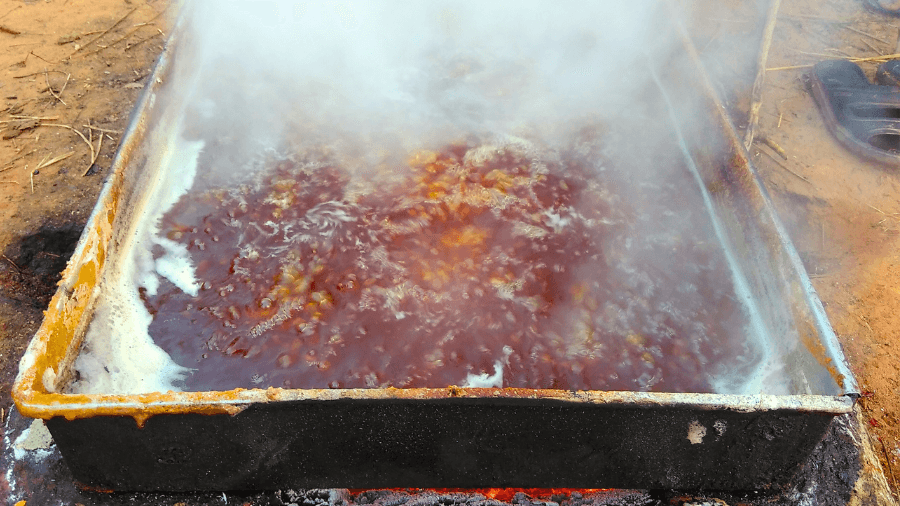
The sap starts to boil.
As you step out of your toto, you are almost knocked out by the aroma of the boiling date palm juice — the air is redolent with the mixed scents of an open wood fire and the heady sweetness of the boiling, thickening juice. It is sure to be one of those transformative moments in your life, when a core olfactory memory is created, never to be erased for as long as you live.
The next thing you notice are large metal trays sitting atop a wooden fire, flames licking the vessels from shallow pits dug into the ground — the quintessential unun that is the lifeline of rural kitchens. The trays are full of khejur ras being stirred to transform the crystal clear ras into caramelised jaggery — a time-taking process where the cold juice slowly bubbles into brownness, thickening into a creamy, golden-brown texture, not unlike the colour of the Korean dalgona popularised by The Squid Games.
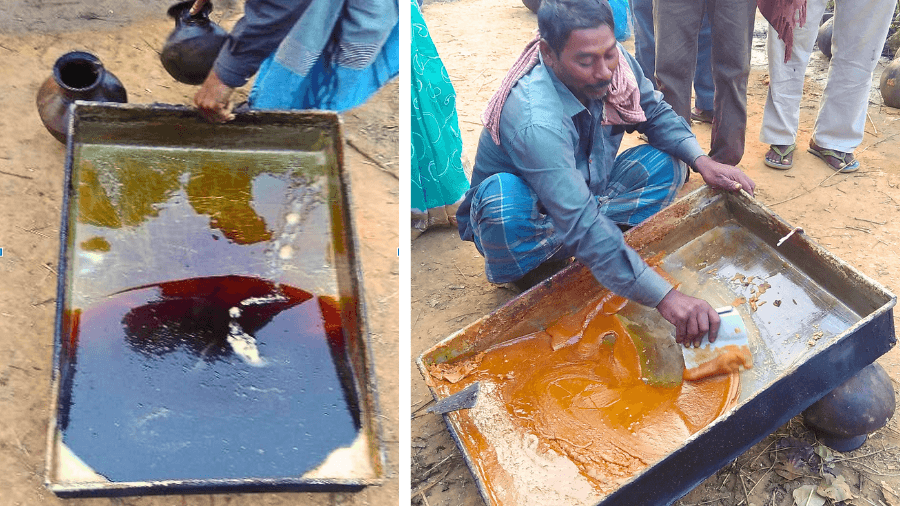
Jhola gur is taken away first for selling; the jaggery is further cooled by moving it around with a metal scraper.
The shiuli families work together, men and women fanning the flames with the leaves and dry stems of the date palm tree, some stirring the boiling juice in the trays, some carrying the trays full of liquid jaggery to cooler grounds and others working steadily at the cooling jaggery. Using metal plates (similar to cake scrapers), the latter scrape the cooling jaggery from the sides to the centres of the trays, and vice versa in a repetitive motion.
The entire gur-making process seems chaotic at first, but a closer look reveals that there is a sharply skilled method to the madness.
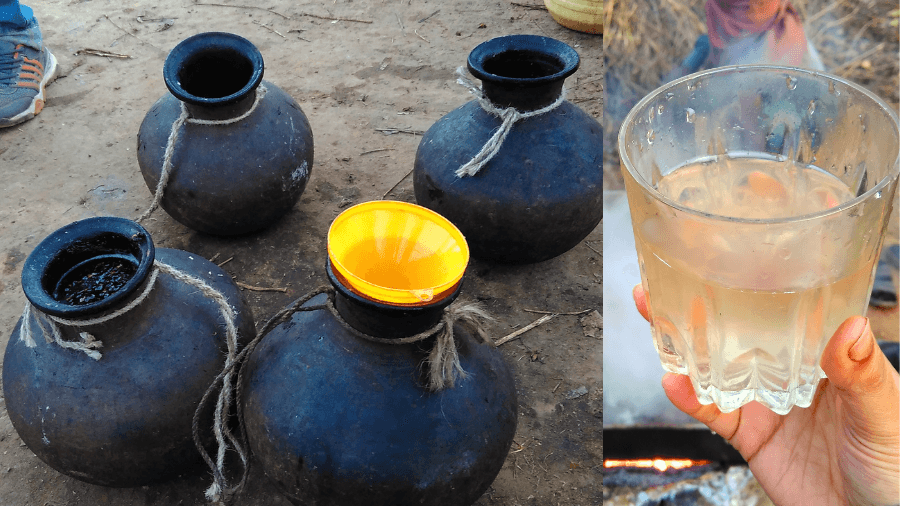
Khejur ras must be consumed fresh, early in the morning, before it can start fermenting.
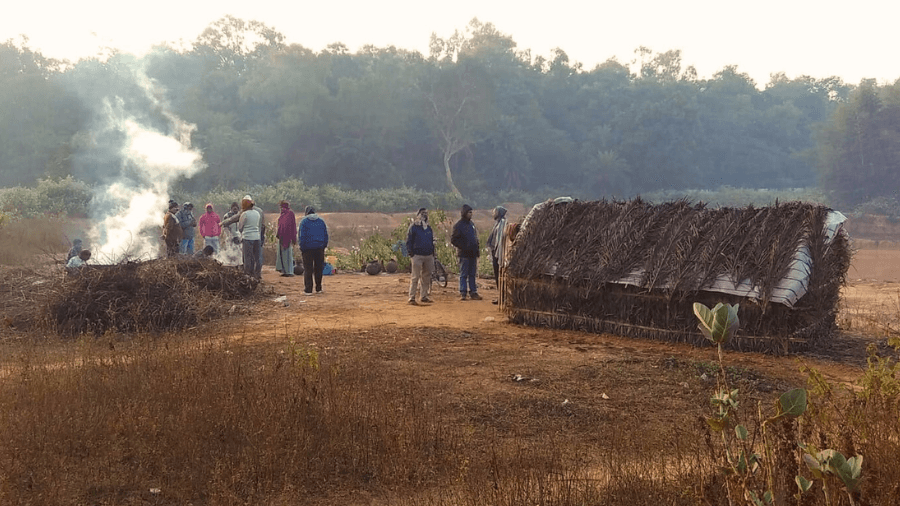
A nearby hut is used as a selling spot for jhola gur.
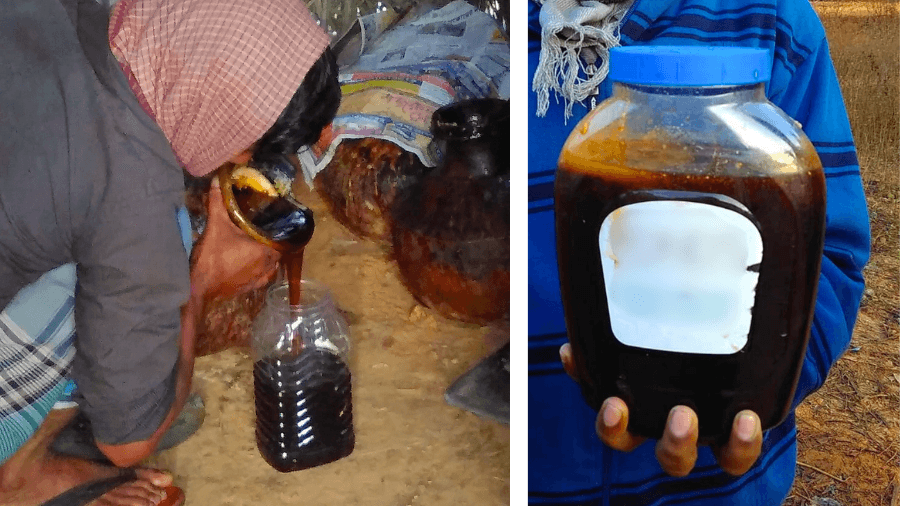
Jhola gur is poured into containers and sold to customers.
While you stand around waiting for the jaggery to set into hardness, glasses of date palm juice are offered to you, poured straight out of the blackened pots untied from the trees. Nothing can truly prepare you for the first sip of this miracle of nature, sourced through human labour and the craft of the tree in the crisp, fresh morning air. The clarity of the juice, the overwhelming sweetness and the coldness of it combine to create another core memory — a cold drink on a scorching summer afternoon has never felt as refreshing as this.
“Have it,” whisper the toto drivers, “it’s the only real guard against soogar (diabetes in colloquial Bangla), and you will never catch a cold in your life again.” You wonder at this locally-gleaned wisdom, watching them stand around in slippers, a basic shawl and a woolen cap — even as you shiver in your branded bomber jackets and three layers of winter garb.
In a thatched hut nearby, jhola gur, which has already been taken out of the trays after it has reached the thick syrupy consistency, is being weighed and sold. This deep brown liquid jaggery is a staple of Bengali homes during the season and a compulsory accompaniment for the various pitha/puli made to celebrate the harvest at Makar Sankranti.
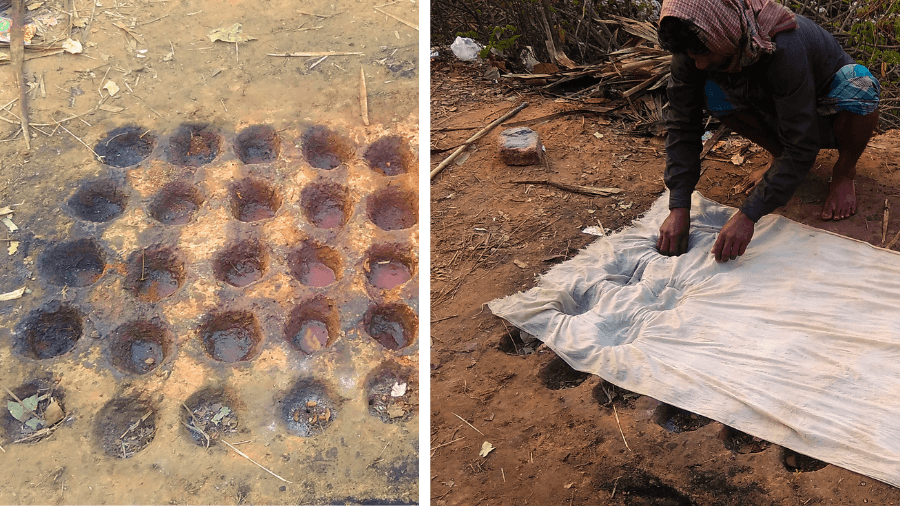
Pits dug into the ground are then lined with clean white cloth.
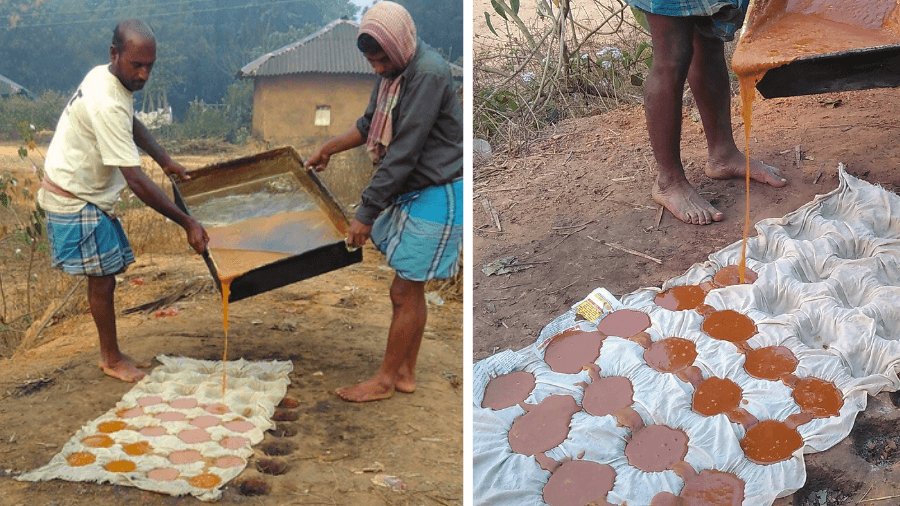
The thickened jaggery is poured into these pits and left to solidify.
As the last, cold drops of the khejur ras slide down your throat, the jaggery has cooled into a thick, brown, semi-liquid mass. The workers carry the tray to a different area in the same grounds, where small round pits have been dug into the ground — all of them covered by a soft, white sheet. The workers skillfully pour out the thickened jaggery, cooler than before but still as hot and viscous as lava, into these little cloth-covered pits. The pits are then covered by another sheet and left till jaggery hardens — a process that takes about an hour.
By this time, morning has set in, and life has come alive in the local villages. Soon, the gur-processing areas transform into a local jaggery market. Sheets are placed on the ground, newspapers strewn over them. The workers carefully lift out the cloth sheets from the pits, and roundels of jaggery (now, hardened into patali) are placed carefully on the newspapers. They are then individually wrapped into pieces of newspaper, secured in place with jute strings. Sellers sit with their weighing scales and cash boxes, and each little roundel is sold for a mere fraction, compared to city prices. Buyers throng the little makeshift market: with Makar around the corner, the demand is high — and therefore, the first to buy is the one to gain the most. Buyers leave with large bags of jhola (liquid) and patali (hard) gur, still warm to the touch, some buying nearly 14 to 15 kilos!
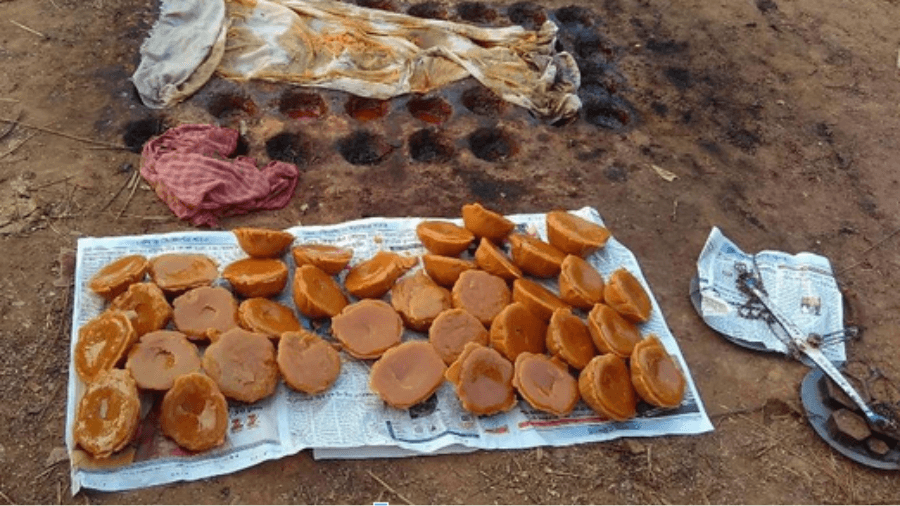
Finally, the newly formed patali is unwrapped and placed on newspaper sheets for selling.
Soon, the sale is over — as the sellers run out of gur — and only the scents linger. The last of the metal trays are cleaned, and the shiulis offer you free gur-chanchi (the bits that stick to the edges of the metal trays), alternately creamy and burnt in parts. As the totos prepare to leave, you scurry back to your seat, two roundels of warm jaggery in your hands. The morning sun is now slanting over the grounds, the fog has lifted, and the cold seems to fade out as the rays of the sun grow brighter.
As the toto trundles back to town, with your clothes carrying smoky whiffs of boiling khejur ras, you create a little montage in your heart. Flashes — foggy brown-grey lands, thick smoke rising above burning coal and wood, the quick motions of practiced hands, the sweet flavour of ras on your tongue, a pinkish orange sun slowly rising from behind the bushes, the world coming to life.
Your quest for khejur ras and khejur gur is now complete — the sweet prizes in your hands will carry you through the winter till it’s time again for the next expedition.


