
A joint initiative by



 Published on 2026-10-06Updated on 2026-10-06
Durga Puja and food are inseparable. The festival generates its own ecosystem of eating — street stalls outside pandals, late-night food binges, mishti bought by the boxful. But at the centre of it all sits bhog: food offered to the goddess that is distributed among devotees. Bhog is a form of prasad, which, unlike the fruit or sweets offered everywhere, is usually a full, cooked meal — prepared in the pandal kitchen by special cooks, offered to the deity during the puja and then served to everyone who is present. In community pujas across Bengal, the bhog is the one plate that makes no distinctions. It is the great equaliser. Everyone eats the same food, seated together.
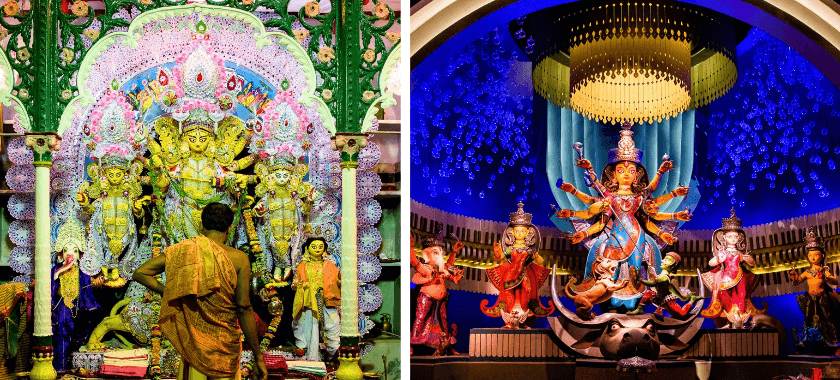
There was a time when Durga Puja was confined to Bengal’s zamindar baris or bonedi baris — the estates of the elite. It was an entirely private affair where few outsiders could enter, and the celebration was restricted to a select, privileged few. That changed in Guptipara, a village in Hooghly, where twelve friends who had been barred from a zamindar’s household puja decided to organise their own in the late 1700s. The word “barowari” comes from this — baro meaning twelve and yaari meaning friends.
From Guptipara, the barowari puja slowly spread. The Bhowanipore Sanatan Dharmotsahini Sabha, established in 1910, is recognised as the first barowari Durga Puja in Kolkata. The Simla Byayam Samity followed; other areas of Kolkata soon took up the tradition. Gradually, the puja terminology evolved from barowari to “sarbojonin” — meaning for everyone and of everyone.
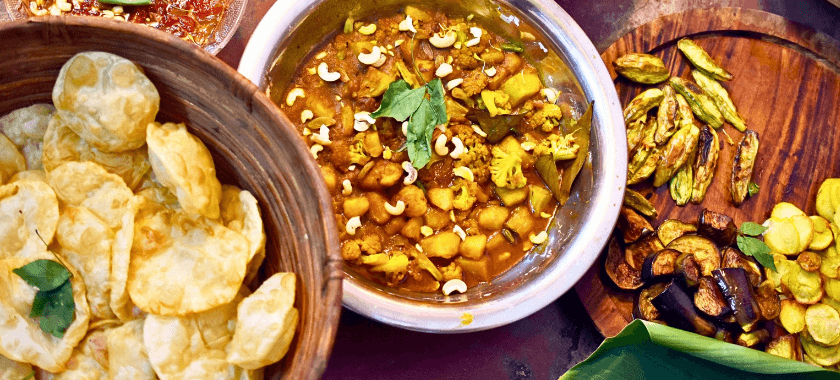
For hundreds of years, Durga Puja bhog was defined according to the bonedi bari families hosting them. Each had their own distinctive offerings made to the goddess. Till this day, the Sovabazar Rajbari is known for its Mithai Bhog while the Dutta Chowdhury family of Andul serves the Agmonda — a triangular sweet made from mawa, coconut paste and kheer, garnished with dry fruits, with the outer layer crafted from chandani kheer. The Chorbagan Sil family offers luchi, kochuri and various sweets to the goddess, but no annabhog — rice-based items — at all. Each household has its own tradition, its own recipe, its own way of feeding the goddess that remains unchanged.
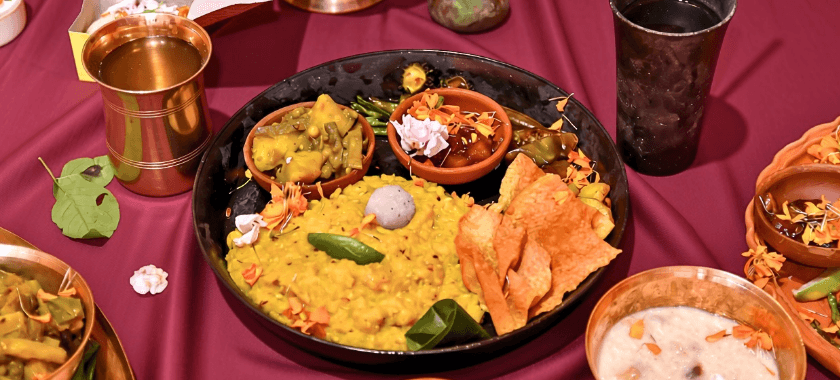
As the puja opened up for the masses the nature of bhog also changed. The barowari or community bhog set its own standard of offerings.
The meal was built around Gobindobhog rice and shona moong dal, slow-cooked together into a khichuri that filled the hearts and stomachs of the entire para or neighbourhood. This was accompanied by beguni, labra — a mixed vegetable dish made with an assortment of seasonal vegetables — a chutney, and payesh to finish. This has remained the standard format for community puja bhog across Bengal ever since.
Swami Vivekananda is also said to have introduced the khichuri bhog tradition at Belur Math. The distinctive quality of his bhog was the addition of a wide variety of vegetables.
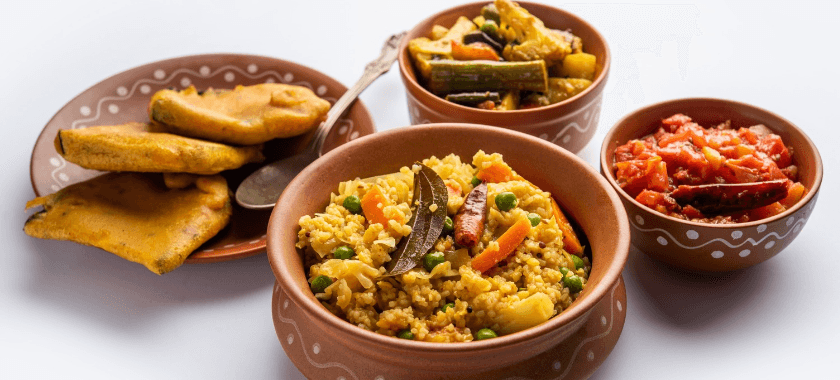
The smell of piping hot khichuri, paired with labra and that particular style of payesh that only puja cooks seem able to make, fills the entire para with its aroma long before it reaches the plate. The taste of the meal is also quite unlike anything prepared in an ordinary kitchen. It is something every Bengali waits for the entire year and patiently queues up for.
The idea behind barowari bhog is not just the food itself but the act of eating the same meal together. A sense of equality is built into it. To feed an entire community, khichuri and labra was probably the most affordable and nourishing combination that could be served at scale. Though many community pujas now include additions like fried rice, paneer dishes and vegetable chops, it is still the khichuri–labra combination that comes to mind whenever anyone speaks of bhog.
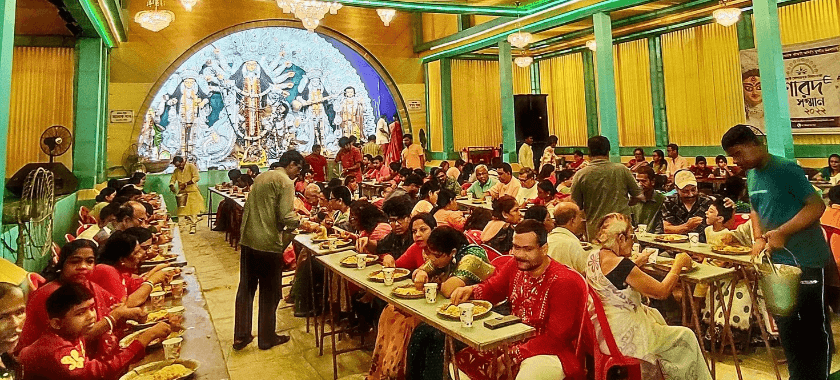
The making and distribution of bhog also played a role during the freedom movement. It was used as a way to bring revolutionaries together under the cover of a community celebration. The Simla Byayam Samity is a notable example. Netaji Subhash Chandra Bose also played an important part in taking Durga Puja to the masses, using the community celebration to unite the youth and foster nationalism. The festival, once restricted to the elites, became a gathering point for everyone — and the shared plate of bhog was central to that transformation.
Decades on, the bhog plate has remained remarkably unchanged. The additions come and go — a vegetable chop here, a rosogolla there — but the core of it is still the same. Khichuri, labra and payesh eaten off a paper, sal or banana leaf plate, sitting in a community park or designated area near a Puja pandal alongside a few hundred people you may never see again.
It is, in the end, the simplest meal of the season and the one nobody forgets.
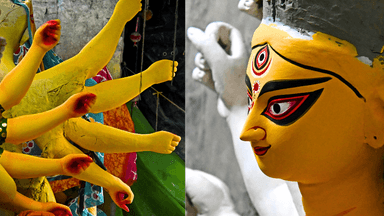
Step inside Kumartuli in the weeks before Puja and this is what you see

Bengal’s grandest festival rivals the planet’s greatest cultural spectacles
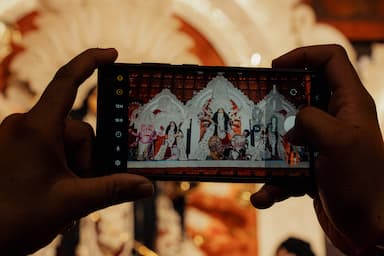
Kolkata was swept up in a tide of devotion, celebration and unstoppable joy


