



Maa Phire Elo: A city's tribute to its cultural core — Durga Puja
The museum inside the Rabindra Sarovar Complex is a homage to the art, the effort and the cultural impact of Durga Puja

 Published on 2026-02-07Updated on 2026-02-07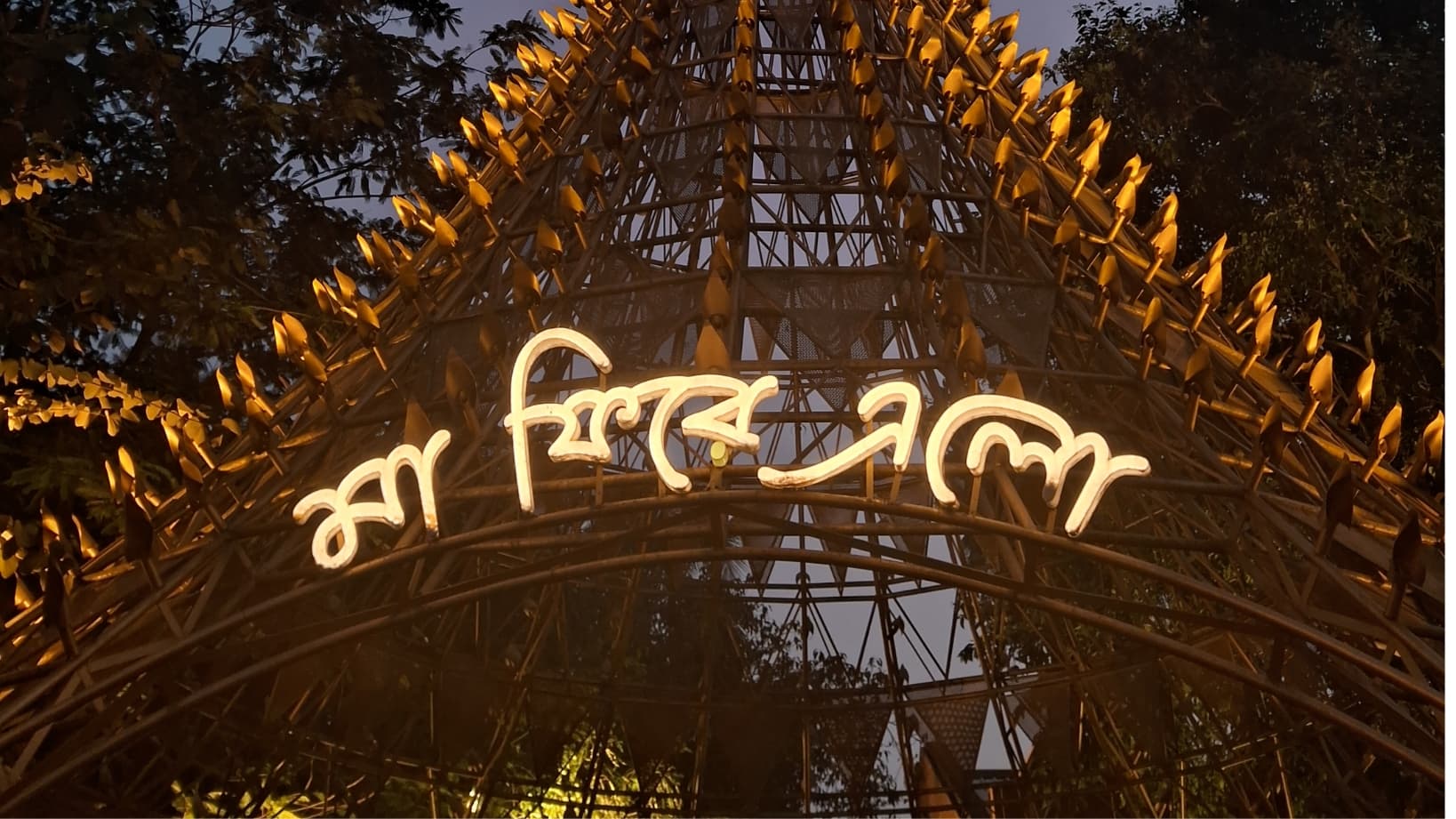
At the museum's entrance, there is a metal tower lit with the glowing words ‘Maa Phire Elo’. (Picture by Saradindu Bhattacharya, Wikimedia Commons)
Kolkata is often a keeper of secrets that manage to catch its own residents off guard when revealed. It does not give away its most cherished cultural spaces easily. More often than not, they lie at the end of a walk—beyond gates that appear mundane or unremarkable—inviting explorers to find the special hidden in plain sight.
The Durga Museum at Rabindra Sarovar, known as 'Maa Phire Elo', which roughly translates to 'Mother Has Returned', is one such place. It is meant to be discovered not by accident but by intention.
Opened in 2012, it occupies a rectangular one-acre plot within the Rabindra Sarovar complex, one of south Kolkata's cherished green lungs. Reaching it requires entering the park through Gate Number 2, after crossing the gates of the famed Bengal Club. From here, a wide asphalt walkway stretches ahead for roughly 450 metres. It is flanked by trees, flowering plants and shrubs that soften the edges of the path. Once inside the Rabindra Sarovar Complex, the noise from passing traffic fades, replaced by calls of birds lifting off from the surface of Rabindra Sarovar AKA Dhakuria Lake, which spans more than 70 acres.
Arriving at Maa Phire Elo
As you approach, two gigantic terracotta lamps, their surfaces textured and earthy, highlight the gate of the museum. A little further ahead, an unexpected structure rises into view: a metal 60-foot tower-like installation that resembles the Eiffel Tower in Paris, with the words 'Maa Phire Elo' crafted on it. Even in the evening, it is unmissable, draped and decorated as it is with LED lights that switch on automatically after dusk.
Stepping inside the museum grounds, the first Durga idol appears almost immediately on the left. This idol was part of the Chetla Agrani Club's Durga Puja in 2017—a puja always known for its craftsmanship and community involvement. Removed from the chaos of festival crowds, the idol seems calmer here, her expression easier to read, her form more approachable. At the rear is a sculpture of Lord Shiva, making the installation a 360-degree piece of artwork.
Opposite this pavilion stands another idol of Maa Durga with her children, Saraswati, Lakshmi, Ganesh and Karthik enclosed within a glass enclosure. This idol belonged to Hindusthan Club's Durga Puja in 2021. Even now, Durga and her children stand in quiet resplendence, preserved as though suspended in time. The glass enclosure creates both intimacy and distance, allowing close viewing while reminding visitors that these objects have crossed from ritual use into remembrance.
As one walks further in, both the Eiffel Tower-like structure and the main gallery align visually, creating a sense of symmetry. The outer walls of the gallery are adorned with terracotta installations, including a striking depiction of a horse and a wheel—images suggestive of movement, power and continuity. Other panels feature terracotta motifs drawn from folk traditions, their simplicity contrasting with the elaborate idols inside.
Along the roof, figurines bearing bows, arrows and swords stand frozen in mid-gesture, guardians watching over the space. Their presence reinforces Durga's identity not only as mother but as a force of balance.
Inside the Main Gallery
The heart of Maa Phire Elo lies within the main gallery. As many as 16 Durga idols stand here, each one retaining the visual language of the club that commissioned it. Alipore 78 Palli, Barisha Club, Bhowanipore 75 Palli and Ahiritolla Sarbojanin are among those represented—names that resonate deeply with anyone who has navigated Kolkata during Puja season.
Lighting plays a crucial role in shaping the experience. Each idol is illuminated differently, with careful attention to facial expressions, posture and detailing. Some are bathed in warm light, emphasising maternal gentleness. Others are lit more starkly, drawing attention to Durga’s fierce warrior/protector form. Freed from the press of crowds, visitors can linger, noticing details that might otherwise be missed—the curve of a hand, the texture of clay, the individuality of each sculptor’s style.
Traditionally, Durga idols are immersed in water at the end of the festival, symbolising impermanence and renewal. The museum interrupts this cycle—not to deny it, but to document it. Because in West Bengal, Durga Puja is as much a cultural event as a religious celebration. Every idol, every pandal, every light panel, every artisan involved in any of the multitudinous aspects of the festival, elevates it to the level of art. This museum celebrates that art.
An Unfinished Journey
Outside the main gallery at Rabindra Sarovar stands an installation depicting four men carrying a platform. The figures appear frozen mid-stride, the work visibly incomplete. It is an oddly fitting image since carrying the goddess through the streets—on shoulders, through crowds, accompanied by dhaak and chants—is one of the most recognisable sights of Durga Puja. This unfinished representation probably acknowledges that the story itself is ongoing.
As visitors begin the walk back towards the park gate, past the trees and the lake, the meaning of Maa Phire Elo sinks in. The mother has returned—but she has also remained. In clay, terracotta and memory, Calcutta has found a way to hold on without interrupting the rhythm of departure.
Beyond the Museum Walls
This endeavour reflects a broader shift in how the city relates to its cultural production. What was once fleeting is now being consciously archived, curated and displayed.
Maa Phire Elo sits within a wider cultural movement in West Bengal, one that seeks to preserve and celebrate the art and spirit of Durga Puja beyond the festival’s fleeting days. Across the city, Durga Puja idols and installations have found new lives in public spaces. Eco Park features several preserved idols, metro stations display former pandal artworks and hotel lobbies showcase sculptures that once stood at the heart of neighbourhood celebrations. In New Town, traffic islands host installations from past pujas, integrating festival art into everyday commutes.
One of the most anticipated expressions of this intent is the upcoming Durga Angan project in New Town, Kolkata—a permanent cultural and spiritual complex dedicated to Goddess Durga and the festival’s socio-religious and cultural heritage. Announced with the aim of honouring Durga Puja’s UNESCO Intangible Cultural Heritage recognition and bringing its richness into a year-round experience, the Durga Angan is being developed on over 17 acres near Eco Park.
It is envisioned as a hub of cultural memory: a place where craft, ritual, music and community life can be experienced throughout the year rather than only during the autumnal festival.
Durga Puja: A City Rebuilt Each Year
Building museums and creating cultural spaces, such as Maa Phire Elo, is not merely about preservation. It’s about proudly affirming the value of traditions that fuel local economies, join communities and inspire devotion and creativity to go hand-in-hand for generations.
In essence, it is a way to recognise not only the sheer scale and social impact of Durga Puja, but also its place as both art and shared heritage in the collective Bengali and global imagination.
Fact File:
The Durga Museum is open to the public from 6am to 6pm, every day. Entry is free for all.