
A joint initiative by



 Published on 2026-04-03Updated on 2026-04-03
Centuries-old terracotta temples and weavers’ looms that spin a fabric so fine the Mughals named it Baft-Hawa or “woven air’ — temple tales and textile fables intertwine in Ambika Kalna, a small town around 90km from Kolkata.
Located on the banks of the Bhagirathi, Ambika Kalna is home to the 108 Shiva temples built in Bengal’s typical aatchala style by Maharaja Tej Chandra Bahadur of Burdwan in 1809.
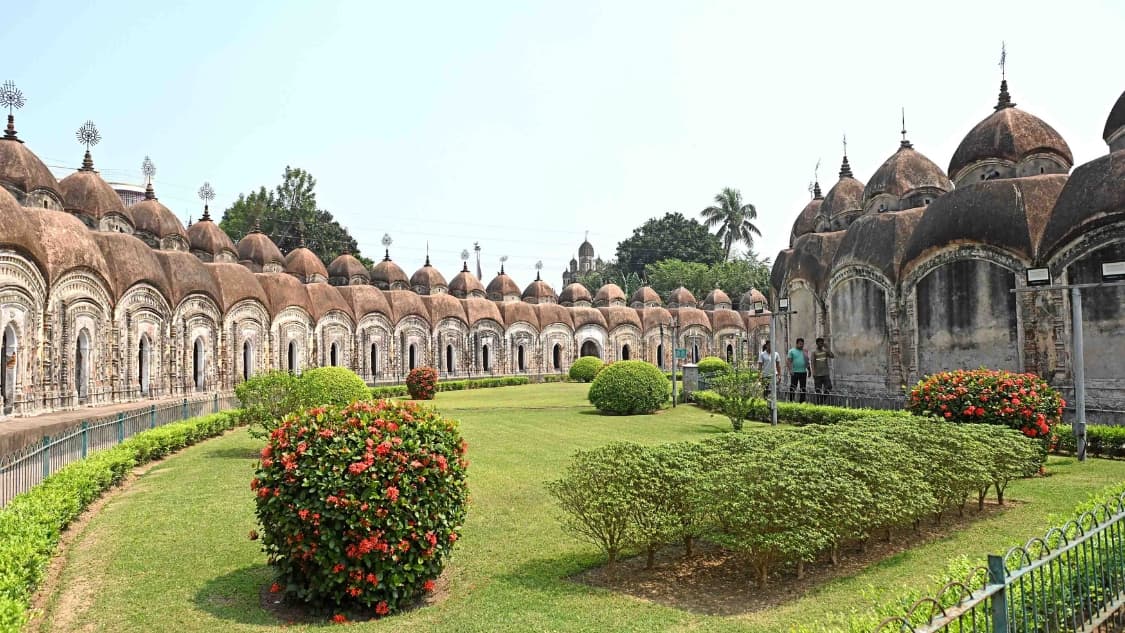
The 108 Shiva temple complex, where 108 Shiva temples are arranged in two concentric circles.
The journey to Kalna is a road to discovery — a three-hour drive from Kolkata, crisscrossing past canals, emerald green paddy fields and villages. One can spot the occasional bullock cart along with a multitude of electric three-wheeled contraptions — totos that now seem to be everywhere and have the innate capability to appear out of nowhere, taking even the most seasoned drivers by surprise.
As the town emerges, the roads narrow down exponentially before the first domes of the temples can be spotted.
On entering Kalna, the streets themselves seem to guide visitors into history. Narrow lanes open into courtyards where looms click steadily, temple spires suddenly appear between houses that stand cheek by jowl with each other. It is a place best explored on a battery-powered three-wheeler as anything on four wheels will find it difficult to negotiate the narrow lanes and bylanes of the town. For those with more time on hand, a walking tour is ideal although in summers it can get scorching hot.
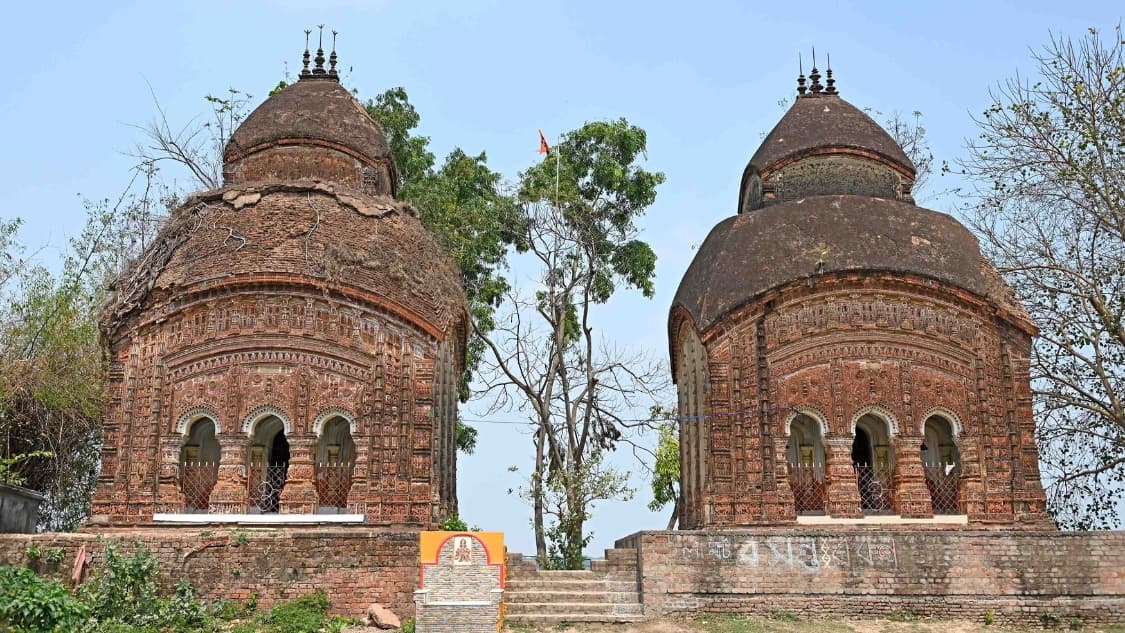
The twin Shiva temples of Jagannathtala.
A trip to Kalna needs some planning. The place lives up to its temple town tag with one at almost every corner.
Begin at the Rajbari complex, home to the town’s finest and oldest terracotta temples with stucco artworks. From here, a clockwise route takes one to the Ratneswar temple, the 108 Shiva temple complex where 108 Shiva temples are arranged in two concentric circles, the Jaleswar temple, the Siddheshwari Kali Mandir from where the town derives its name, the Gopalbari Panchabimsati Ratna temple and the twin Shiva temples of Jagannathtala.
Morning is the ideal time to start as sunlight bounces off the terracotta panels at the Lalji Temple built in 1739, highlighting the detailed Krishna-lila scenes while shadows play among the pinnacles. Birdcalls lend a living soundtrack.
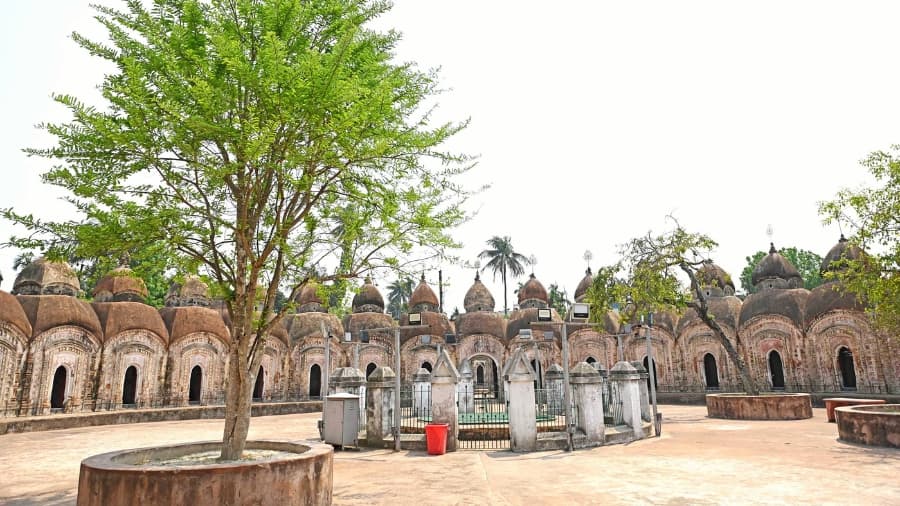
The 108 Shiva Temples Complex was built in 1809 by Maharaja Teja Chandra.
The complex of 108 Shiva Temples is a sight to behold with its carefully curated greens in the four quadrants. Built in 1809 by Maharaja Teja Chandra, the shrines form two concentric circles — 74 in the outer ring and 34 in the inner. Each houses a Shiva lingam, the outer circle alternating in black and white to signify duality and the inner circle in pure white to signify spiritual unity. Walking through the concentric rings feels less like sightseeing and more like entering a meditative mandala, a rare encounter where architecture doubles as spiritual geometry. The entire complex is built to mimic a mammoth-sized rosary. The only other 108 Shiva temple complex in Bengal is also in Burdwan but has a rectangular structure.

The Rajbari complex is a treasure trove of terracotta artwork.
Located in the heart of Kalna, the Rajbari complex is a treasure trove of terracotta artwork. Here, temples are not merely structures; they are structures adorned with manuscripts in clay, narrating the life, devotion and artistic vision of Bengal in those days.
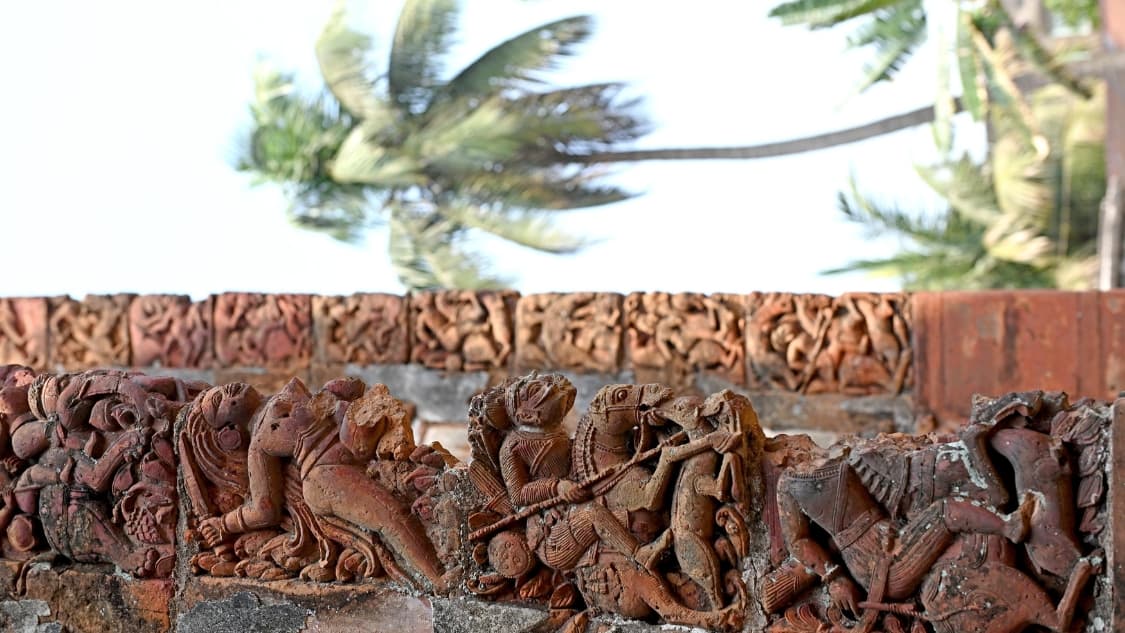
Dedicated to Radha-Krishna, the temple’s terracotta panels depict Krishna-lila.
Built by Maharaja Kirti Chand back in 1739, the Lalji Temple is the oldest temple in Kalna. It follows the Panchabimsati Ratna style, with 25 pinnacles arranged over three tiers. Its unique octagonal second storey sets it apart, creating a rhythm of pinnacles unlike any other in Bengal. Dedicated to Radha-Krishna, the temple’s terracotta panels depict Krishna-lila, scenes from epics and glimpses of contemporary life, stringing a narrative sequence almost like a sculpted manuscript.
Flanked on all four sides by panels depicting scenes from a hunting party, motifs of horses, lions, tigers and soldiers on horseback. The higher walls also have Shiva temples on their terracotta panels.
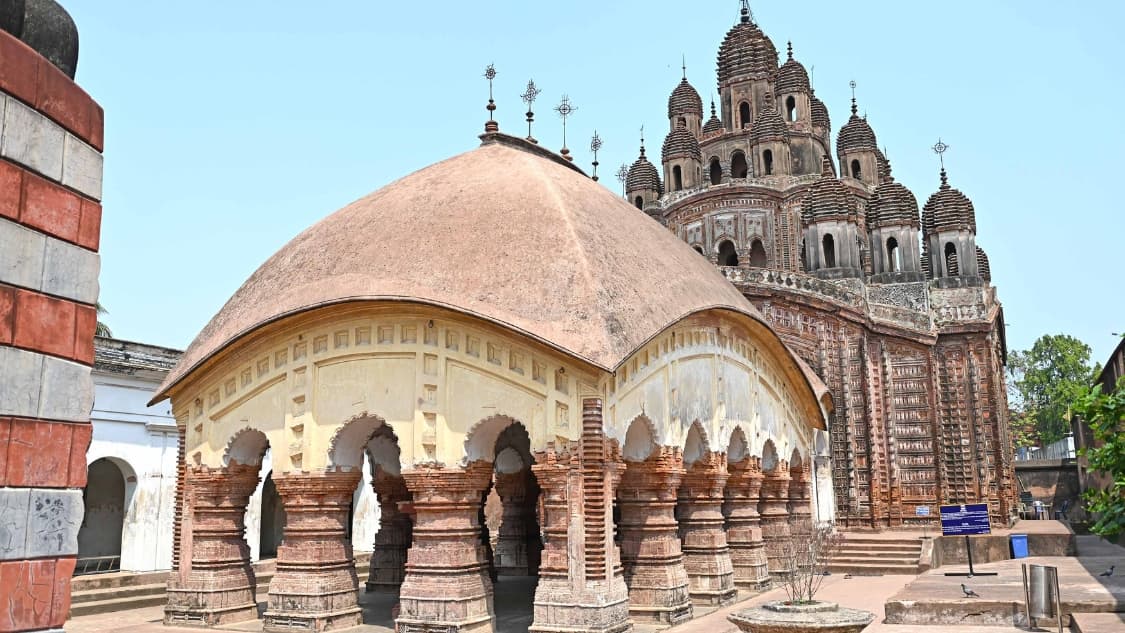
The Lalji Temple is the oldest temple in Kalna.
Inside this temple complex is a Natamandapa built in charchala style where devotees can gather and stand for their prayers. Garuda, the vahana of Krishna mounted on a raised plinth, stands guard inside the Natamandapa. Behind this is a mountain-like temple called Girigovardhana. The facades of the Natamandapa, although adorned with terracotta panels, have not stood the test of time with exposed brickwork everywhere.
The Girigovardhana temple, too, has terracotta panels depicting the life of Krishna while its roof is adorned with mythical characters and animals.
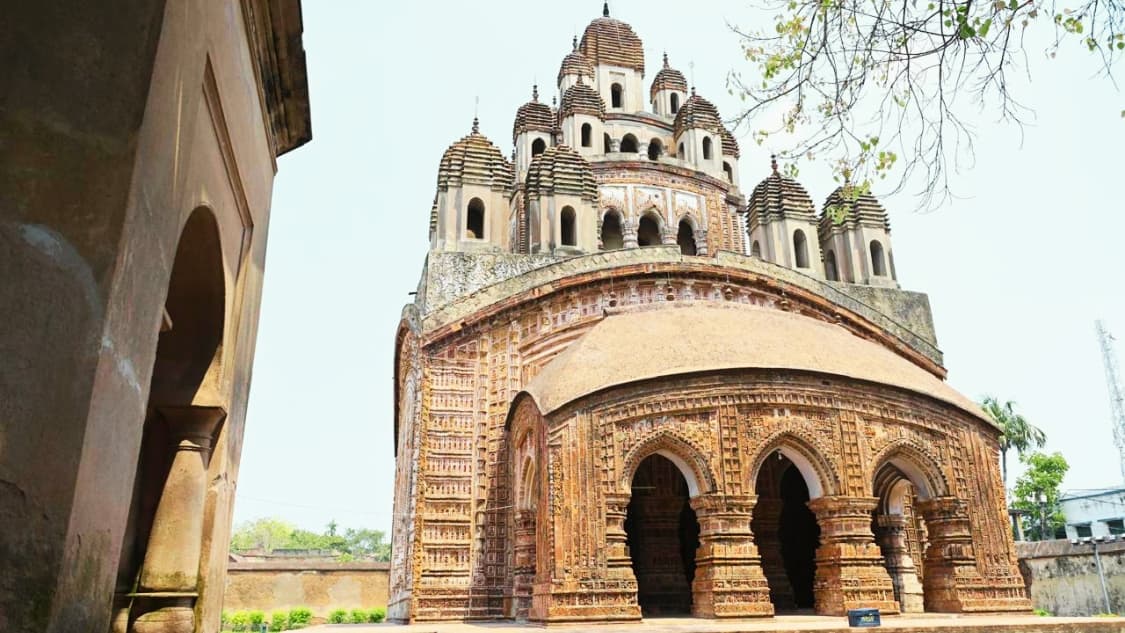
The Krishna Chandra Temple was built in 1755.
The Krishna Chandra temple is a refinement of the Lalji design. One has to turn left and go past the Pancharatna Temples to reach this. The Pancharatna temples are a collection of five aatchala, sloped-roofed temples that vary in their shapes and sizes while remaining architecturally similar. The carvings here are the most intricate.
The construction of the Krishna Chandra temple started in 1751 and ended in 1755, according to the Archaeological Society of India (ASI). The temple has a boundary wall running around it and one has to enter through a small gate. As one goes through the gate, the Vijay Vaidyanath temple comes into view. This brick-built aatchala temple stands on a high platform and has a balcony with triple-arched entrance in the front. The front façade has terracotta panels depicting hunting parties armed with swords and long guns. Other panels depict musicians with their instruments.
The terracotta panels of the Krishna Chandra temple depict episodes from the Ramayana and Mahabharata. Panels showcasing boats, musicians and domestic chores can also be spotted here. The carvings effortlessly blend the tales from the two epics with the daily life of people. In comparison, the temples of Bishnupur, though monumental, often emphasise vertical grandeur over narrative density, making Kalna a subtler, more immersive experience. Inside this temple complex, there are other buildings as well that serve as places where devotees can gather and smaller temples. The courtyard itself has a huge banyan tree in its centre.

Terracotta of Pratapeshwar Temple showcasing Ramayana.
The first temple to greet visitors inside the Rajbari Complex is also the smallest and most detailed in terms of terracotta panels adorning it. Built in 1849, the Pratapeswar Temple also stands on a raised platform. It has a curving tower with a single arched entrance and is built in the ridged rekha deul style, a signature of the Bishnupur-Burdwan architectural tradition.
The temple’s exterior is a tapestry of elaborate terracotta carvings, with every elevation telling a story in clay. Across its walls unfold epic narratives — the battle between Ram and Ravan, the fierce triumph of goddess Durga as Mahishasuramardini and Ram enthroned as the king of Ayodhya with Sita by his side. A sprawling horizontal panel celebrates the many facets of Krishna-lila, capturing divine playfulness alongside devotion. One can also catch glimpses of life in 18th-century Bengal — processions, musicians and everyday social scenes. Intriguingly, three of the four doors are mere stone façades, masterfully crafted to appear functional. Only close examination would reveal that they are not real doors. The craftsmanship is so refined that the carvings on the doorway appear sculpted rather than moulded.
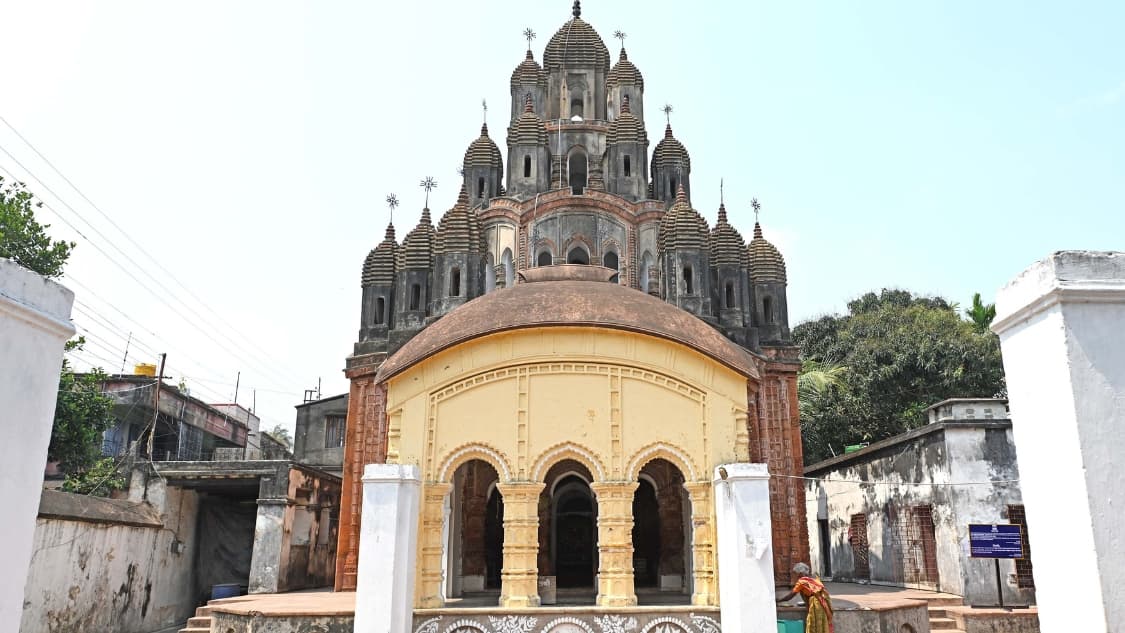
The Gopalji Temple or Gopalbari is a hidden jewel that can be missed if one is not attentive.
Tucked slightly away from the bustle of the Rajbari Complex, the Gopalji Temple or Gopalbari is a hidden jewel that can be missed if one is not attentive. The third specimen of temples built in Panchabimsati Ratna design is located inside a small lane and surrounded by houses. The temple is easy to miss from a distance. However, as one moves closer, the spires come into view, followed by the gate and the temple’s boundary wall.
Unlike its more visited neighbours, Gopalbari exudes a quiet intimacy as if inviting you to linger and explore its narratives slowly and to savour the artistry without distraction.
The temple’s terracotta panels are a feast for the eyes. Two aatchala-like structures form the gate of the temples that lead into its central courtyard. Devotional scenes of Radha and Krishna in playful repose intermingle with more worldly tableaux — boats gliding along riverine canals, village musicians mid-performance and hunters on horseback, all rendered with astonishing precision. A panel depicting the divine marriage of Krishna and Rukmini stands out, the figures delicate yet vibrant, each expression captured in clay with almost photographic realism.

Terracotta panels of Pratapeshwar Temple (left) and Lalji Temple (right).
Three of the temple’s entrances are false doors, carved in stone to mirror wooden portals, a signature of Kalna’s architectural ingenuity. The single functional doorway opens into a sanctum suffused with cool shadow, the quiet air carrying centuries of whispered prayers.
Walking along the perimeter, the subtle asymmetry of Gopalbari’s pinnacles and panels becomes apparent. Unlike the perfectly symmetrical Lalji Temple, Gopalji’s architectural variations suggest experimentation. The tactile detail of the terracotta has, in places, worn out due to rigours of time but exudes a charm of its own.

The Siddheshwari Kali is believed to be centuries old.
Kalna is not just about the terracotta temples. A stone’s throw away from the Gopalji temple stands the Siddheshwari Kali temple.
Nestled amidst the winding lanes of Kalna, it is believed that the town was named after Ambika, a manifestation of Kali housed inside the temple’s sanctum sanctorum. The Siddheshwari Kali temple carries an aura of timeless devotion that residents say predates the town’s famed terracotta temples. Believed to be several centuries old, it anchors the spiritual landscape of Kalna. Approaching the temple, the first thing you notice is the intense red colour in which its outer façade is painted. Next, as one looks up, an installation of a lion with its fangs bared can be spotted. Unlike the ornate terracotta temples, this temple has a steady stream of devotees carrying offerings lining up at the gate.
The sanctum houses a black stone idol of Kali, adorned with fresh flowers, vermilion and flickering lamps. Devotees offer prayers throughout the day. The lane outside is a busy one, interspersed with shops selling sweets, flowers and other offerings.
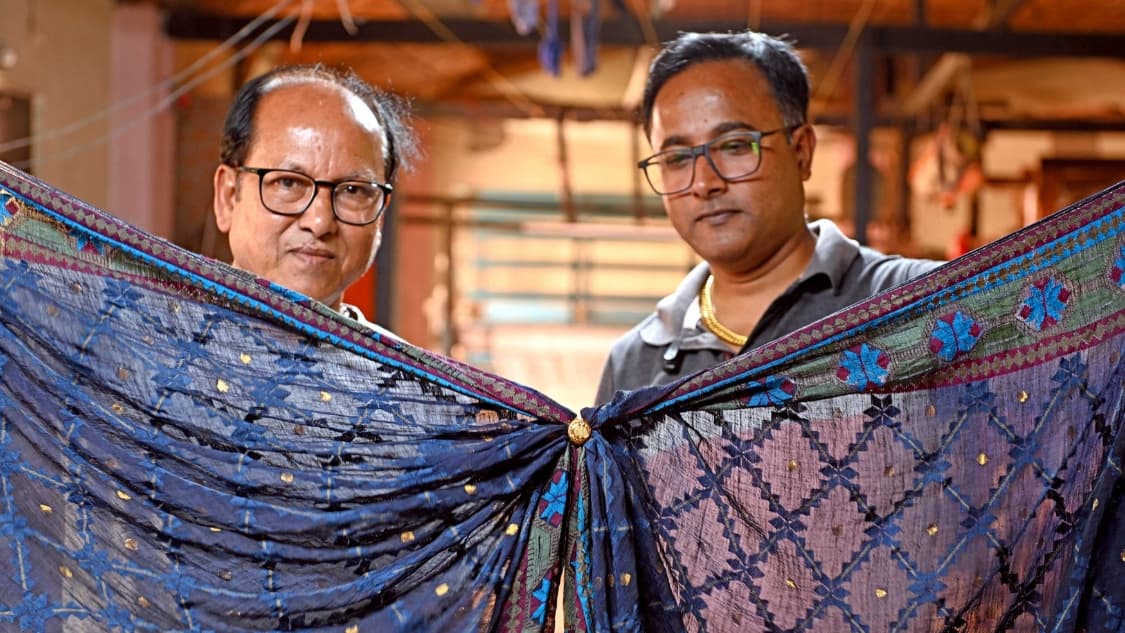
Padma Shri awardee Jyotish Debnath of Kalna, pictured with his son Rajib holding a muslin sari and ring, explains that an authentic muslin sari is so fine it can pass effortlessly through a finger ring without snagging.
No visit to Kalna can be complete without a feel of the delicate muslin. Once among the most prized fabrics globally, muslin’s fame peaked under Mughal patronage. Its extraordinary fineness required meticulous skill at every stage. Needless to say it was a favourite among the wealthy across the world.
Legend goes that Aurangzeb once expressed displeasure at his daughter for wearing to the royal court an attire so sheer that he deemed it immodest when, in fact, the princess was dressed in several layers of the fine Bengal muslin.
Muslin is an inseparable part of Kalna’s legacy. A visit to the weaver’s hub, or tanti para, is a must when here. The narrow lanes here resonate with the hum of handlooms. Once described as “woven air” for its delicacy, muslin was the pride of undivided Bengal under Mughal patronage and commanded admiration across courts in India, Persia and Europe.
Kalna’s muslin owes its delicate texture to a unique variety of cotton with ultra-fine fibres. The weaving process is painstakingly slow — yarns are hand-spun in humid conditions to prevent breakage and looms are prepared with exacting precision. Even the smallest lapse can ruin an entire piece. Inside a weaver’s workshop, one can see threads so fine that they seem almost invisible to the naked eye. The threads are stretched out carefully across a handloom and spun with a dexterity that can only come from generations of practice. The rhythm of shuttle against warp, the soft click of weaving and the faint scent of starched cotton evoke a unique sensory experience.
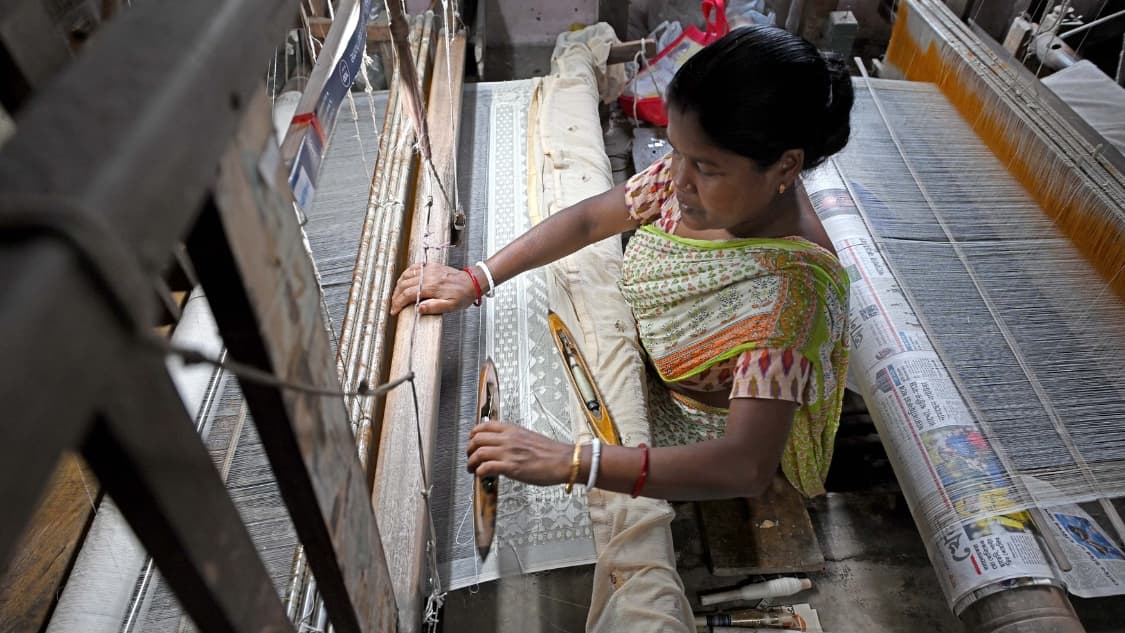
The weaving process is painstakingly slow — yarns are hand-spun in humid conditions to prevent breakage and looms are prepared with exacting precision.
In recent years, Kalna’s muslin has been granted a Geographical Indication (GI) tag in recognition of its uniqueness, linking it officially to this region. This has encouraged a new generation of weavers to sustain the craft, experimenting with not only saris but dress materials, stoles and dresses. Visitors can watch, often through guided tours or private workshops, how threads are drawn, woven and washed repeatedly to achieve the signature softness and translucency. The process can take days or even weeks for a single piece and each garment bears the subtle irregularities that mark it as handcrafted.
Those interested in buying can take their pick from some of the best-spun muslin on this side of the border. Prices start from Rs 3,000 for a stole and can go up to Rs 15 lakh for a sari, depending on thread count.
The test to know if the muslin is authentic is to pass it through a finger ring. Jyotish Debnath, a weaver from Kalna, was awarded the Padma Shri in 2026 for weaving traditional muslin and Jamdani saris. “Thread count aside, a genuine muslin sari can be passed easily through a finger ring without any effort. If it snags, then it is not authentic,” Debnath said.
How to get there: Kalna is around 110km from Esplanade in Kolkata. By car or taxi, it takes about three hours to reach there. Trains from Howrah stop at Kalna station.
Best way to get around Kalna: Hire an e-rickshaw. The drivers know the area well and act as guides.
Best time to visit: Can be visited throughout the year. Start early and visit the temples before sundown.
Tips to explore: Start at the Kalna Rajbari Complex, proceed clockwise through the 108 Shiva Temples and include Siddheshwari Kali Mandir and Gopalbari Temple. Spend some time on the banks of Bhagirathi.
Muslin workshops: Ask for tanti para or weavers’ localities when in Kalna. Tantajo, run by Jyotish Debnath and his son Rajib, offers guided tours and workshops.
Where to buy muslin: Can be bought at weavers’ homes or factories. There are several shops in Kalna as well.
Ideal for: A day trip or weekend getaway. Only basic accommodation is available.


