A joint initiative by



 Published on 2026-02-27Updated on 2026-02-27
Bishnupur, the land of terracotta temples and Baluchari saris, has another hidden gem — the handcrafted Dashavtar Tash. Once a popular game in the region, the intricately painted cards have now become collectors’ items.
Solitaire, Bridge, Spades and Hearts to the more modern UNO — card games are a common pastime among children and grownups but the tradition goes back many many centuries. The most ancient forms of card games can be traced back to China in the 9th century. In India, Ganjifa played with circular cards became popular in the Mughal era.
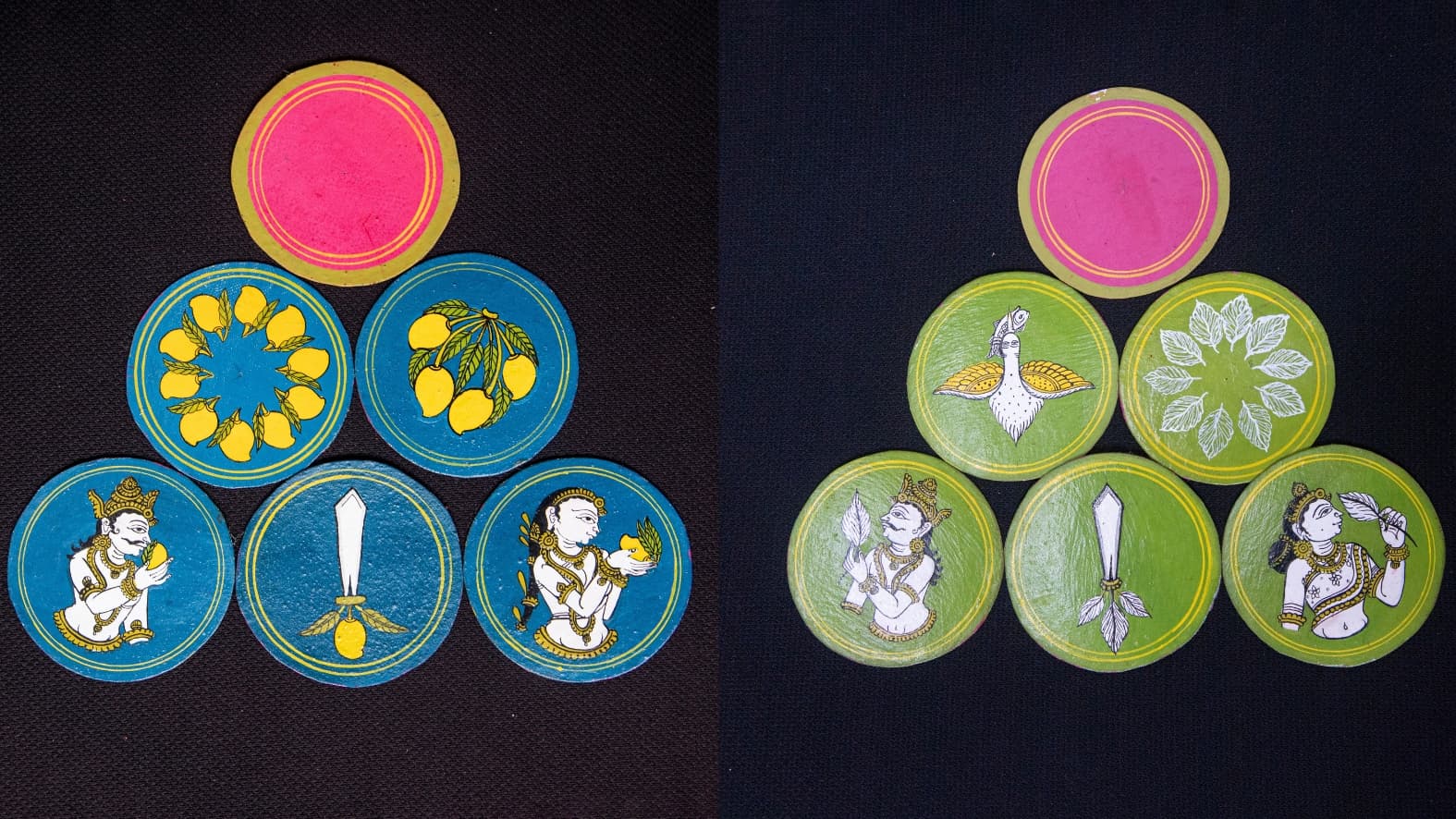
Played with striking circular cards, Ganjifa rose to prominence in India during the Mughal era. (Shutterstock)
The earliest mention of Ganjifa can be found in Baburnama, Mughal emperor Babur’s memoirs and later in Ain-i-Akbari. The Persian word ‘Ganjifa’ comes from ‘Ganj’ denoting treasure, treasury or minted money. The pack of 96 cards consisted of eight suits, each containing 12 cards — 10 of them numerical (pip) and two court cards (King and Minister). The treasury was represented by two suits in the set named Safed and Surkh. The number of players ranged from three to six.
Bir Hambir, the king of Mallabhum (mainly present-day Bankura) from 1565 to 1620, introduced the Dashavtar cards, modelled after Ganjifa. Soon, the game gained popularity and left the four walls of the palace.
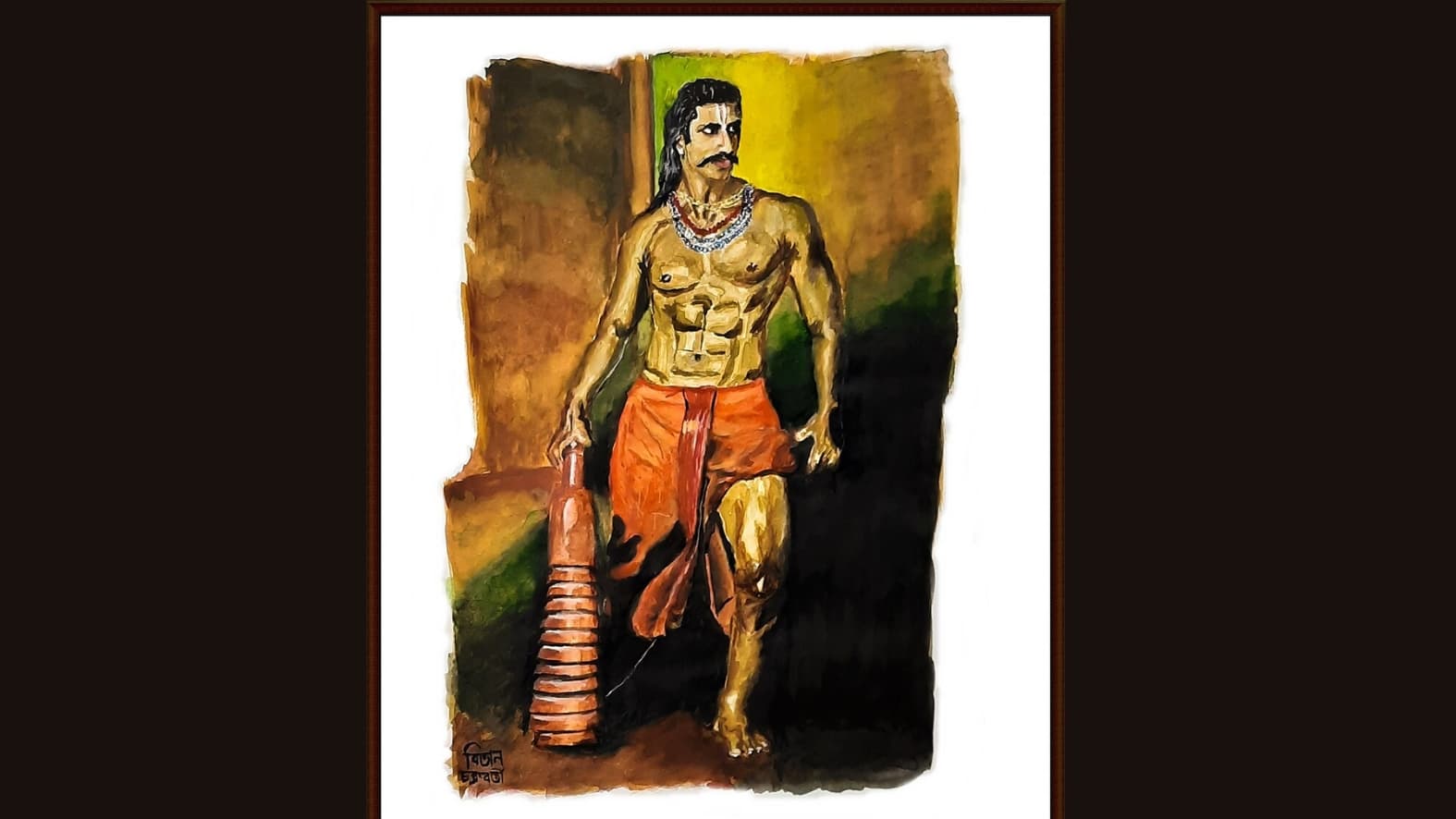
Bir Hambir, who ruled Mallabhum from 1565 to 1620, introduced the Dashavtar cards. (Picture by BitanChakraborty, Wikimedia Commons)
The Dashavtar cards were a pack of 120 circular handcrafted brightly coloured cards. Each suit was named after an avatar of Vishnu — Matsya (fish), Kurma (turtle), Baraha (boar), Nrisingha (a combination of man and lion), Baman (dwarf), Parshuram (the warrior sage with an axe), Ram (of Ramayana), Balaram (brother of Krishna), Buddha and Kalki (the avatar yet to come). For each avatar, there are 24 cards with distinct colours — red for Matsya and Parshuram, yellow for Ram, Balaram and Baraha and so on.
The game requires five players. Each player is dealt 24 cards. Different suits (card sets) were played at different times of the day. For instance, The Ram avatar cards are to be played from 7am; the Parshuram avatar cards from 2pm to 4pm and the Narsimha avatar cards after dusk.
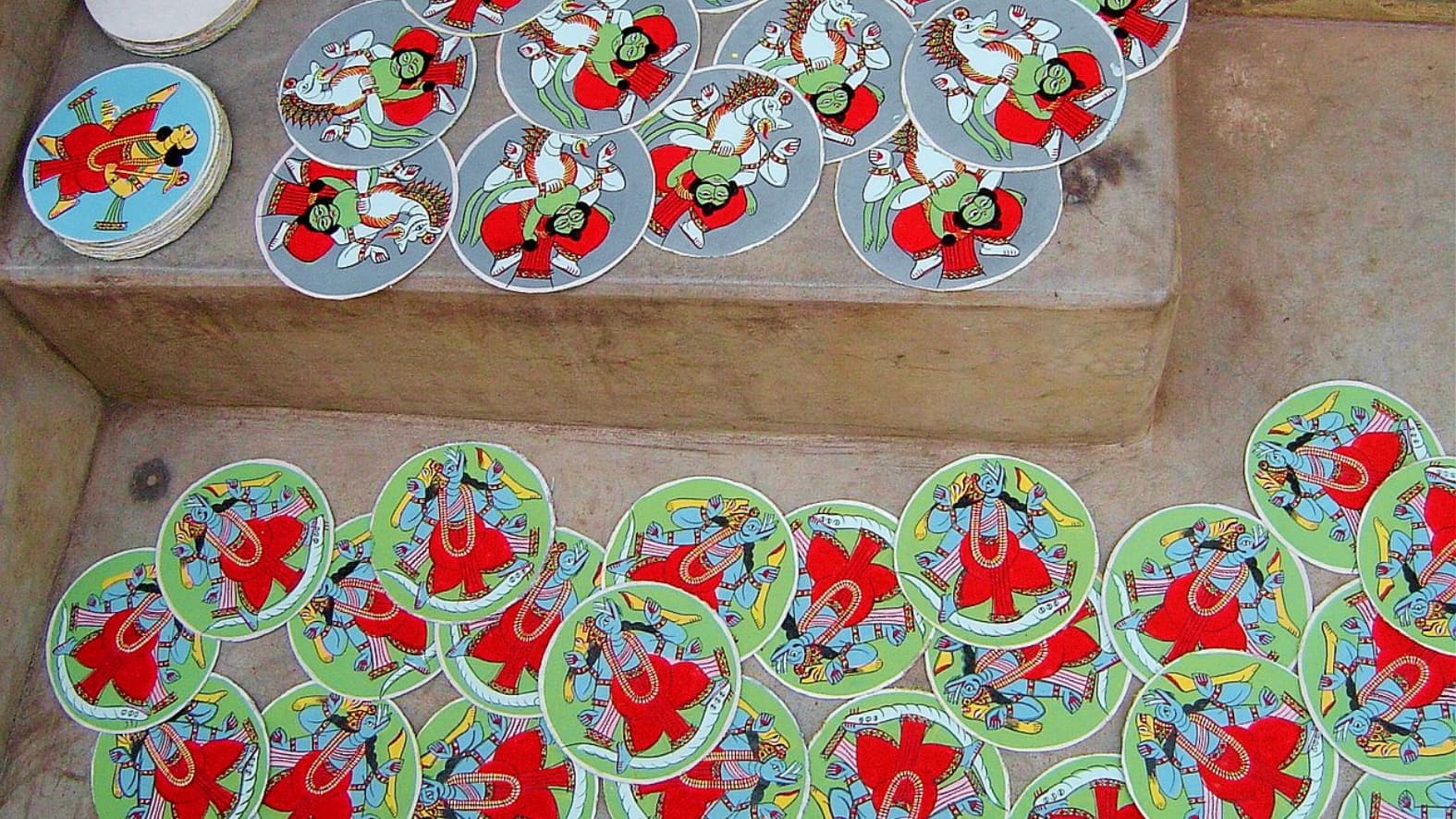
Dashavtar cards of Bishnupur. (Picture by Sumita Roy Dutta, Wikimedia Commons)
The Fouzdars of Shankhari Bazar in Bishnupur are the artists behind the intricately crafted cards. One of the first makers was Kartik Sutradhar, who painted a set of cards in the Odisha patachitra style that impressed King Bir Hambir and earned him the title of Fouzdar. Since then, generation after generation, the Fouzdars have been making Dashavtar cards and also painting Durga patas for the royal family.
The cards are made by layering markin cloth, a kind of durable cotton. Eight to 10 layers of cotton fabric are pasted together using natural adhesives such as glue from tamarind seeds and sirish plant. These are then painted with natural colours extracted from vegetables, leaves and flowers. For instance, beet is used for red, yellow is obtained from raw turmeric and black from burnt charcoal.
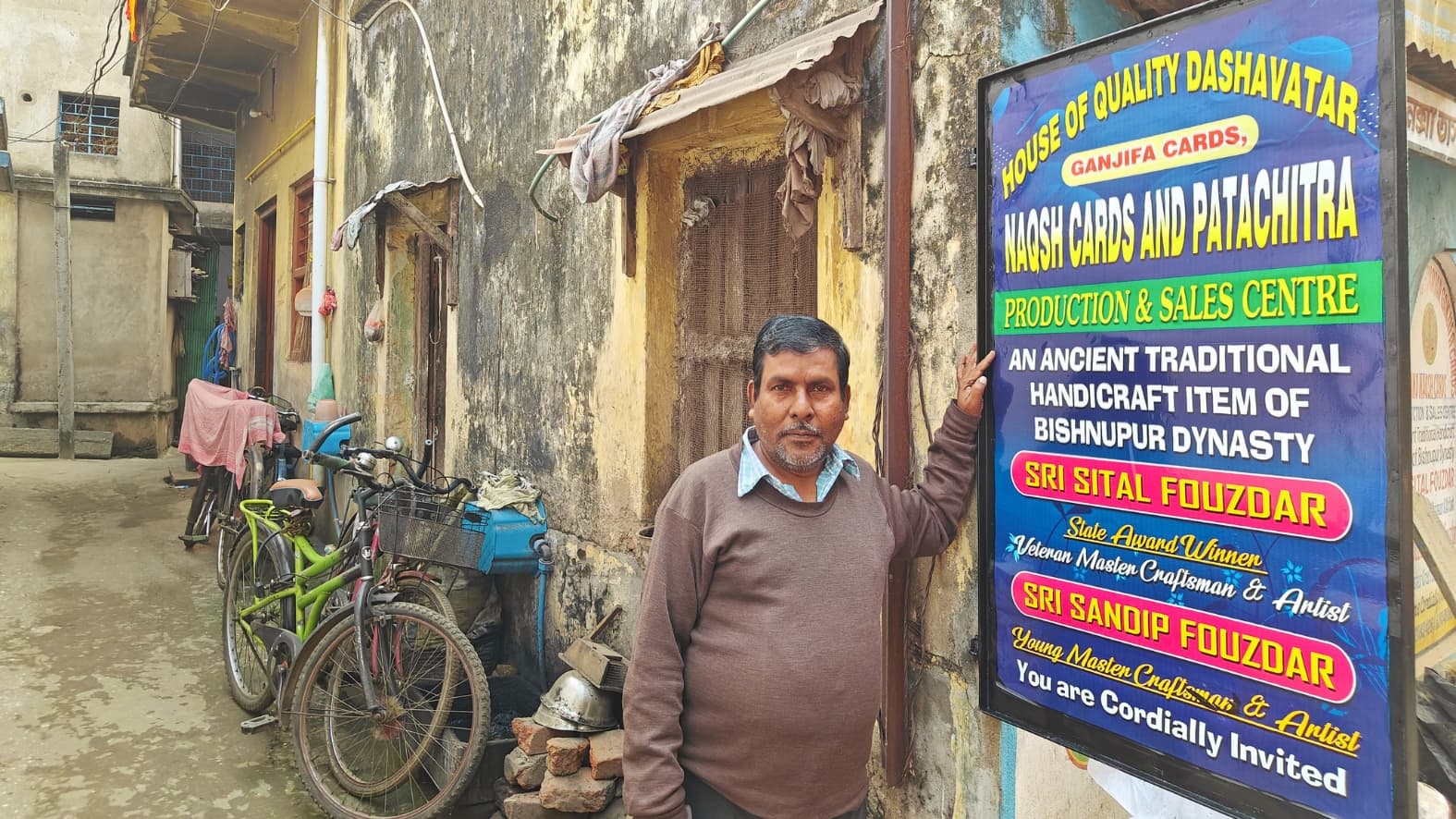
Sital Fouzdar, a member of the 87th generation of his family, is now the chief artist of Dashavtar cards.
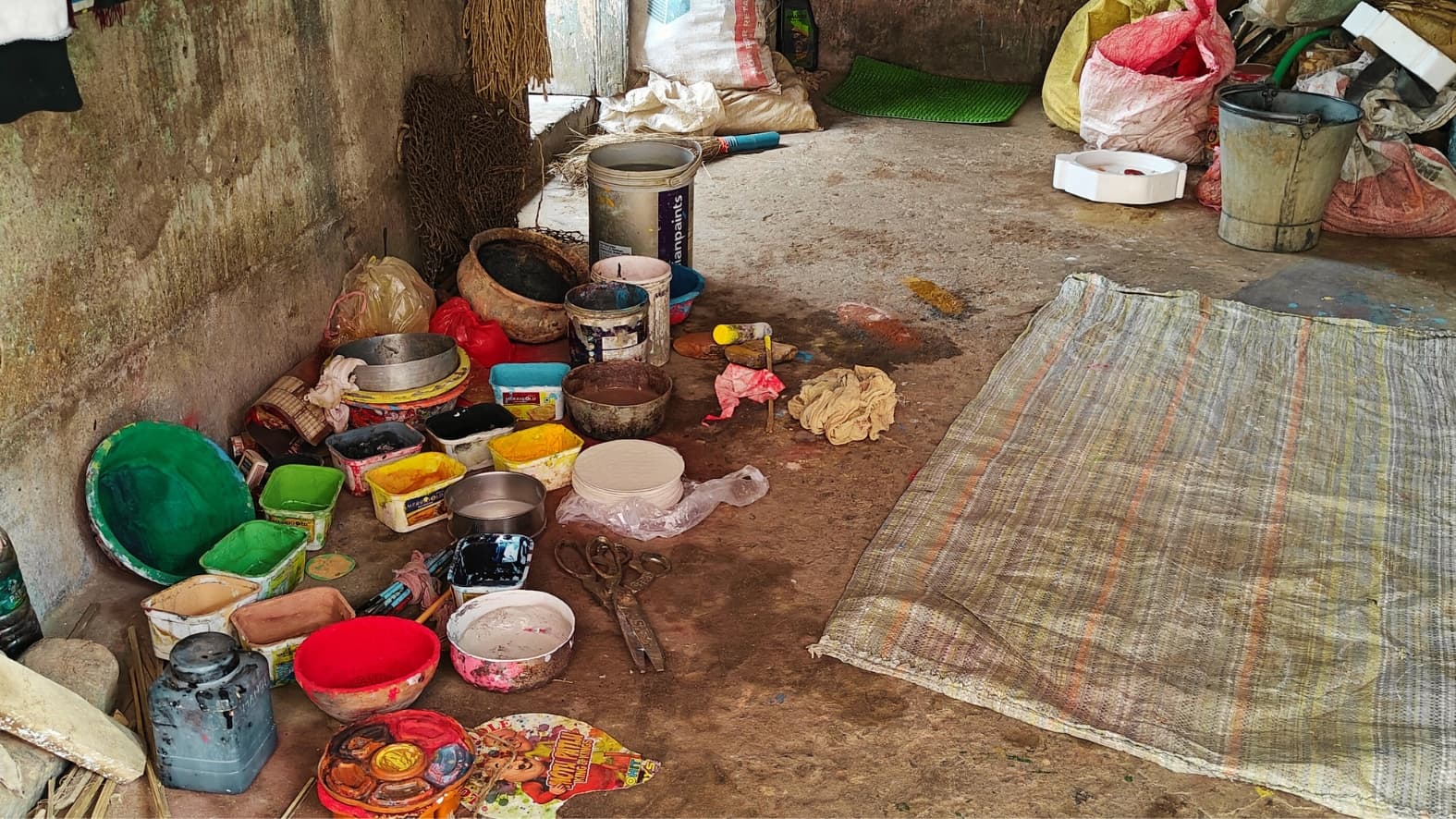
The workshop of Sital Fouzdar.
Sital Fouzdar, a member of the 87th generation of his family, is now the chief artist of Dashavtar cards. The entire family is involved in making the cards as it is a meticulous and time-consuming process. The cards are made by the female members of the family, after which Sital Fouzdar makes the drawings before they are filled up with colour.
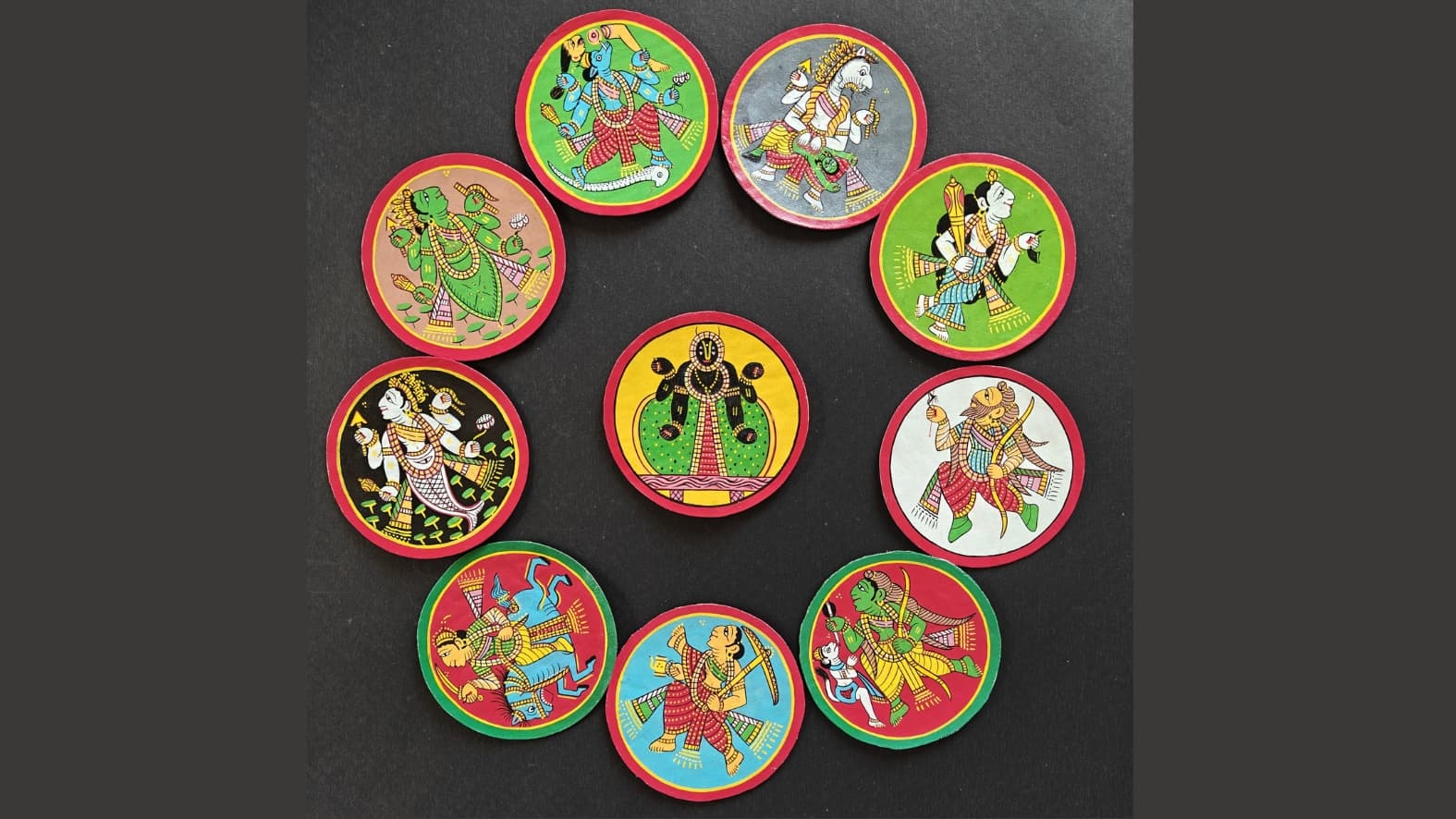
Today artists make compact 10-card sets, each illustrating a different avatar of Vishnu.
A complete set of 120 cards would cost around Rs 25,000 to Rs 30,000 but with the game now extinct, there is no demand for the expensive set. Instead, the artists have started making sets of 10 cards, one representing each avatar of Vishnu, in different sizes. These are priced at Rs 3,000 to Rs 5,000 and bought as home decoration items. The cards can be bought directly from the Fouzdars in Bishnupur.