A joint initiative by



 Published on 2026-11-13Updated on 2026-11-13

It takes around four hours to reach Darjeeling by car from the plains. But step aboard the steam-engine-powered heritage Darjeeling Himalayan Railway (DHR) train, that same journey can take more than seven hours!
For anyone accustomed to measuring journeys by how quickly they can be completed, that may seem an unlikely choice to make. Yet on a DHR trip, time is not something to be saved. It is something to savour as the toy train slowly winds its way into the mountains.

The locomotive climbs gradually from New Jalpaiguri, slipping past forests, tea gardens and mountain settlements, at times running almost alongside the winding Hill Cart Road. Its whistle echoes across the valleys as the little train negotiates tight curves, reverses and loops, gaining altitude almost imperceptibly. At Ghum, the highest point on the line, the landscape has become unmistakably Himalayan. At Batasia, the track sweeps around the hillside in one of its most celebrated manoeuvres. Beyond it, the railway descends towards Darjeeling, with Kanchenjunga appearing above the ridges when the weather is clear. Nearly 145 years after the railway first reached Darjeeling, the journey remains one of India’s most distinctive travel experiences.
The DHR is not merely a heritage attraction preserved for visitors. It is a living mountain railway, where tracks, stations, locomotives and engineering traditions remain part of the landscape through which the train passes. To understand the magic of the Toy Train, however, it helps to understand why it was built in the first place.

Darjeeling was already emerging as an important hill station in the 19th century when the need for a faster and more dependable connection with the plains became increasingly apparent. The expanding tea industry added urgency to the problem. Tea, food, building materials and other goods had to move between the hills and the plains, while the existing road system struggled with the growing volume of traffic.
By 1878, railway connectivity had reached Siliguri from the plains, but Darjeeling remained separated from the railhead by a steep and winding mountain road.
Franklin Prestage, an agent of the Eastern Bengal Railway, saw an opportunity. He proposed a steam railway linking Siliguri with Darjeeling, following much of the alignment of the existing Hill Cart Road. The proposal was approved and construction began in 1879.
The objective was decidedly practical. A railway would reduce the cost and difficulty of transporting goods to and from Darjeeling while making passenger travel considerably easier. It would also strengthen the transport network supporting the region’s growing tea economy.
What emerged from that utilitarian requirement would eventually become one of the world’s best-known mountain railways.

The engineering challenge was formidable. From the foothills, the railway had to climb to more than 7,400 feet above sea level at Ghum before descending towards Darjeeling. There was little room for the broad curves normally preferred by railway engineers, while the terrain was too steep and broken for a conventional railway alignment.
The answer was to build small.
The DHR was constructed to a gauge of just two feet, or 610 mm. Its narrow track allowed the railway to negotiate extremely tight curves, while a succession of reverses and loops enabled the train to gain height without a rack-and-pinion system. The result was an ingenious response to a landscape that seemed almost hostile to railway construction. Construction proceeded remarkably quickly. The railway reached Tindharia in 1880 before being extended progressively towards Kurseong and the higher reaches. On 4 July 1881, the railway officially reached Darjeeling.
The line was initially built and operated by the Darjeeling Steam Tramway Company. Soon after the railway reached Darjeeling, the company was renamed the Darjeeling Himalayan Railway Company, reflecting the transformation of what had begun as a small tramway project into a fully fledged hill railway.
The achievement was extraordinary for its time. The New Jalpaiguri–Darjeeling route today measures approximately 88 km and is 7,408 feet above sea level at its highest point.

The Toy Train did more than provide a picturesque route into the hills. It changed the relationship between Darjeeling and the plains. The railway reduced the time and cost involved in transporting goods, made travel easier and strengthened economic links between the hill settlements and Siliguri. The tea industry, already becoming central to Darjeeling’s economy, benefited from improved transport.
For the traveller today, it is easy to focus on the romance of the little locomotives and the mountain views. But the DHR was never conceived as a tourist attraction. Its original purpose was to make the hills more accessible and create a dependable transport link through some of the most difficult terrain in the region. That practical beginning is an important part of what makes its survival so remarkable.

The railway climbs from New Jalpaiguri to Ghum, at about 7,408 feet above sea level, before descending to Darjeeling at roughly 6,808 feet. Along the route, six zig-zag reverses and three loops help the railway gain altitude, with a ruling gradient of about 1 in 31. This unconventional alignment gives the journey its distinctive rhythm. The train appears to climb, reverse, climb again and then emerge suddenly on a higher section of hillside. At times, it seems almost impossibly close to houses, shops and roads. The railway and the landscape have, over generations, grown around each other.
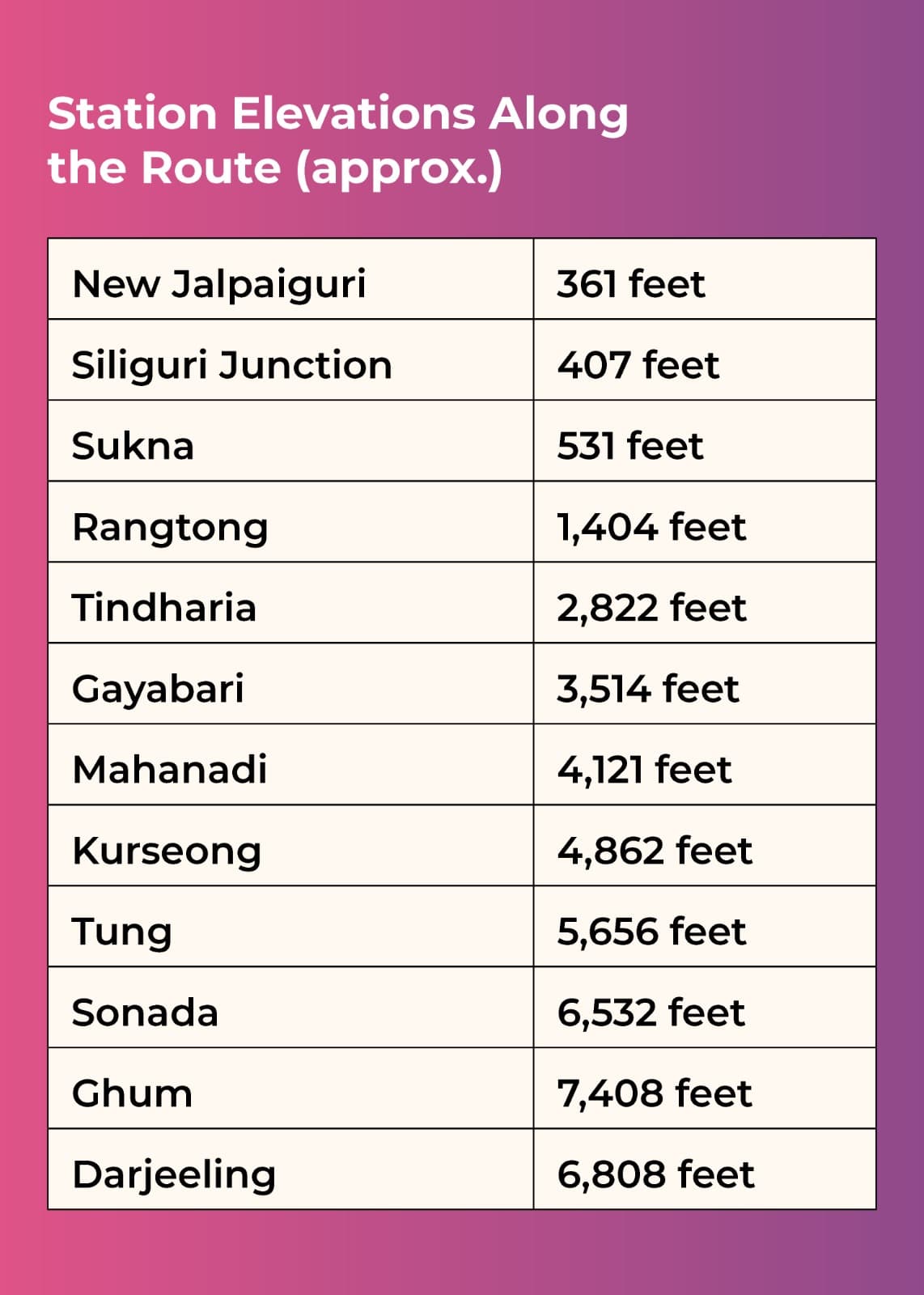

Tindharia is one of the important places along the line. Its historic railway workshops became a centre for maintaining locomotives and rolling stock and remain closely associated with the DHR’s operational heritage. Kurseong, meanwhile, developed into one of the railway’s principal operational centres and remains an important part of the DHR story.
The railway’s survival has depended heavily on this culture of maintenance. A mountain railway exposed to monsoon rain, landslides and rockfalls cannot simply be left untouched. Tracks have been relaid, retaining walls rebuilt and station structures repaired over the decades.
This is why the DHR is better understood as a living heritage railway. Its authenticity does not depend on freezing it in 1881. Instead, the challenge has been to keep it functioning while retaining the character that made it unique.

For decades, the DHR remained privately owned. After Independence, its status changed. The Government of India purchased the railway in October 1948, bringing the historic line into the national railway system. By then, roads were improving, motor vehicles were becoming more common and faster forms of transport were gradually reducing the railway’s importance as an essential means of reaching Darjeeling.
Yet the Toy Train survived. Its practical role diminished, but its cultural and historical importance grew. Steam locomotives became symbols of a vanished railway age, while the line itself became an increasingly important part of Darjeeling’s identity.
The railway’s international significance was formally recognised in 1999, when the Darjeeling Himalayan Railway became the first of India’s great mountain railways to be inscribed on the UNESCO World Heritage List. The Nilgiri Mountain Railway was added in 2005 and the Kalka–Shimla Railway in 2008, creating the larger World Heritage property known as the Mountain Railways of India. The recognition was based not simply on the railway’s age or picturesque setting. The DHR was recognised for the ingenuity of its engineering, its contribution to the development of mountain railway technology and its continuing operation as a working railway. That distinction matters.
The DHR is not an abandoned railway preserved as a relic. It remains part of the transport and cultural landscape of the Darjeeling hills.

Few places capture the character of the Toy Train more vividly than Batasia Loop. Here, the railway bends around itself in a sweeping curve, allowing the train to gain elevation while giving passengers a panoramic view of the surrounding hills. The Gorkha War Memorial stands at the centre, surrounded by gardens and mountain scenery. On a clear day, Kanchenjunga rises beyond the ridges, turning the railway journey into something approaching theatre.
There is also a particular pleasure in watching the train from outside the carriage. The locomotive disappears around the curve, emerges again on a higher section and slowly continues towards Ghum. For a few minutes, the engineering ingenuity of the 19th century and the landscape of the Himalayas become a single spectacle.
At around 7,408 feet above sea level, Ghum is the highest point on the DHR and one of the defining stops on the journey. The station has long been associated with the railway’s heritage and houses a museum that helps visitors understand the history of the line, its locomotives and the people who operated it.
Beyond Ghum, the railway begins its descent towards Darjeeling. The change is subtle. The mountains open up, settlements become denser and the final approach to the hill town carries a sense that the long climb from the plains is almost complete.

For anyone who wants to experience the DHR as a railway rather than simply as a tourist attraction, the full New Jalpaiguri–Darjeeling journey is the definitive choice. It takes more than seven hours — considerably longer than travelling by road — but that slowness is precisely what makes it memorable.
The journey gives the landscape time to change and allows the traveller to appreciate how the railway was built. Those with less time can opt for a Darjeeling–Ghum Joyride, which includes Batasia Loop and the climb to Ghum. The Kurseong–Mahanadi sector offers another perspective, particularly for railway enthusiasts. Its quieter stretches provide a more intimate experience of the hills, while steam-hauled heritage services bring the sound and atmosphere of the old railway vividly back to life.
There are faster ways to reach Darjeeling. There are more convenient ways, too. But neither speed nor convenience explains why travellers continue to seek out the Toy Train.
The railway was born from a practical problem: how to connect a growing hill station and its tea-producing hinterland with the plains. Its engineers responded with an audacious little railway that climbed mountains using a two-foot track, tight curves, reverses and loops. Over the decades, its purpose changed.
What was once an essential transport link became an emblem of Darjeeling, an engineering landmark and eventually a UNESCO World Heritage railway. Yet its greatest attraction remains wonderfully uncomplicated. Sit by the window. Listen to the locomotive. Watch the tea gardens give way to forests and the plains disappear behind the bends. Let the railway take its time.
A car can get you to Darjeeling in around four hours. The Toy Train takes more than seven. But when the whistle sounds and the locomotive begins its unhurried climb, those extra hours stop feeling like time lost. They become what you came for.
Because on the Darjeeling Himalayan Railway, the journey is the destination.