A joint initiative by



 Published on 2026-04-08Updated on 2026-04-08
Every Thursday, a stretch of road in Darjeeling town turns into something most visitors never see — a weekly market where the hills show up with everything they’ve got.
Walking past, you would recognise momo, chicken lollipops, aloo chops and Darjeeling tea. Familiar comforts — easy to place.
But would you recognise dalle, sisnu, gundruk, simrayo, wachipa or bhui amla?
Or dishes like sha phaley, laphing, fumbi, taipo, millet momo and kodo selroti?
And then there are things that sit somewhere between food and culture — traditional Mangar attire, Bhotey Baku, Gunyo Cholo or the ever-present Gorkhey khukri.
If some of these made you pause, that is exactly the point. And if there is one place that features all this variety, it is the Gorkhey Haat.
A walk through Gorkhey Haat in Darjeeling feels a bit like this list: part familiar, part unfamiliar, yet entirely rooted in the local life of the hills. From well-known hubs like Darjeeling, Kalimpong, Sikkim and Kurseong to lesser-known corners like Bijanbari, Sittong, Fikkal and countless other hamlets tucked within the hills, it is where everyday ingredients, traditional foods and cultural artefacts come together as something lived and accessible.
The local taste of the hills isn’t merely confined to Darjeeling’s restaurants and cafés. If one wonders where this freshness actually begins, Gorkhey Haat offers a far more grounded and vibrant experience.
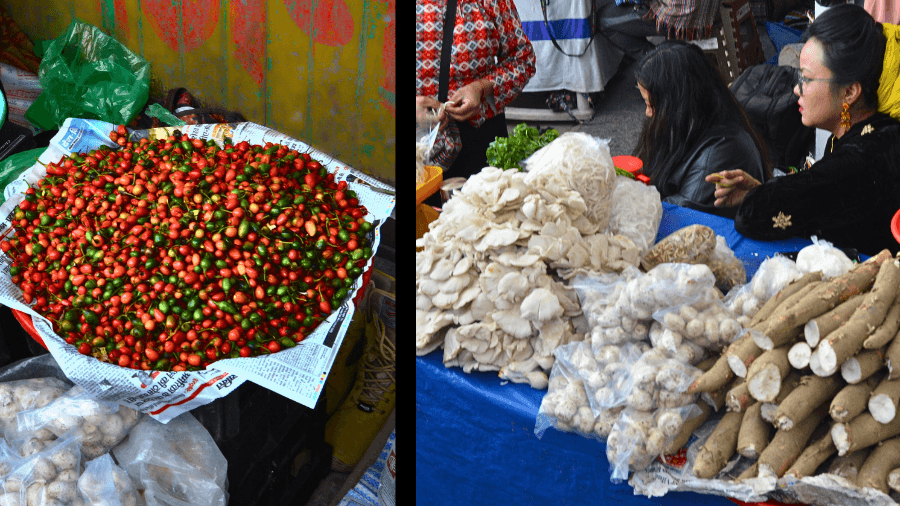
Dalle, bamboo shoot, tarul and other vegetables on sale. (Pictures by Purav Pradhan)
Tucked along the stretch between the Bata shop and the Rotary Club sign under the clock tower, the Haat unfolds into a lively trail of colours and conversations. Local vendors in traditional attire line the path, their stalls brimming with local produce — numerous varieties of authentic Darjeeling tea, dals, saags and veggies, local hardi and wachipa rice. You feel a sense of immediacy here — a feeling that everything has arrived straight from nearby villages rather than some distant supply chain.
As I walked through the market, I found myself drawn to the variety of greens and vegetables. Some were familiar, others completely unrecognisable — a reminder of how, living in the city, I’d stopped noticing what actually grows in my own hills.
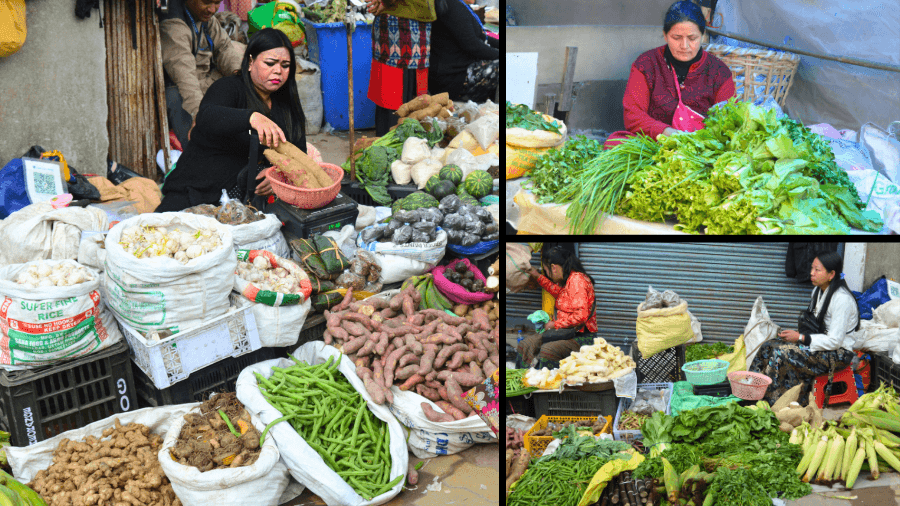
Vendors supply locally produced organic fresh greens at the Haat. (Pictures by Purav Pradhan)
The lively air of the Gorkhey Haat does carry a constant hum. Amidst that, the vendors call out prices, visitors drift from stall to stall, and somewhere between it all, the metallic gleam of khukris catches the eye. What follows is the smell of smoked meat, curling up from orange embers, lingering just long enough to slow your steps.
In recent years, the rise of large retail chains has been steadily reshaping how people buy groceries. As these supermarkets expand, local vendors often struggle to compete and survive, let alone thrive. A certain intimacy of food culture begins to fade.
It is also true that in many parts of Darjeeling, elements of local culture — from traditional attire to objects like the khukri — are often repackaged for tourists and sold at higher prices. What were once everyday objects gradually become curated displays, increasingly distant from the people who originally used them and, in fact, still continue to do so. Gorkhey Haat seems to quietly counter this trend. Here, a khukri isn’t mounted behind glass with a price tag aimed at tourists — it’s lying on a cloth next to a stack of greens, waiting for someone who’ll actually use it. The difference is hard to miss.
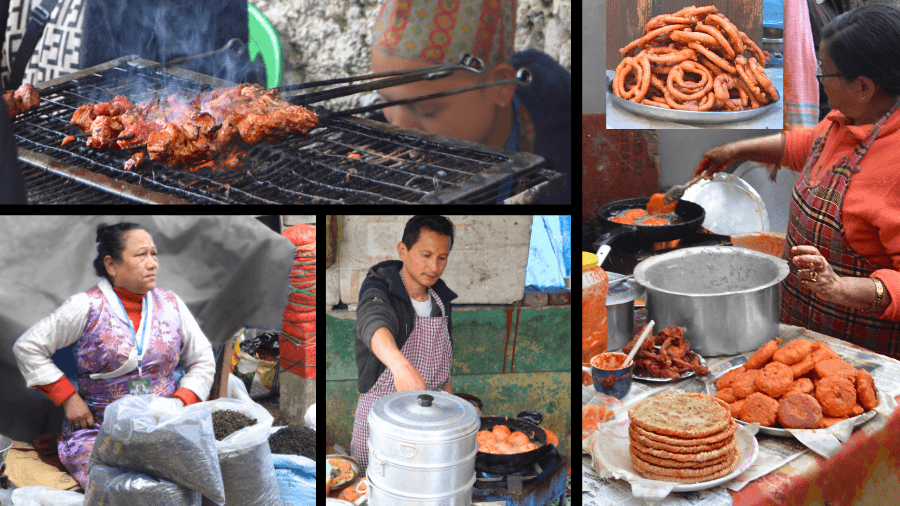
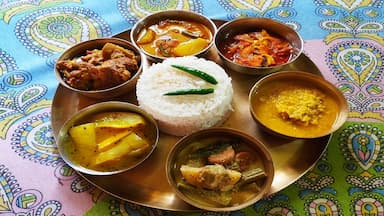
A variety of freshly cooked food is on offer for those wishing to try authentic hill cuisine. (Pictures by Purav Pradhan)
Gorkhey Haat is part of a broader initiative to promote local produce and Nepali culture across the Darjeeling hills, with similar weekly markets held in Kurseong, Mirik, Kalimpong and Siliguri. Smaller versions, like Gauley Haat, have also emerged in Kurseong and elsewhere, echoing the same local spirit.
To describe some of the rarer offerings of the Gorkhey Haat: you’ll find a good deal of millet foods, like dhero — a traditional, thick porridge made from millet or maize flour, cooked slowly. It is simple, filling, deeply rooted as a staple in the hills and almost impossible to find in restaurants. But there’s also millet adapted into more familiar forms like kodo selrotis (ring-shaped soft bread) or even millet momos.
If you see a yellow pudding-like block, you’ve come across fumbi, which is cut into blocks and served with aachar. Fumbi has a mild, almost neutral taste with a soft texture. It won’t overwhelm the palate; rather, it takes on the flavours of the aachar it is paired with.
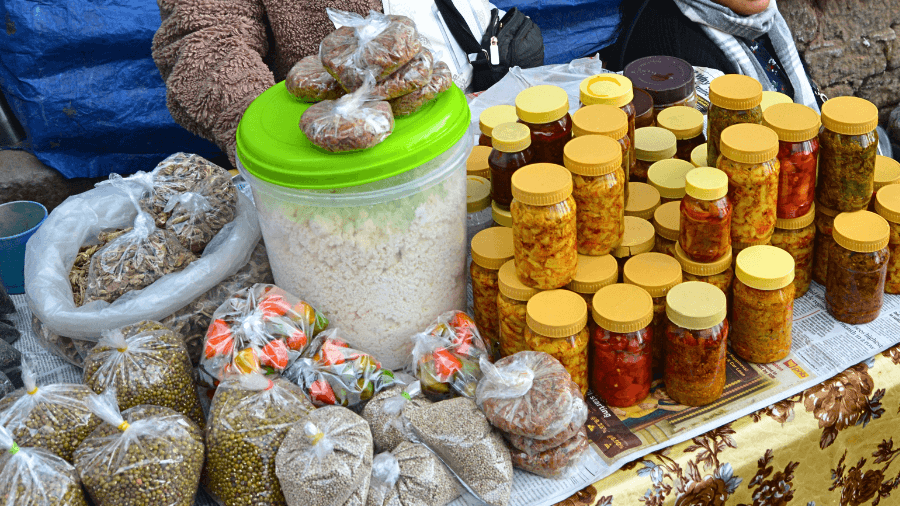
Homemade pickles, both vegetarian and non-vegetarian, are a must-try. (Picture by Purav Pradhan)
Pickles are essential to the hills, and Gorkhey Haat offers a wide range of home-prepared varieties. One can find aachars of mango, banana, bamboo shoot and more.
Tarul features regularly at Gorkhey Haat and is a major festive vegetable. Tarul are essentially a variety of edible tubers, similar to root vegetables, commonly eaten in the hills. They’re usually boiled or roasted, and have a mildly sweet, earthy flavour and a soft, starchy texture. Often associated with winter and festivals like Maghe Sankranti, tarul is both a seasonal comfort and a traditional staple.
Meats surface in every form — roasted over embers, grilled with a smoky edge, fried to a crisp, dried to an intense flavour or simmered in simpler preparations. Stop by and try some grilled meat of your choice. Smoked and dried meat, sukuti, is another popular takeaway, just as likely to be carried home as it is to be enjoyed on the spot, often paired with an evening drink.
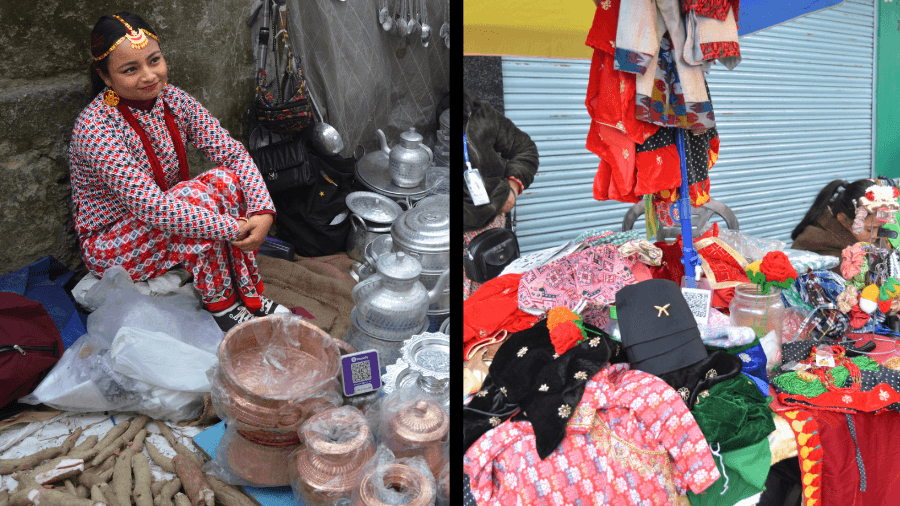
(Left) A local in traditional attire sells her wares at the Haat, (right) colourful outfits on sale at a stall. (Pictures by Purav Pradhan)
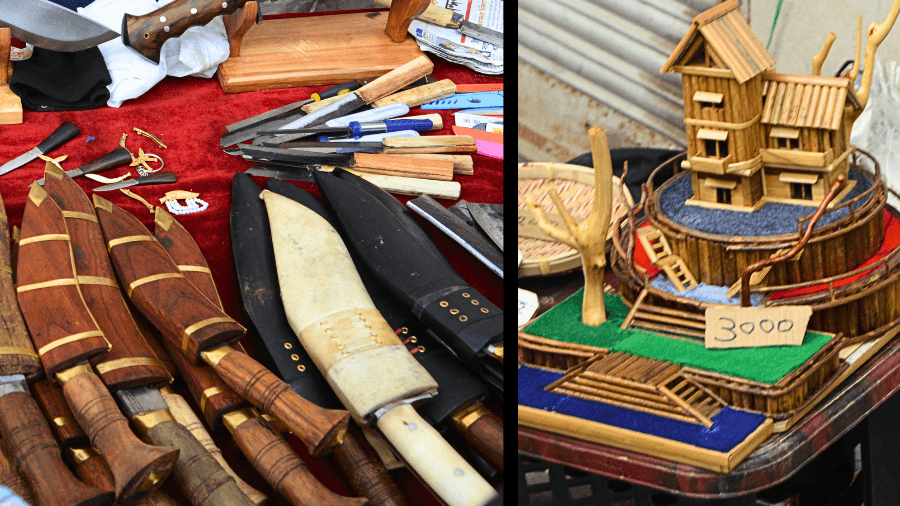
Khukris and other household items are sold alongside handmade baskets and decorative items. (Pictures by Purav Pradhan)
Beyond food, Gorkhey Haat also features khukris, local trinkets, brass and silver-toned utensils and traditional attire, among other things. Unlike the polished displays of touristy shops, where such items are often elevated and overpriced, here they feel grounded and accessible. A khukri is not just a symbol and traditional clothing is not just costume — they remain in quiet circulation, handled, worn and used without ceremony. Gorkhey Haat makes that proudly apparent.
What makes the walk even more engaging is the sheer range of what turns up along the trail. Fresh produce like tanba, sisnu, gundruk, tarul and locally grown cucumbers sit alongside staples, such as kodo ko pitho, dals like masyam or masyang and organic local masalas. Bright dalle chillies and bhui amla (ground amla) add to the mix, while roasted corn and seasonal fruits like mangoes and bananas offer their familiar comfort.
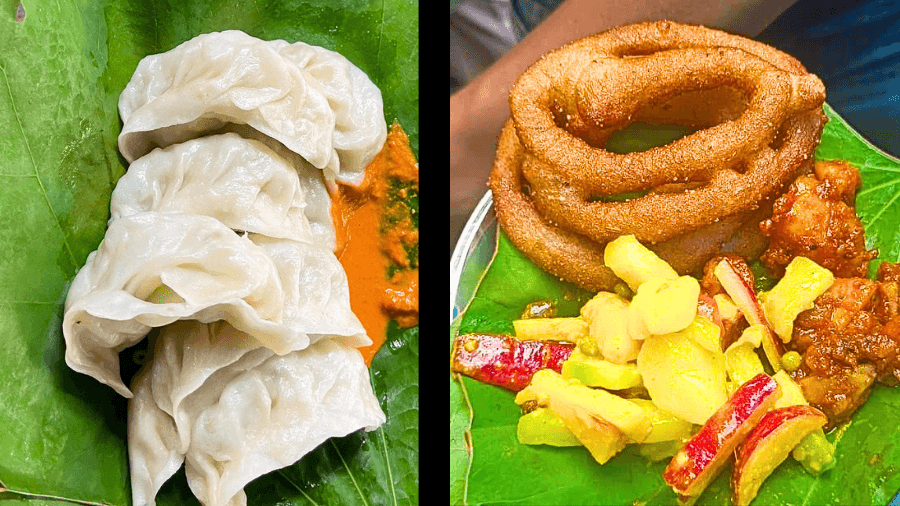
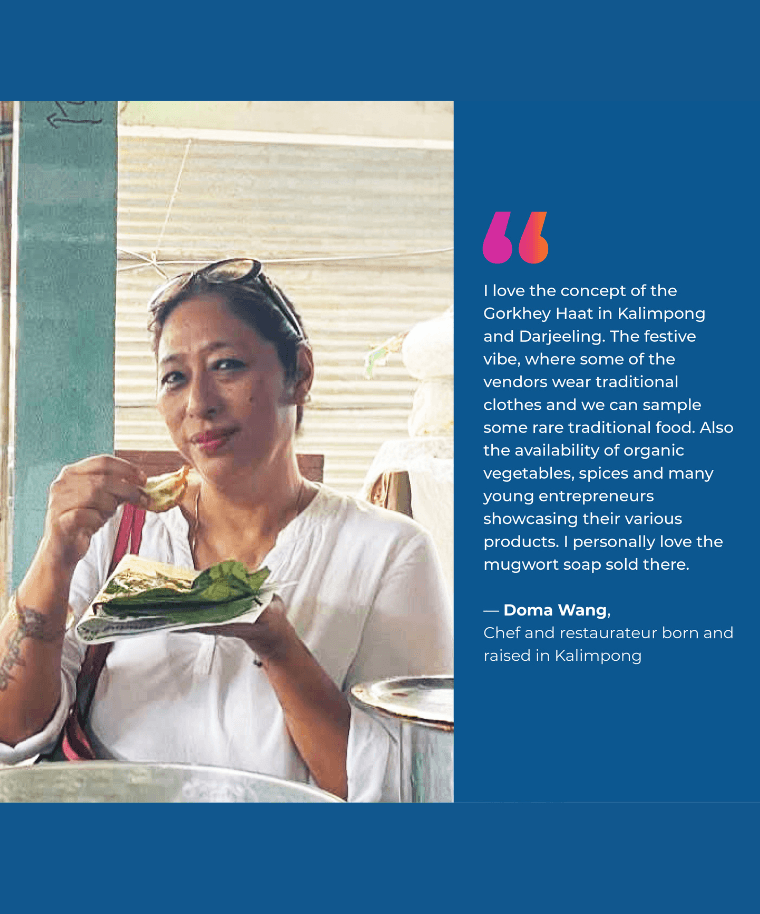
Similar food and fresh produce offerings at the Kalimpong Gorkhey Haat. (Pictures by Doma Wang)
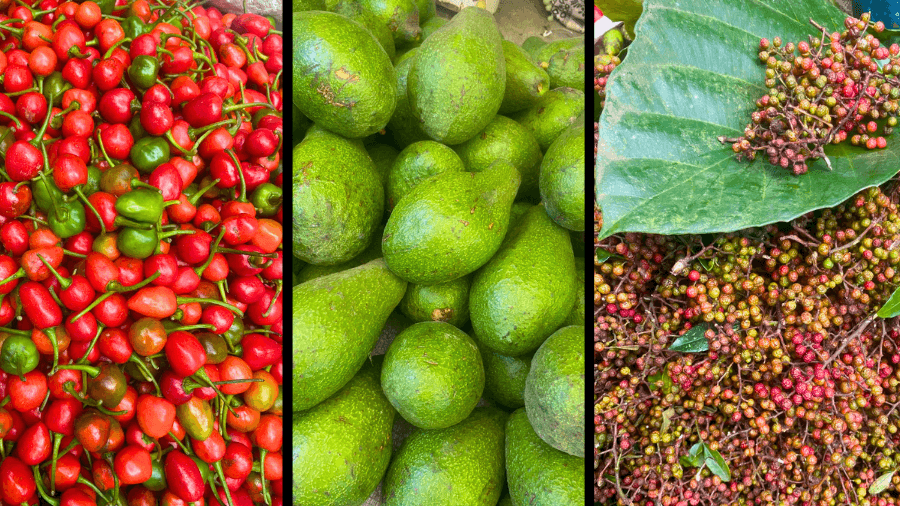
Similar food and fresh produce offerings at the Kalimpong Gorkhey Haat. (Pictures by Doma Wang)
To a tourist, it might look like a local market on a hillside road. But walk through any Gorkhey Haat once and you’ll understand why people keep coming back — not for the bargains, but for the feeling that this is still how things are actually done in the mist-draped bustle of North Bengal’s hill bazaars, no matter what else changes.
Open from 8am on Thursdays in Darjeeling.
The day varies for other towns like Kalimpong, Kurseong, Mirik or Siliguri.