
A joint initiative by



 Published on 2026-10-13Updated on 2026-10-13
There is a moment in Kolkata, just before Durga Puja, when the city seems to hold its breath thrumming with anticipation.
Bamboo poles rise above rooftops. Streets acquire arches of lights. In Kumartuli, idol-makers work late into the night inside their dimly-lit workshops. Old buildings get a fresh coat of paint. Food stalls prepare for their busiest days of the year. And across neighbourhoods that otherwise have little in common, people begin discussing the same question: Which puja should we see first?
Then the festival arrives, and Kolkata changes completely.
For five–six days, the city is in almost continuous movement. Families dress up and step out after dinner. Friends walk for hours. Strangers swap recommendations about the next pandal. The Metro runs deep into the night, roads become pedestrian promenades and the sound of the dhaak seems to follow you everywhere.
However, the real pleasure lies not in trying to see everything, but in discovering the many versions of Kolkata that appear during these few days.
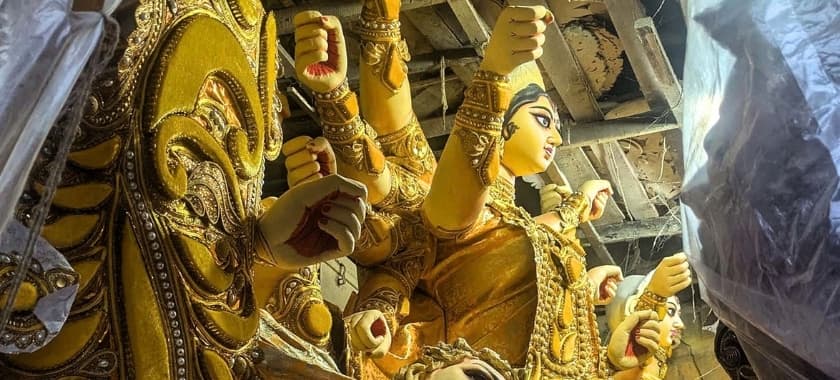
An idol at Kumartuli waiting to be transported to a pandal.
Begin in North Kolkata, where Durga Puja has its deepest roots in the city's history.
Shobhabazar, Kumartuli, Ahiritola, Baghbazar and Hatibagan offer a particularly rewarding introduction. Here, grand public pandals stand alongside family pujas held in courtyards and old thakur dalans. Kumartuli tells another side of this story: this is where generations of sculptors have fashioned the clay idols that travel across Bengal and beyond.
This part of the city is best explored on foot. Walk through the lanes, stop to look at the workmanship, visit a pandal, have a cup of tea and continue.
Getting there:
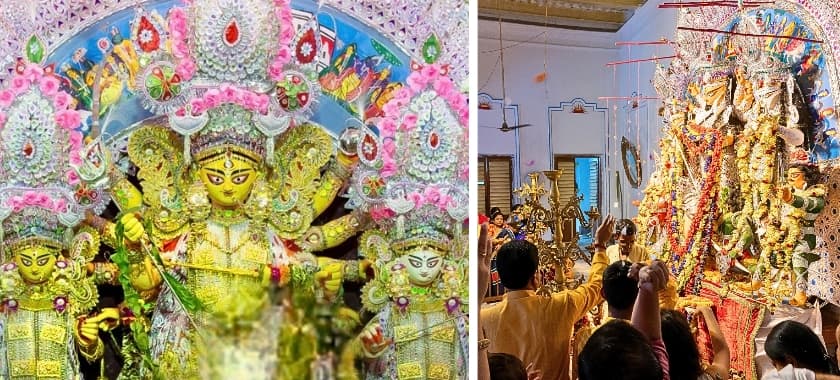
Bonedi Bari pujas are known for their traditional idols and age-old rituals.
The grandest public pandals may draw the largest crowds, but the soul of Kolkata's Durga Puja is often found behind old gates.
The Bonedi Bari pujas belong to old families whose celebrations predate the community Puja movement. The ancestral houses of Shobhabazar, Hatkhola, Darjipara and Pathuriaghata offer glimpses of an older Bengal. The attraction is not simply the age of the buildings. It is the intimacy of the rituals: the courtyard, family members performing the ceremonies, the traditional style of the idol and customs that have survived for generations.
Remember that these are religious ceremonies, not tourist attractions. Not every house is open to casual visitors, photography may be restricted and some areas are private.
Getting there:
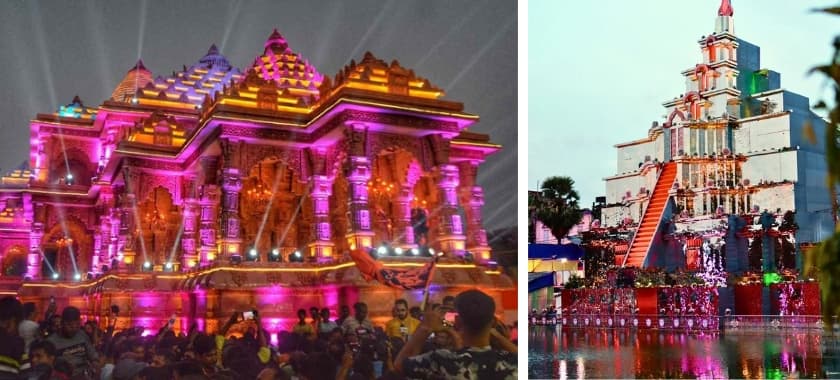
Prominent pujas in Central Kolkata are known for their scale and grandeur.
For the modern face of Kolkata's Puja, head to central Kolkata.
Around Bowbazar, Sealdah and College Street are some of the city's most talked-about pandals, known for elaborate themes, lighting and dramatic presentation. They belong to a tradition in which the pandal is no longer simply a temporary shelter for the deity but an immersive work of art.
Close by, the historic College Square pond offers a striking view, its water framing one of the city's most atmospheric pandals after dark. The pleasure is in that contrast: within a small area, you move from old Kolkata's intellectual and architectural landscape into the full theatricality of the contemporary Puja.
Getting there:
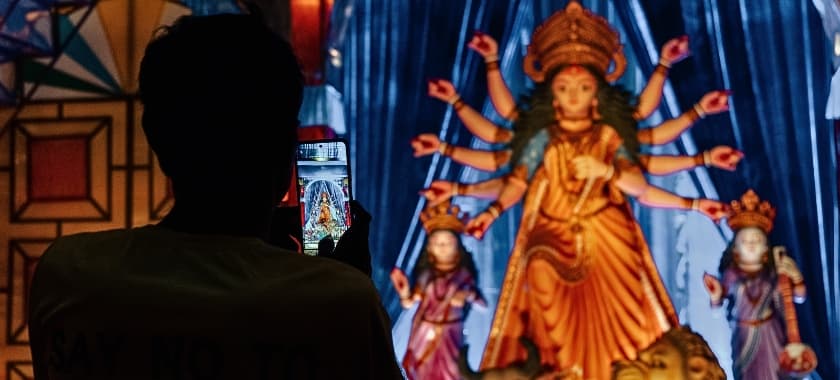
South Kolkata is known for its out-of-the-box ideas and incredible artistry.
If North Kolkata is about history and continuity, South Kolkata is where experimentation has become an annual ritual.
Ballygunge, Gariahat, Rashbehari, Chetla, Jodhpur Park, New Alipore and Behala are home to some of the city's best-known pujas.
Do not try to cover all of South Kolkata in one evening. Choose a few adjoining neighbourhoods and walk between them. Roads near Gariahat, Lake and Kalighat become pedestrian zones in the evenings. This is one of the rare times when walking through residential Kolkata at night becomes sightseeing in itself.
Getting there:
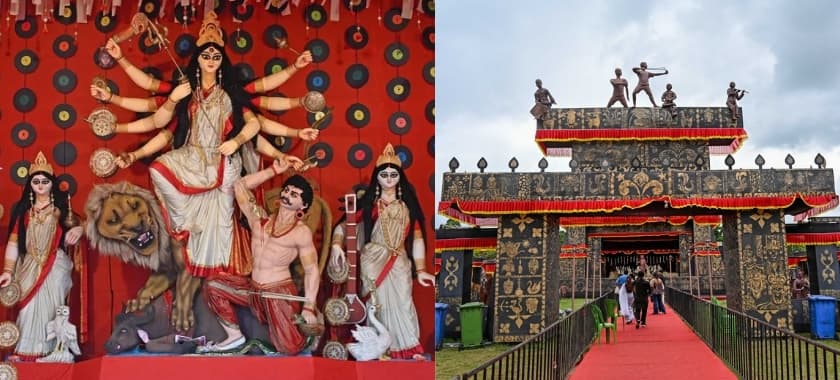
Pujas in Salt Lake and New Town also draw huge crowds.
The eastern edge of the metropolis tells a newer story.
Salt Lake's wide avenues and planned neighbourhoods make room for large community celebrations. VIP Road becomes a major festive corridor, particularly around the airport-facing neighbourhoods and the large pujas of the surrounding residential areas.
New Town has developed its own contemporary Puja culture amid high-rises, landscaped avenues and new residential districts. It feels distinctly different from old Kolkata: more spacious, modern and architectural, with large installations set against the backdrop of a rapidly developing city.
For travellers staying near the airport or in New Town, this is a convenient way to experience the festival without spending every evening in central Kolkata.
Getting there:
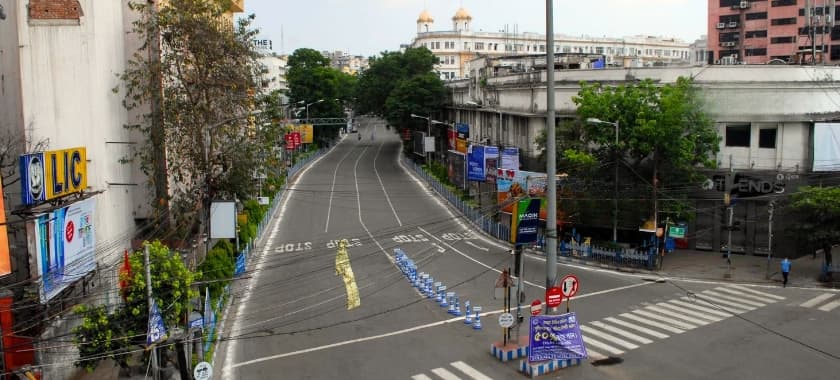
This famous stretch will light up for Durga Puja this year.
Park Street is synonymous with Christmas and New Year — illuminated restaurants, music, late-night dinners and the city's cosmopolitan side.
This year, that festive landscape acquires a new dimension. The park at the heart of Park Street's Christmas celebrations is hosting a Durga Puja for the first time.
For visitors, it is more than another pandal to tick off. It is a small but telling example of how Kolkata's festive identity continues to evolve.
Getting there:
Metro: Park Street station on the Blue Line is a short walk away.
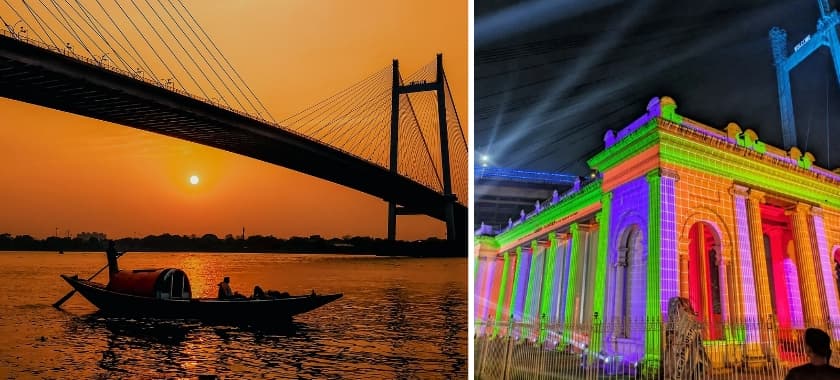
Try to catch a sunset at Prinsep Ghat when you plan your riverside Puja route.
Kolkata is a river city, but visitors often experience remarkably little of the Hooghly. Durga Puja is an excellent excuse to correct that.
Take a launch ride, preferably late in the afternoon when the sun begins to soften. From the river, the city acquires a completely different scale. The ghats, bridges, warehouses, colonial buildings and modern towers form a constantly changing panorama.
Longer heritage cruises depart from the Millennium Park and Strand Road riverfront in a range of formats during the Puja season, so check the day's sailing schedule before setting out. Watch the ferries cross the water and let the lit-up city drift past.
Another great plan is to watch the idol immersion on Dashami from the river.
Afterwards, head to Prinsep Ghat. The white Palladian-style monument, the Maidan, the river and Vidyasagar Setu form one of the city's most recognisable landscapes. The best time is to go around sunset to enjoy the view and then make the most of the seasonal lights and festive decor.
Getting there:
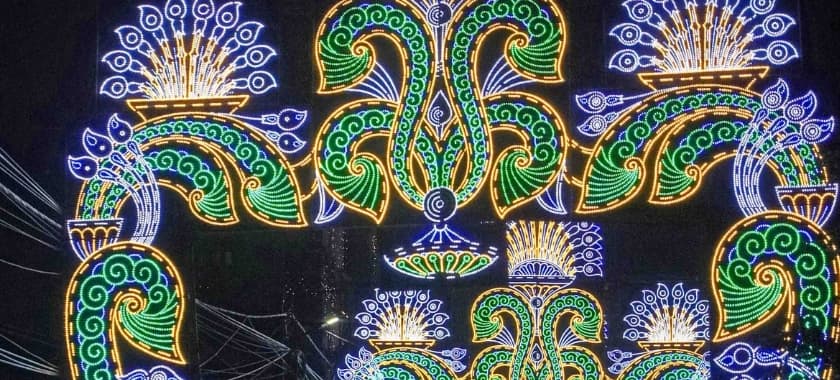
Chandernagore is known for its elaborate light panels.
If you have a little more time, take the trail beyond Kolkata.
The Hooghly corridor is particularly rewarding. Serampore and the towns along the river combine old Bengali family traditions with traces of the river's colonial trading history.
Serampore is easy to reach from Kolkata, and pairs well with a walk along its historic riverfront and old neighbourhoods — and a stop at Naresh Babu's tea stall. For a longer excursion, Chandernagore and the surrounding belt offer a change of pace from the relentless energy of Kolkata.
As in the city, family pujas here keep their own traditions and visiting arrangements, so check before you go.
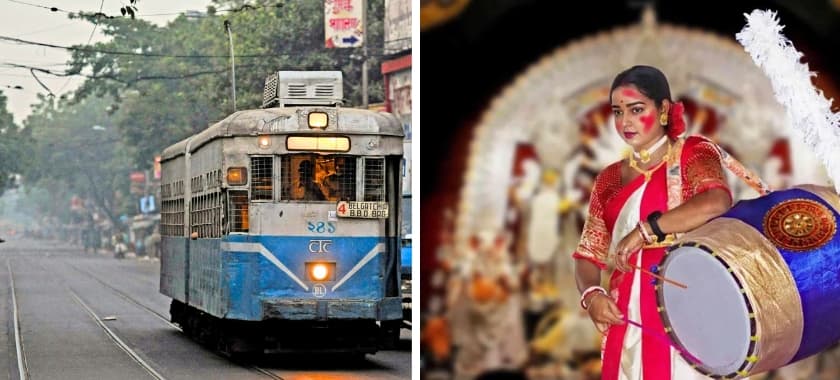
From laid-back tram rides to watching dhaakis on a roll, your trip can be as relaxed or as packed as you wish it to be.
And finally, there is another way to experience Durga Puja in Kolkata.
Have breakfast somewhere old. Take the tram to a neighbourhood you have never visited. Walk without trying to reach the next famous pandal. Stop for tea. Take a ferry across the Hooghly. Return by Metro. Sit by the river at Prinsep Ghat. Have dinner late into the night at any restaurant you want.
Kolkata during Puja rewards curiosity more than efficiency.
Its greatest pleasures are often found between the famous attractions: a dhaaki playing outside a neighbourhood pandal, the smell of freshly fried fritters drifting down a lane, staying up all night and going to bed in the morning.
This is what makes Kolkata different during Durga Puja. The festival does not simply take place in the city. For a few extraordinary days, the entire city becomes the festival.

Eat your way through the festival
In Kolkata, no pujo is complete without pet pujo. Every part of the city brings its own flavour to the festival. North has its kochuri-telebhaja, mishti and more. Central has its sherbet, coffee, and cabin culture. South has its hip cafes and endless multi-cuisine fare. Park Street's got its old restaurant row, while New Town and Salt Lake, its new-age pop-ups and food courts.
And wherever you are, don’t miss the bhog: khichuri, labra and payesh shared at the pandals.
Plan your moves
The Metro lets you move between pandal clusters without getting trapped in traffic, as Kolkata Police impose extensive road closures, diversions and one-way systems, especially as the crowds build at night. Timings vary by line during the festival, so check the schedule before you set out.
If you want to enjoy laid-back heritage travel, the tram is your perfect ride. From the window, Kolkata appears almost cinematic. Bookstalls, sweet shops and old houses with open shutters slide past, and during Puja, so do the lights and crowds of the neighbourhood pandals.
Route autos usually only run till the afternoon. So plan accordingly.


