
A joint initiative by



 Published on 2025-12-22Updated on 2025-12-22
From Lutheran to Orthodox and from Anglican to Armenian, Kolkata boasts an amazing assortment of churches that reflect the many sects of Christianity. Built in gothic, baroque and neo-classical styles, these churches are not just places of worship but also storytellers of the city’s colonial past and multicultural roots. Together, they form an integral part of Kolkata’s heritage.
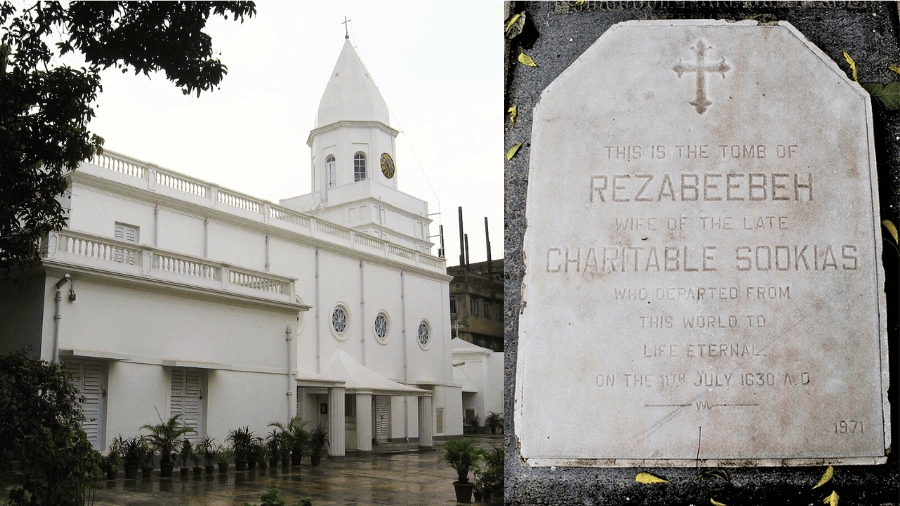
(left) The Armenian Church of the Holy Nazareth (Picture by Grentidez, Wikimedia Commons); (right) The grave of Rezabeebeh Sookias, the oldest Christian grave in Kolkata. (Picture by Rangan Datta)
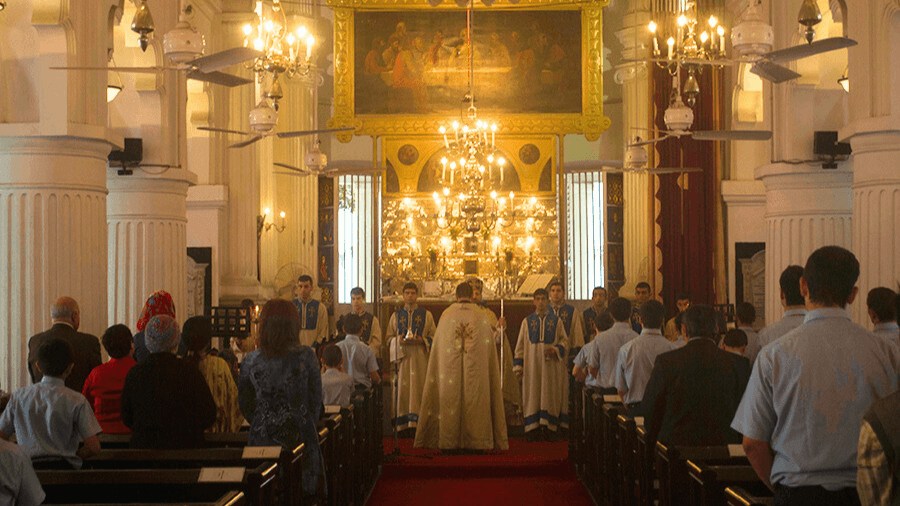
Christmas celebration at the Armenian Church. (Picture by Rangan Datta)
Armenian Church of the Holy Nazareth, or simply the Armenian Church, in Brabourne Road is recognised as the oldest church of the city. The church was initially housed in a wooden structure dating back to 1707. It was gutted by a fire in 1974 and was replaced by a brick-and-mortar structure. Over the centuries, the church has gone through several renovations and extensions, including the inclusion of its clock tower. The Armenian Church is surrounded by a graveyard. Interestingly, it is home to the grave of Rezabeebeh Sookias, who died on June 11, 1630 — making it the oldest Christian grave of Kolkata. The church interiors are simple, with the altar housing a painting of The Last Supper. The church belongs to the Armenian Orthodox Christians and here Christmas is celebrated not on December 25 but on January 6.
Access: Visitors are not allowed inside the church complex but can admire the impressive structure from outside.
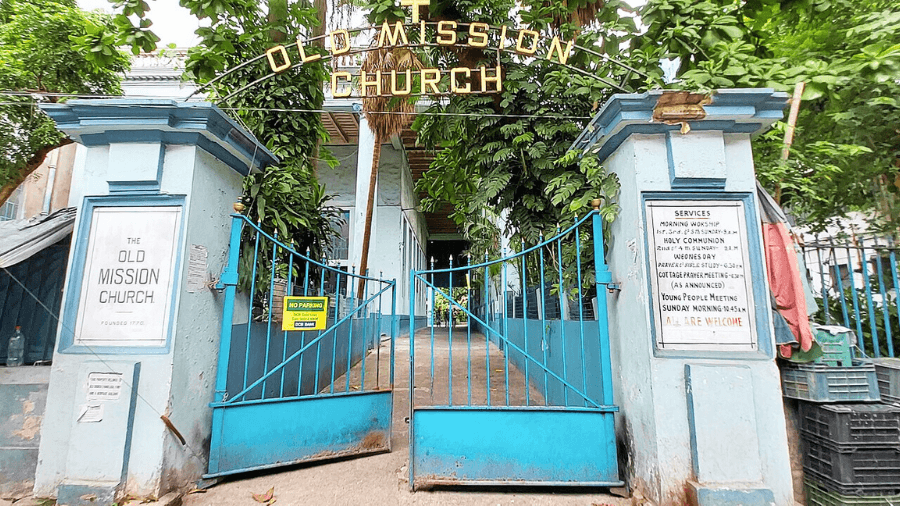
The entrance to the Old Mission Church. (Picture by Pinakpani, Wikimedia Commons)
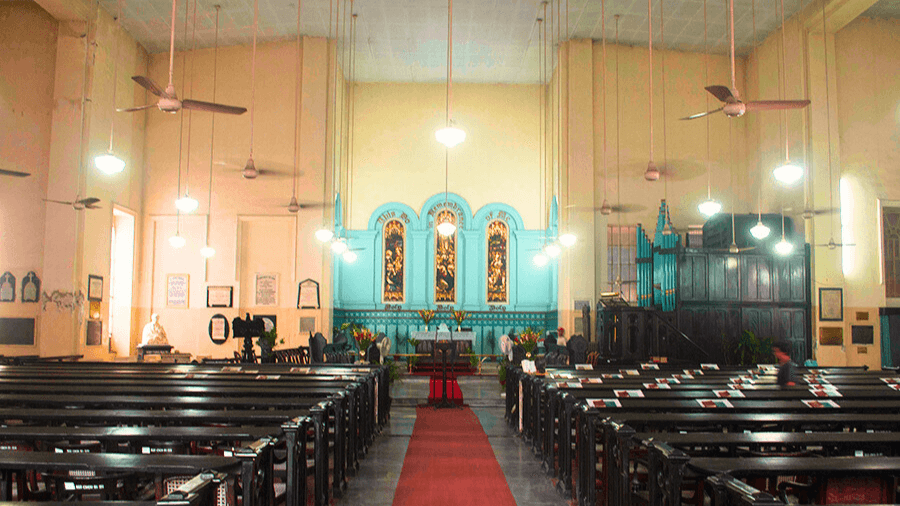
A view of the interiors of the Old Mission Church. (Picture by Rangan Datta)
Mission Church, generally referred to as the Old Mission, is the second oldest church in the city. Located at RN Mukherjee Road, it was founded in 1770 by the Swedish Lutheran missionary Rev. John Kiernander. The church was once topped with a slender spire which toppled during the earthquake of 1897. Today, the church is surrounded by high-rises on both sides and the road in front serves as a parking lot for vehicles — making it difficult to photograph the church exterior. The interior, however, is grand, with long colonnaded corridors leading to the stained-glass-decorated altar. Interestingly, famous Bengali poet Michael Madhusudan Dutt was baptised at this church in 1843.
Access: No fixed timings. The best time to visit is after mass on Sundays, around 9am.
Entry: Free
Photography is generally allowed.
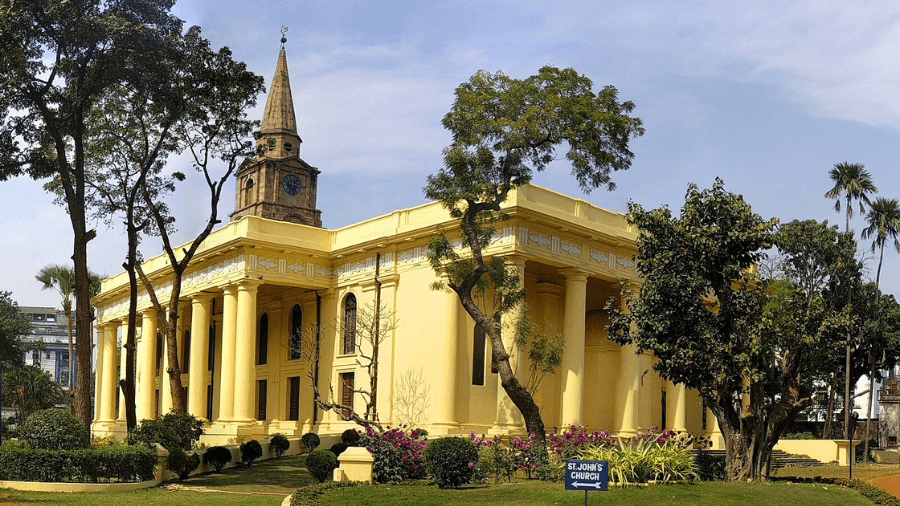
St. John’s Church (Picture by Antaroop 2010, Wikimedia Commons)
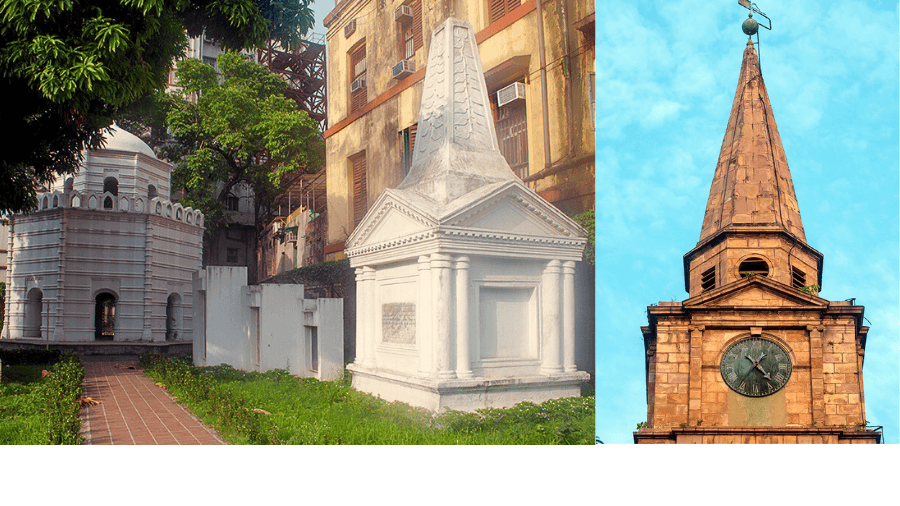
(left) Tombs at St. John’s Church; (right) The stone spire of St. John’s Church. (Pictures by Rangan Datta)
Standing near the Governor House or Lok Bhavan, this is the oldest standing Anglican (English) church in the city. St. John’s dates back to 1787 when it was built. The church, which is built in the neo-classical style, is topped with a stone spire and is often referred to as the Pathure Girja (Stone Church). The interiors are elegant and house marble bas-relief memorial plaques, wood carving, stained glass windows and a painting of The Last Supper by German neo-classical painter Johan Zoffany. The church stands in a large complex housing several tombs, a couple of which predate the church. It includes the tomb of Job Charnock, who was once considered the founder of the city.
Access: 10am–4pm (Monday to Saturday)
Entry: Rs 10
Photography allowed.
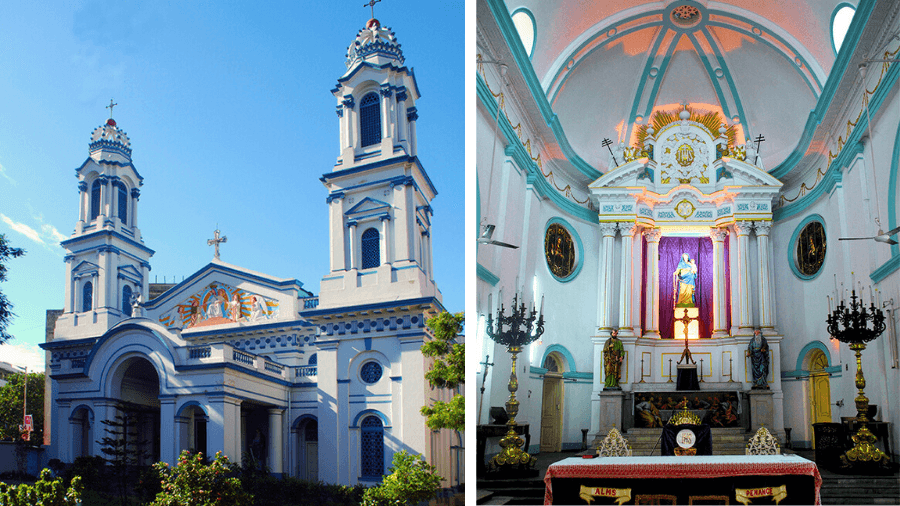
(left) The Portuguese Church or the Cathedral of the Most Holy Rosary; (right) the interiors of Portuguese Church. (Pictures by Rangan Datta)
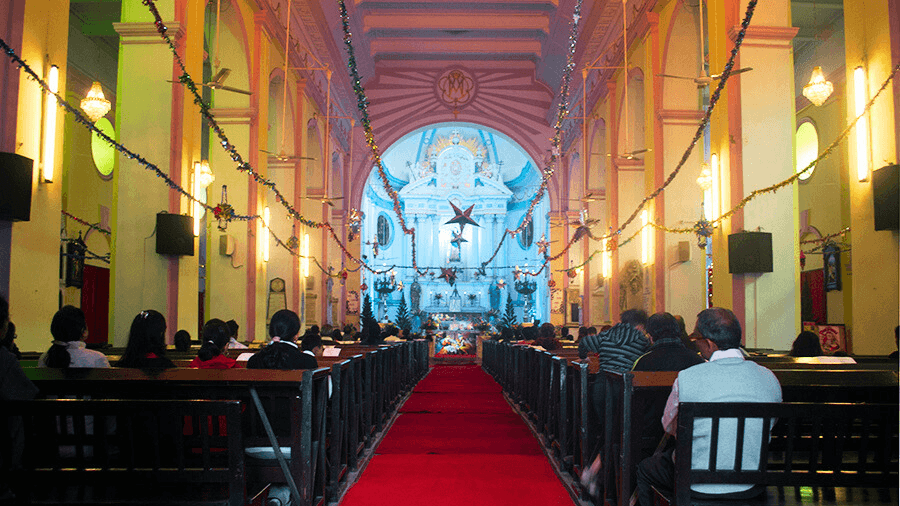
The interiors of the Portuguese Church. (Picture by Rangan Datta)
The Portuguese Church serves as the Catholic Cathedral of the city. It is officially known as the Cathedral of the Most Holy Rosary. The church stands at the bend of Brabourne Road and its twin minarets topped with hollow domes still dominate the skyline. The church dates back to 1799 and has richly ornate interiors complete with stained glass windows and long corridors topped with arches. There are ornate baptism tubs and statues of several saints, including one of Mother Mary with infant Jesus, which is usually wrapped in a sari.
Access: Usually open in the morning hours. The best time to visit is after mass on Sundays, around 9am.
Entry: Free
Photography is generally allowed.
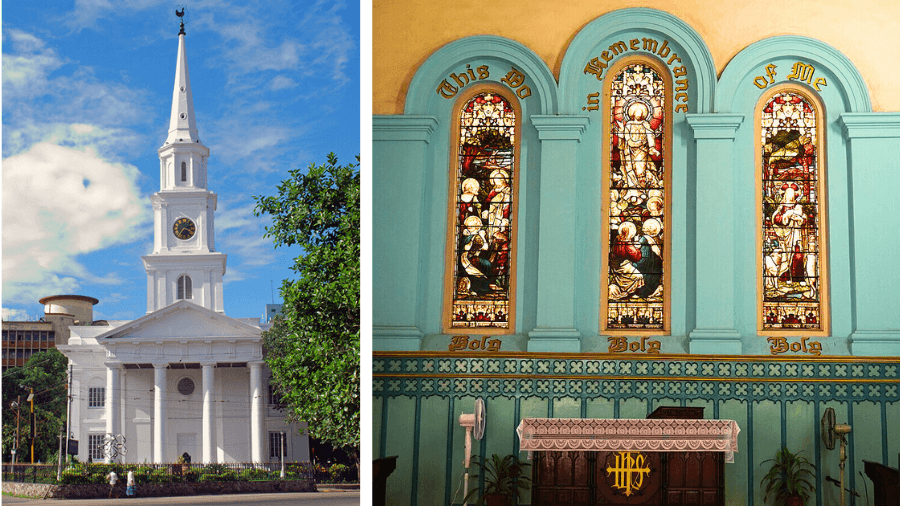
(left) St. Andrew's Church (Picture by Rangan Datta); (right) Interiors of St. Andrew’s Church (Picture by Titofoodie, Wikimedia Commons)
Located next to the Writers’ Buildings in BBD Bagh, St. Andrew’s Church dominates the skyline of the very heart of the city. The Scottish Church (Kirk) came up in 1818 and comes with an elegant spire topped with a weathercock. The interiors are plain and simple with curved seating arrangements. The walls house a handful of memorial plaques.
Access: No fixed timings. The best time to visit is after mass on Sundays, around 9am.
Entry: Free
Photography is generally allowed.
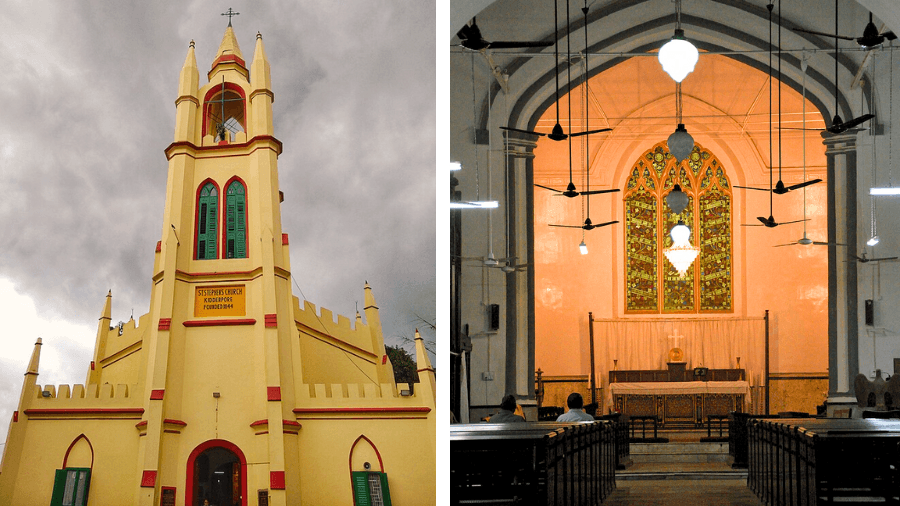
(left) St. Stephen's Church (Picture by Das Juin, Wikimedia Commons); (right) Interiors of St. Stephen's Church (Picture by Rangan Datta)
St. Stephen's Church in Kidderpore is popularly known as the Rocket Church for its unique rocket-shaped spire. Strangely, the steeple was not meant to be designed like a rocket; in fact, it was designed as a ship’s lantern. Probably the proximity of the docks inspired the shape of the steeple of the church which was built in 1846. Its interiors are simple but elegant, with a huge yet intricate stained glass panel at the altar. On both sides of the altar are two closets, which may have been meant for nuns. There are a few memorial plaques on the walls, most of which are dedicated to sailors who died at sea or even drowned in the Hooghly.
Access: No fixed timings. The best time to visit is after mass on Sundays, around 9am.
Entry: Free
Photography is generally allowed.
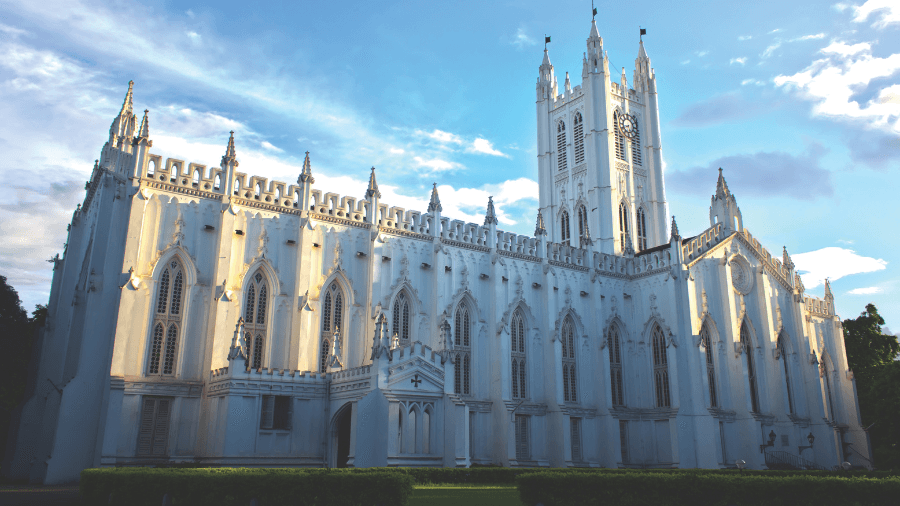
St. Paul’s Cathedral (Picture by Ankitesh Jha, Wikimedia Commons)
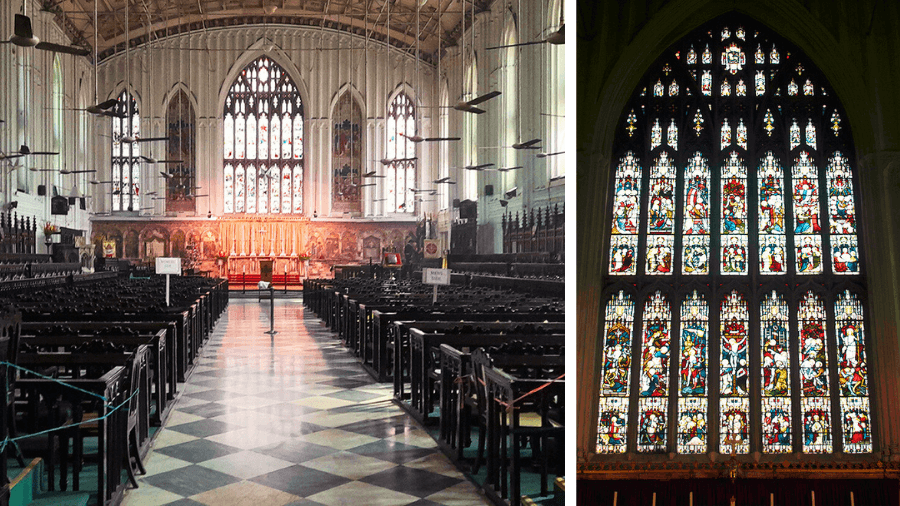
The interiors of St. Paul’s Cathedral. (Pictures by Rangan Datta)
Standing on the eastern side of the Victoria Memorial and next to the Birla Planetarium on the Maidan stretch, St. Paul’s Cathedral was completed in 1847. After construction, it replaced St. John’s as the cathedral of the Protestant Christians of the city. The clock tower of the church was once topped with a steeple which was damaged during the earthquake of 1934 and subsequently removed. The interior of the church is a feast for the eyes, with excellent floral designs on the walls. Exquisite murals, stained glass windows and decorative marble statues and plaques add to its captivating look.
Access: 9am–noon and 3pm–6 pm (Monday to Saturday), 7.30 am–6 pm (Sunday)
Entry: Rs 10
Photography allowed in the complex but not inside the church.
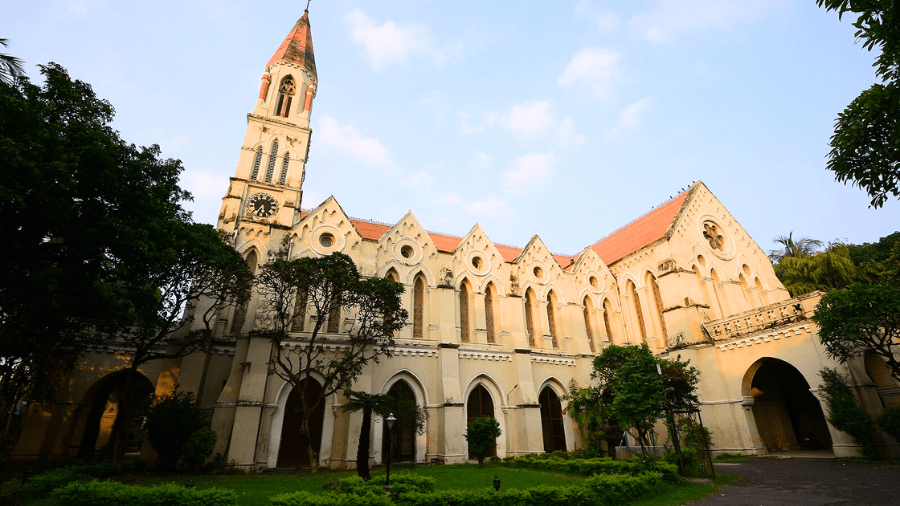
St James' Church
St. James’ Church, or Jora Girja, so named after its twin spires, is more known today as a bus stop than as a church. The church is sandwiched between St. James’ School and Pratt Memorial School in Entally. St. James’ Church dates back to 1868. Built in Gothic style, it is one of Kolkata’s most elegant churches, with pointed Gothic arches on both its exterior and interior. The star attraction of St. James’ Church is the beautifully decorated black mahogany woodwork on the ceiling, something so durable that even the termites of Kolkata have spared it for a century and a half.
Access: No fixed timings. The best time to visit is on Sundays, around 9am.
Entry: Free
Photography is generally allowed.
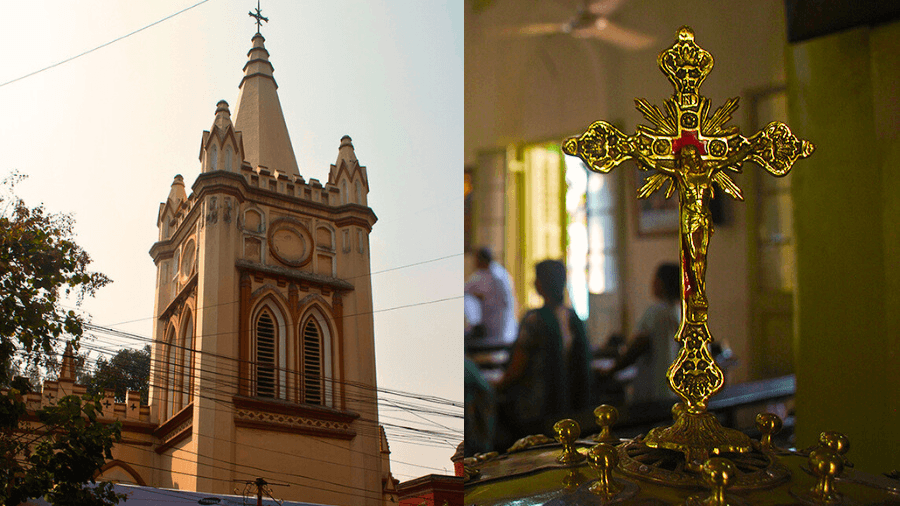
(left) St. Mary's Church; (right) Interiors of St. Mary's Church (Pictures by Rangan Datta)
Located on Elgin Road, St. Mary’s Church stands bang opposite Bhawanipur Education Society College. The 1889 church is popularly known as the Bengali Cathedral as it was founded by a group of Bengali Christians. Today, a large number of its members belong to the Bengali Protestant community and the church has regular Bengali services. The interior of St. Mary’s Church contains beautiful stained glass and several marble memorial plaques written in flowing Bengali script.
Access: No fixed timings. The best time to visit is on Sundays, around 9am.
Entry: Free
Photography is generally allowed.
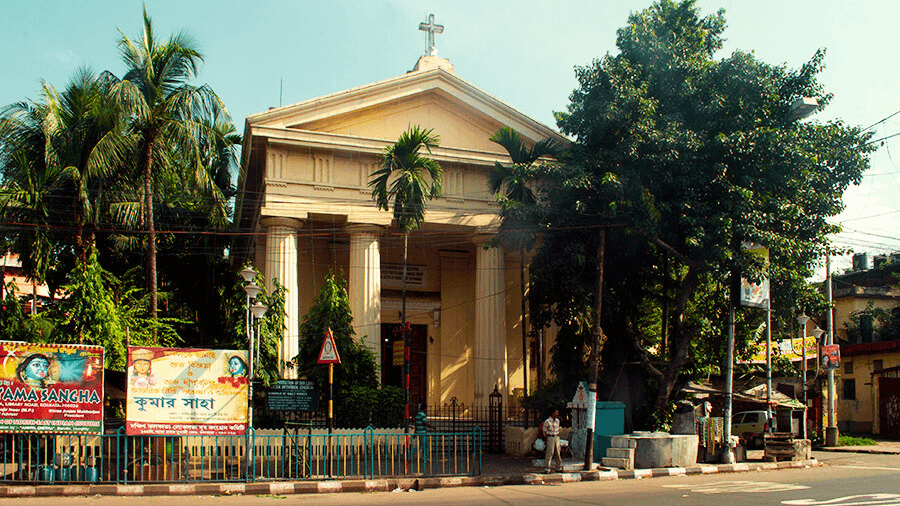
The Greek Orthodox Church (Picture by Rangan Datta)
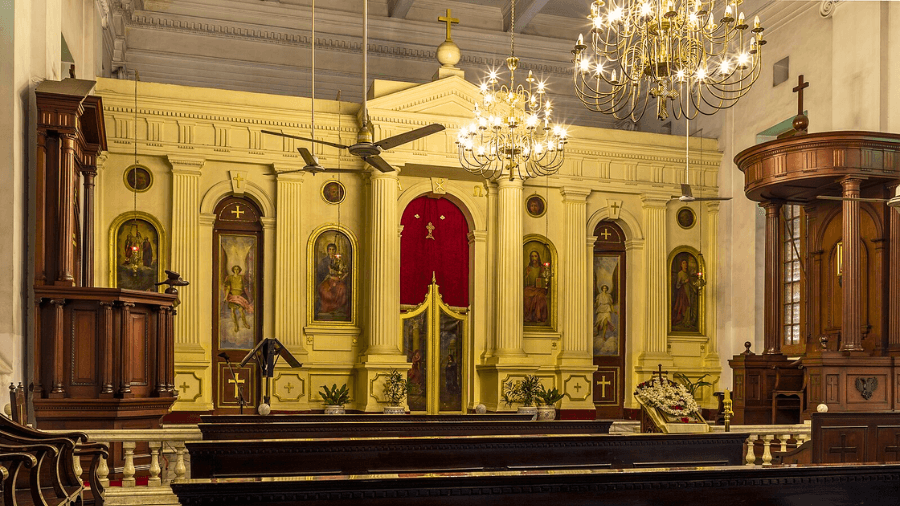
The interiors of the Greek Orthodox Church. (Picture by DeepanjanGhosh, Wikimedia Commons)
Kalighat is known for its Kali temple, but next to the former Kalighat tram depot stands the Greek Orthodox Church. It is officially known as the Transfiguration of the Saviour Church and dates back to 1925. The Greek Orthodox Church was closed down in the 1960s due to a lack of Greek Orthodox Christians in the city but it was reopened in the 1990s. Its structure resembles a Greek palace of winds. The interior has marble floors and wooden pews along with a polished-wood altar with painted panels.
Access: No fixed timings. The best time to visit is on Sundays, around 9am.
Entry: Free
Photography is generally allowed.
With festive lights and the gentle hum of Christmas songs in the air, this is the perfect season to discover these churches. So, plan a church walk during the Christmas–New Year week to explore the sacred steeples and spires of Kolkata.


