
A joint initiative by



 Published on 2026-03-05Updated on 2026-03-05
A city's story unfolds in its bazaars. While you are browsing and bargaining your way through Gariahat, one of Kolkata's most beloved shopping destinations, do not miss the chance to explore its market complex right behind the famous pavement stalls. Step beyond the chaos of the crossing and into the multi-storey Gariahat Market Complex at 212 Rashbehari Avenue, a place most visitors walk straight past.
The market complex stretches across two basement levels and spills out into an outdoor section at the back, offering a welcome respite from the heat and congestion of the pavements outside. A go-to destination for festive shopping, it offers everything from Diwali lights and torans to decorations that can transform a home into a winter wonderland at Christmas, often at a fraction of the price. If you want a glimpse into how a Kolkata household cooks, celebrates, worships and entertains, this is where to look.
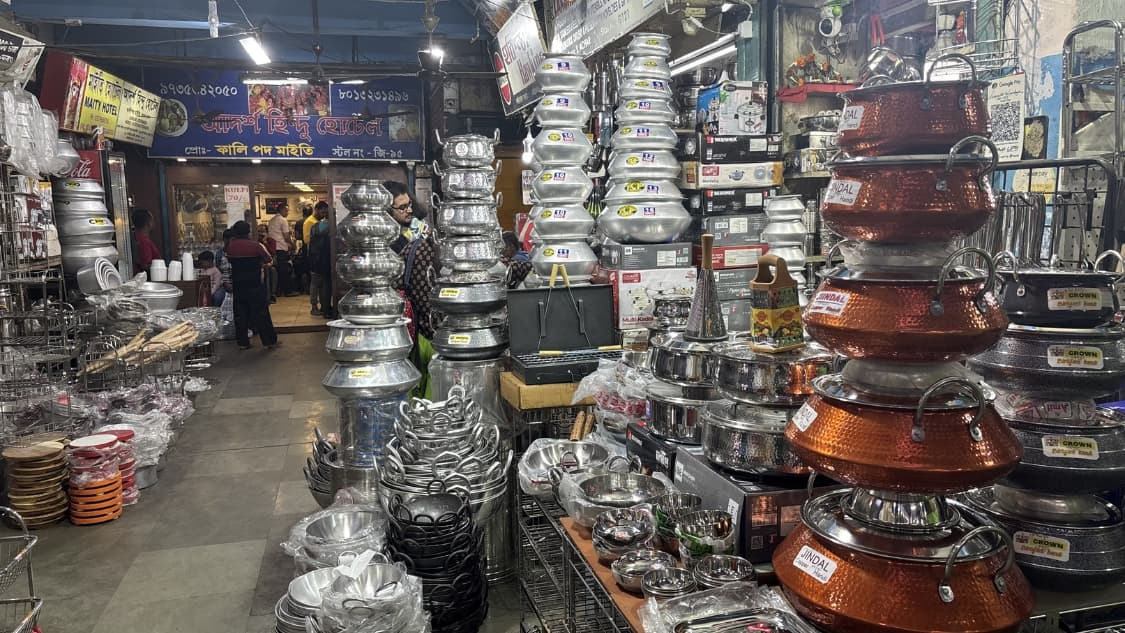
Steel utensils stacked on top of one another.
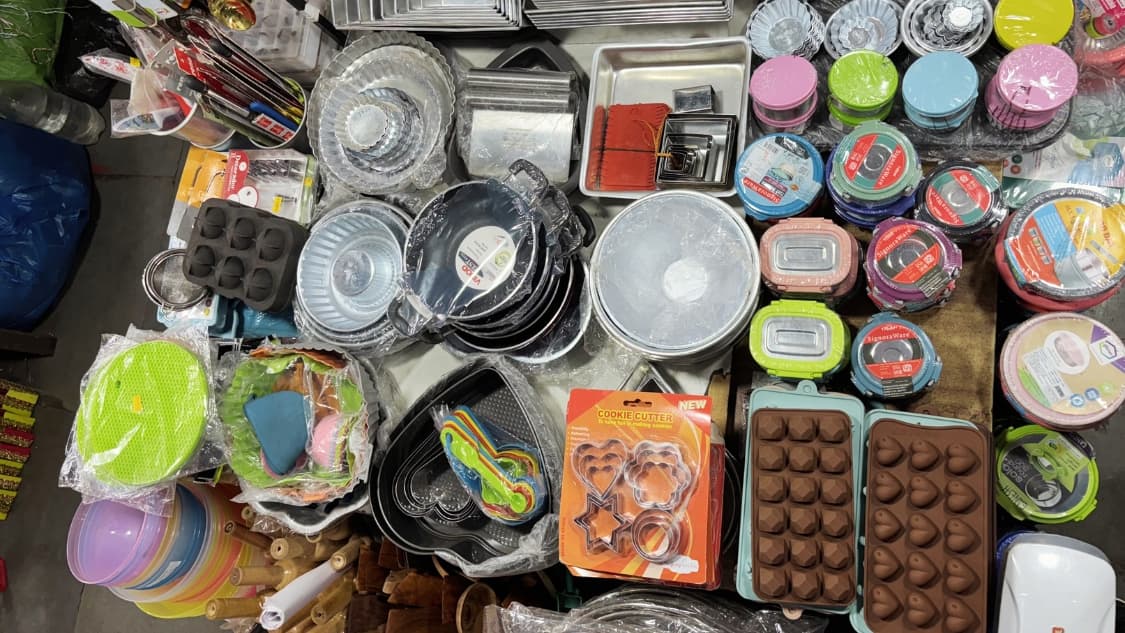
A stall displaying all kinds of baking equipment.
If you enter through Gate No. 6 (just behind the Gariahat crossing next to the MPJ Jewellers store), the first thing you will notice is a gleaming forest of stainless steel. Flat-bottomed dekchis (deep cooking pots) are stacked high beside round-bottomed haanri sets. Tiffin carriers, pressure cookers and ladles fill the shelves.
Even if you are not setting up a kitchen, this section offers a glimpse into how a Bengali household cooks and eats: rice simmering in deep pots, fish curries bubbling in wide haanris and meals packed into neatly stacked steel tiffin carriers. Everything here is practical, durable and built for everyday use rather than display. Nearby stalls sell baking moulds, glassware, ceramic bowls and small appliances. Prices are significantly lower than mall stores, making this a good stop if you are setting up an Airbnb kitchen, relocating temporarily or looking for useful souvenirs.
Pro tip: If you are travelling internationally, skip the heavy pots. Instead, choose a brass or stainless steel spice box (moshla dani) with tiny inner tins, or a tiered steel tiffin carrier. They slip easily into a carry-on and make for a lifelong souvenir — one that carries the scent of India straight into your home kitchen.
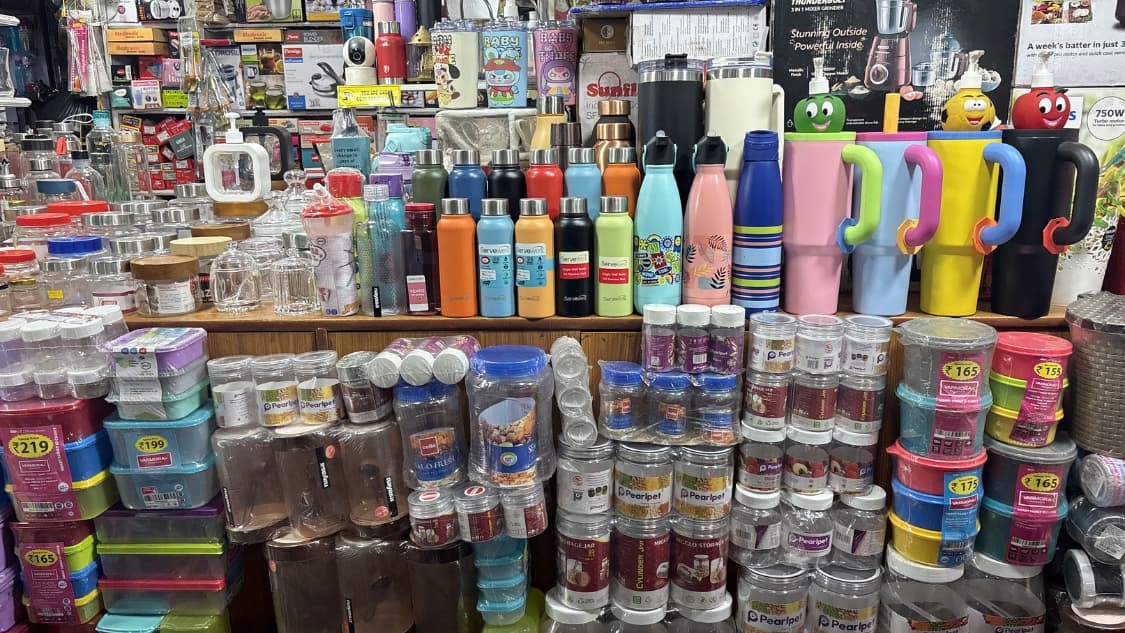
Colourful tumblers and different kinds of storage boxes are on display.
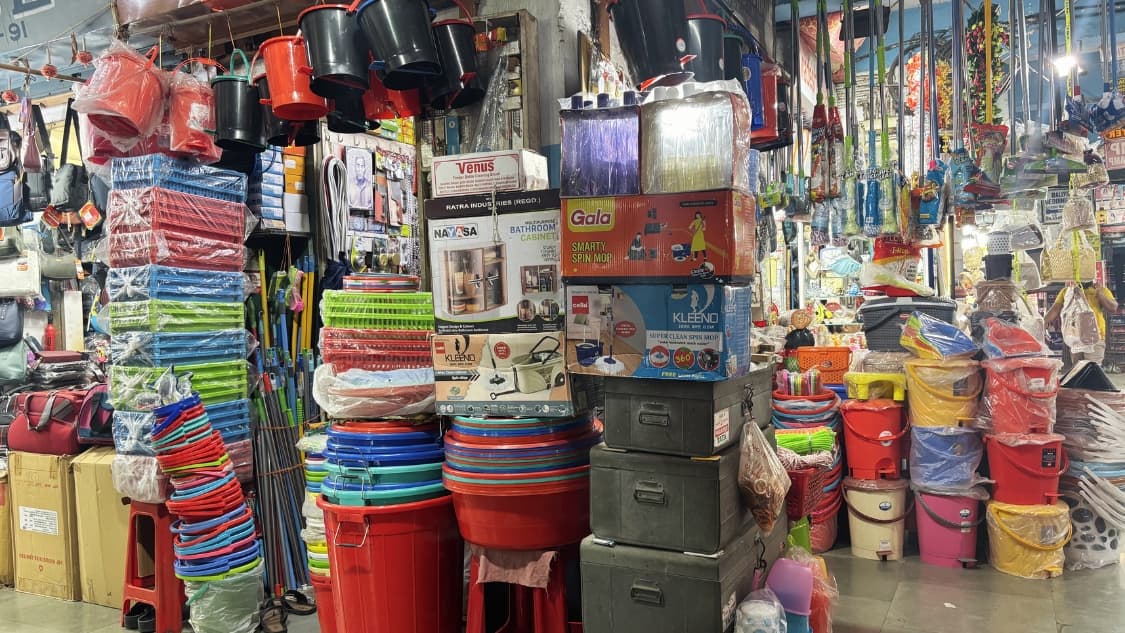
Cleaning items such as buckets, mops, dustpans and brooms on display.
If you’re staying in Kolkata for more than a few weeks, this section is invaluable for setting up a short-term rental at a fraction of supermarket prices.
Adjacent to the utensil stalls is a counter that feels distinctly contemporary, lined with colourful insulated tumblers in teal, navy and olive that mimic the popular Stanley style at a fraction of mall prices. Below them stand storage jars in clear plastic with bright lids, beginning at around Rs 165. Soap dispensers in matte finish, small drawer organisers and stackable containers complete the display. Next door, you can find cleaning items: buckets in different colours, mops, dustpans, brooms and metal storage trunks.
Pro tip: Stock up on storage jars and boxes in a range of sizes. They are practical, easy to carry and rarely regretted. As with most things in Gariahat, buying in bulk often earns you a better discount.
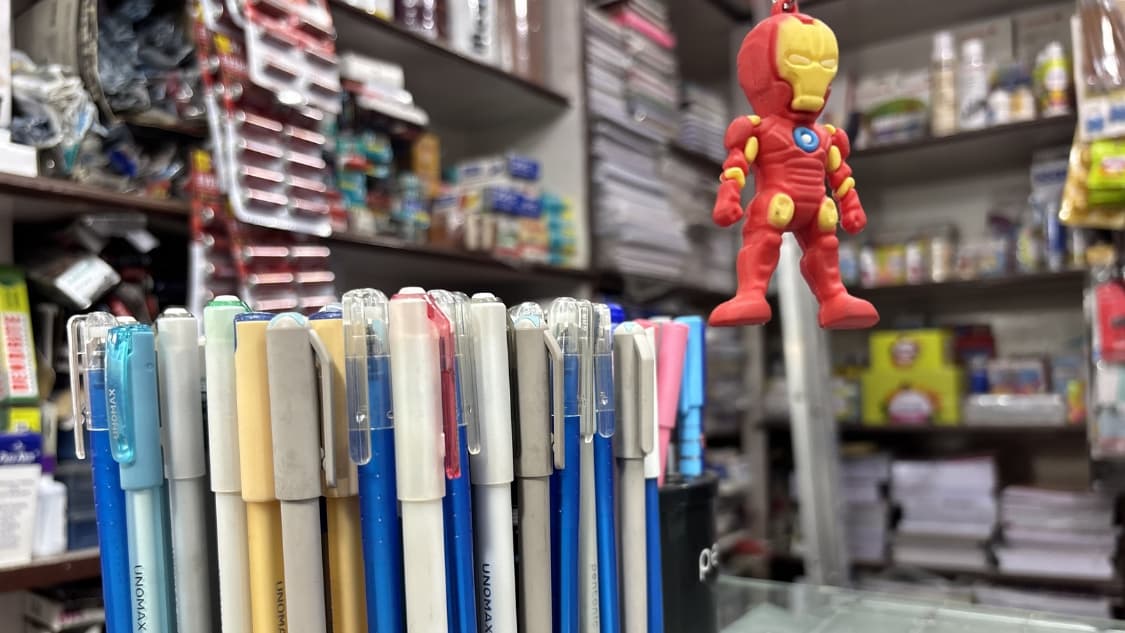
Rows of pens line the counter while a small superhero dangles above.
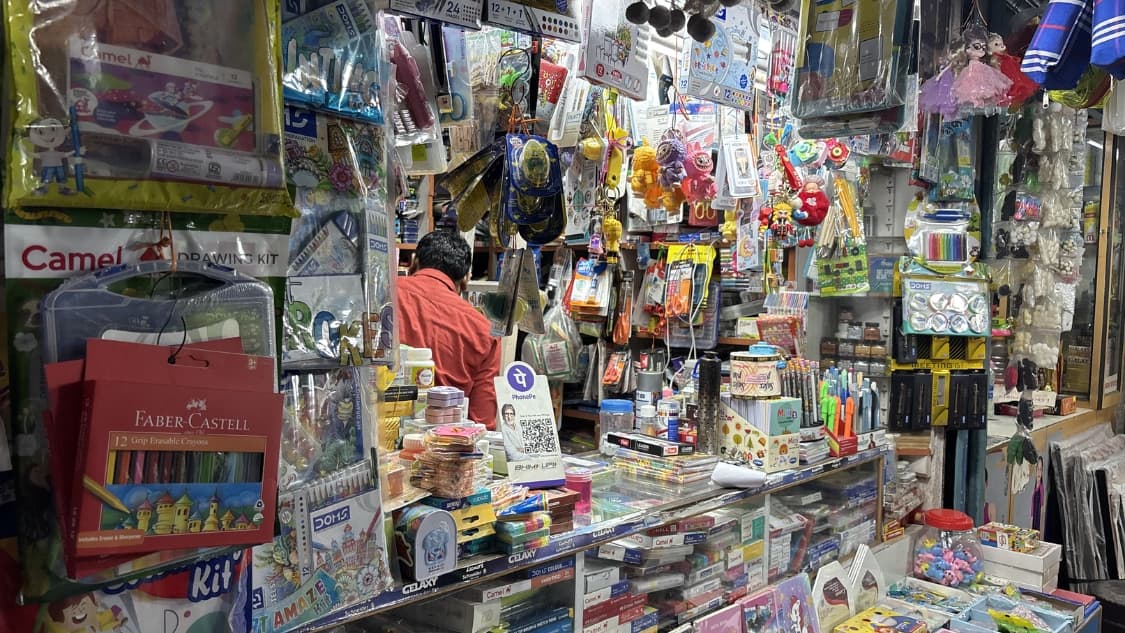
Crayons, sketchbooks, glue sticks and school supplies crowd the shelves of a stationery store.
Few corners in the market hold as much concentrated delight as the stationery and art supply shops. They are dense with colour: sketchbooks, sticker sheets, geometry boxes and pens in every shade imaginable. Small canvases are stored near acrylic paint, while below the counters lie rolls of coloured chart paper, mount board and bundles of wooden sticks for model-making. It is a nostalgic stop for many Indian visitors and a charming one for international travellers, a reminder of how deeply craft and art are embedded in everyday life here.
Pro tip: If you’re travelling with children, this is one of the most affordable places in the city to pick up craft kits and colouring supplies.
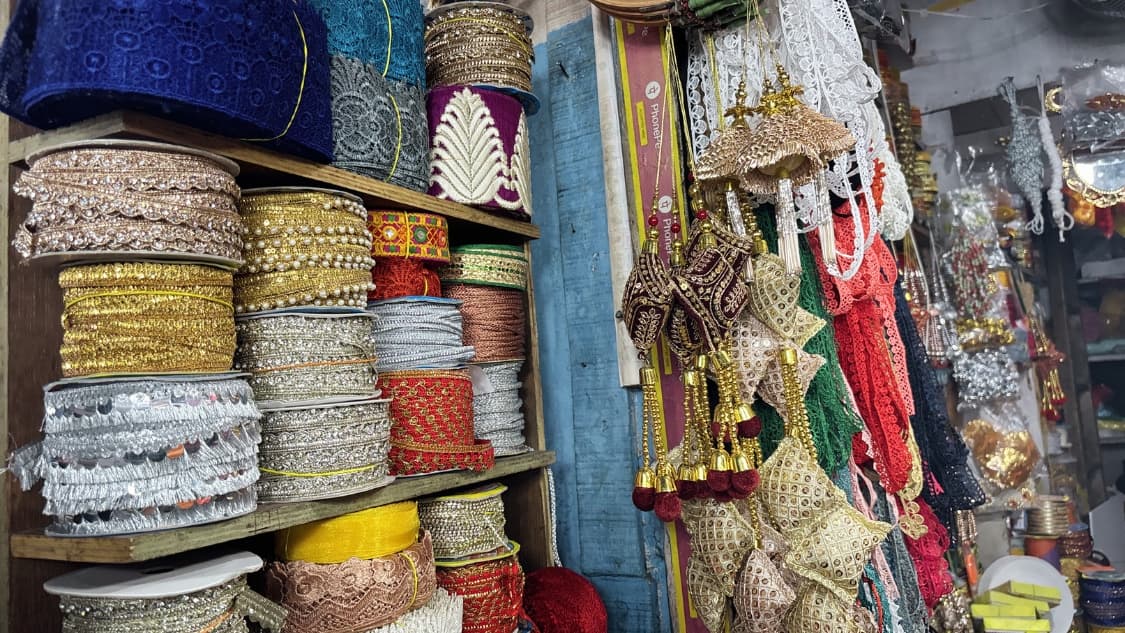
Rolls of embroidered trims and ornate tassels spill from a shop that supplies fabrics and embellishments for weddings, festivals and tailoring.
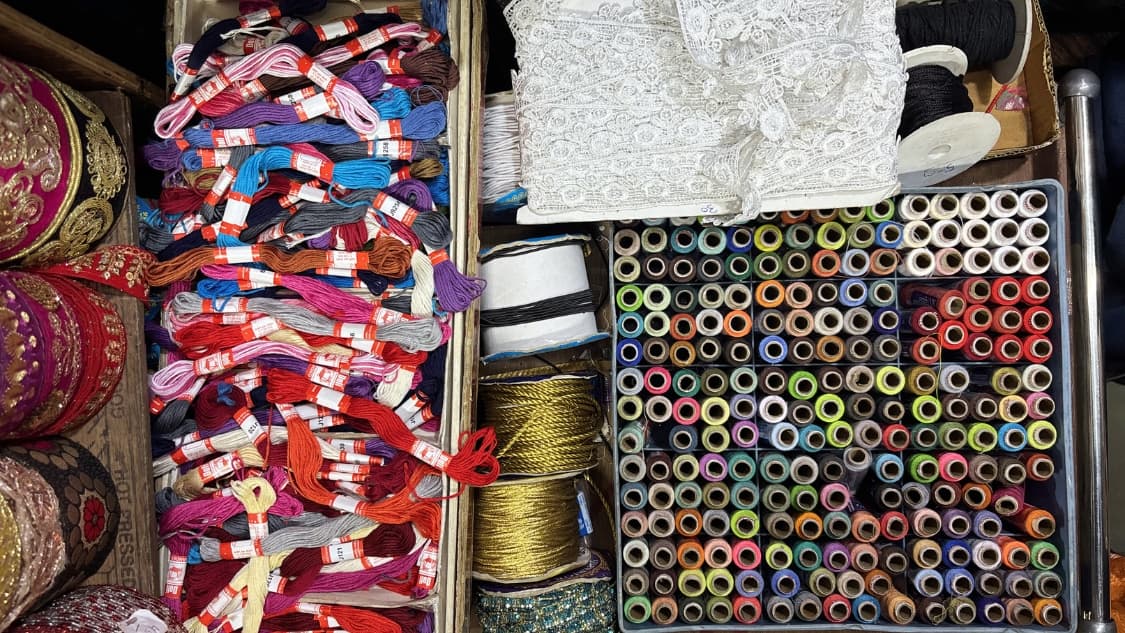
Neatly stacked skeins of embroidery thread are displayed next to rows of colourful spools.
Directly opposite, the scene shifts from paper to thread. Zari borders, pearl-edged trims, tassels and sequinned ribbons are sold by the metre. On the counter, hundreds of embroidery threads tumble in bright piles, with machine bobbins arranged by colour beside them. These are the materials that transform simple fabrics into festive garments.
Pro tip: If you are getting clothes tailored in Kolkata, this is an excellent place to source decorative trims at a fraction of boutique prices. If you are buying trimmings for a specific garment, bring a small swatch of the fabric with you.
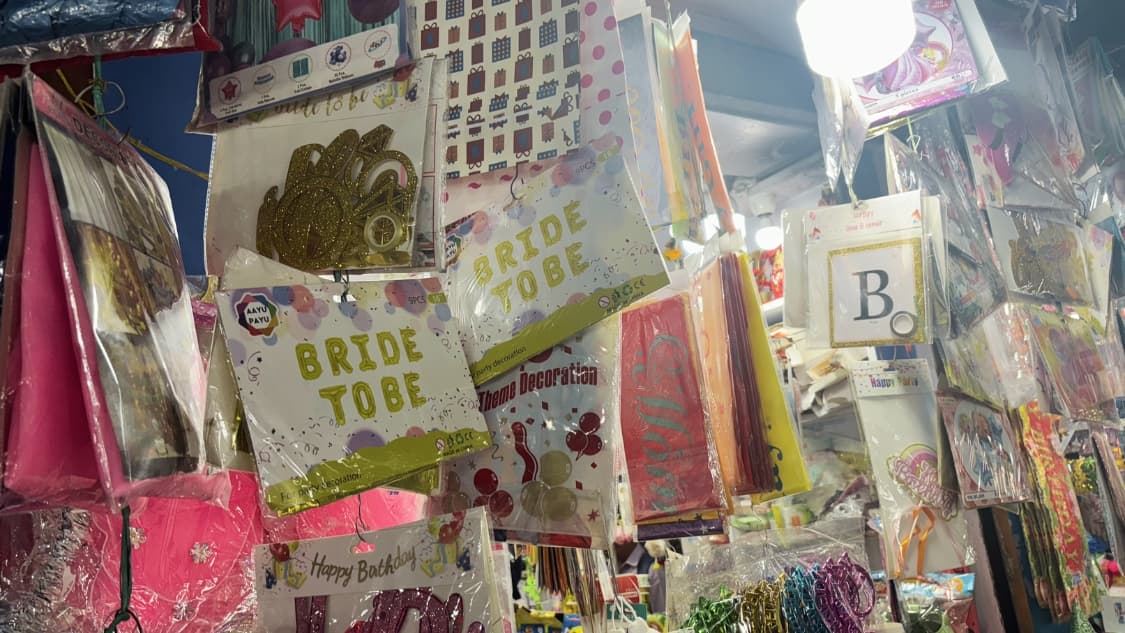
A close-up of a party supply stall featuring "Bride to Be" banners, gold glitter cake toppers and various colorful gift-wrapping papers and decorative streamers.
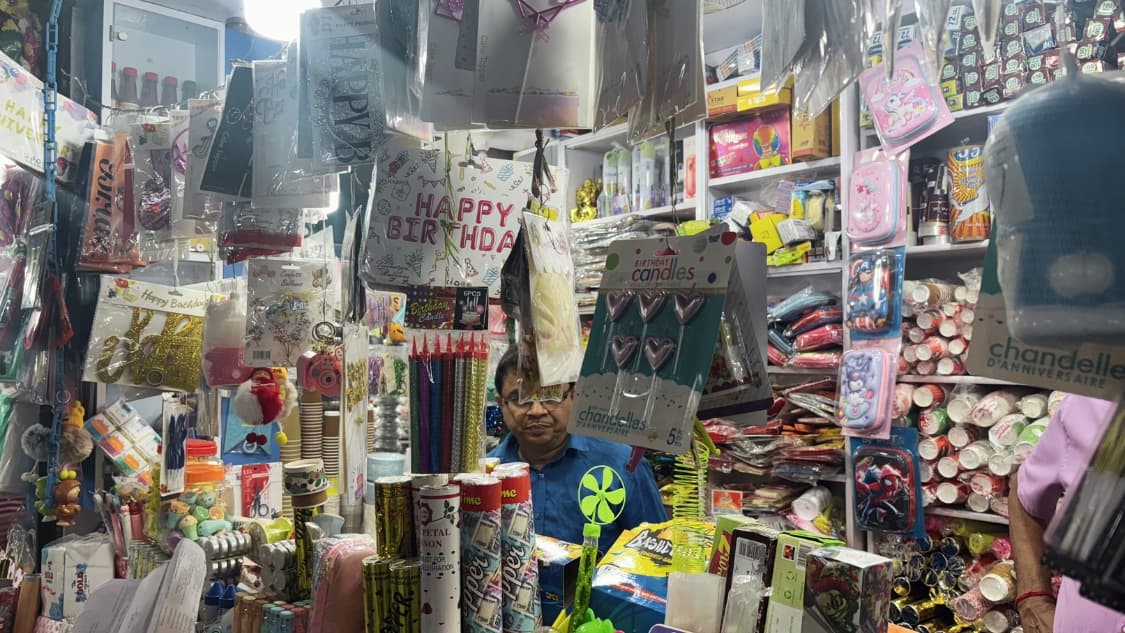
A bustling stall packed with birthday celebration essentials, including "Happy Birthday" banners, heart-shaped candles, party poppers and character-themed stationery sets.
Paper houses in the market stock everything required to throw a party and then some. The sheer range on offer is a useful window into how Kolkatans celebrate and a few well-chosen items make for unexpectedly fun souvenirs.
From disposable plates and cups in every size and shape to foil trays, wrapping paper and gift bags, you will find it all. Birthday candles, including the relighting variety that are either delightful or a menace depending on your age, sit alongside paper hats, streamers and confetti poppers. Glittering "Bride to Be" banners dangle from the ceiling along with bright letter balloons and Happy Birthday foil balloons, enough sparkle to mark any milestone.
Pro tip: If you are planning a large event, come here first before buying anything from a dedicated party store. The prices are significantly lower and the range is wide enough to handle most themes.
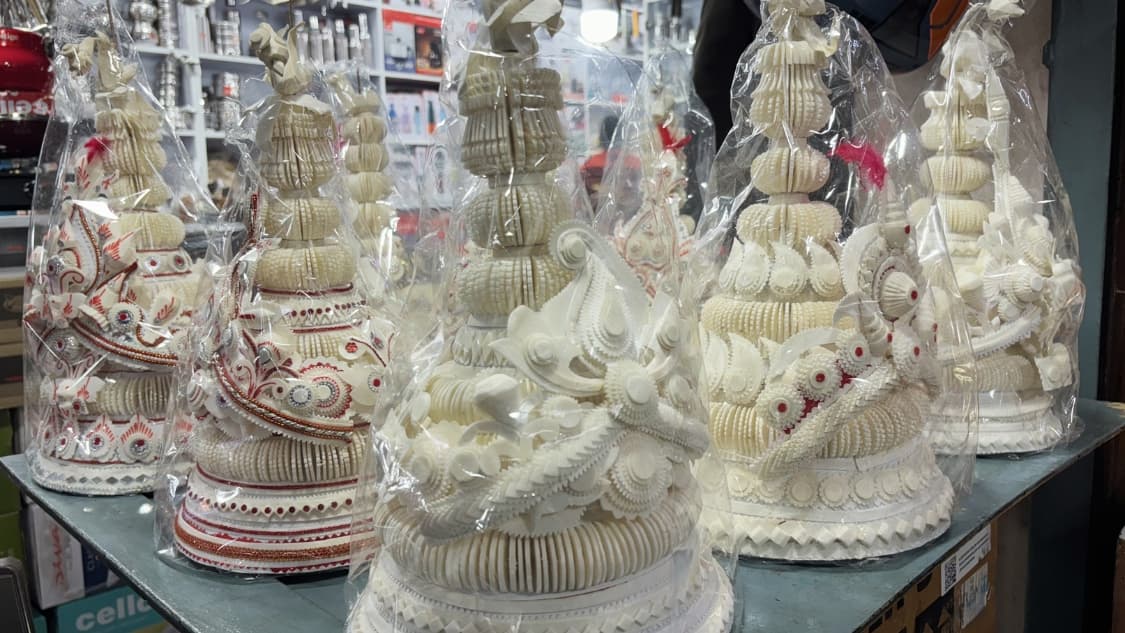
A row of traditional topors — intricate, white sholapith (pith foam) crowns are traditionally worn by grooms in Bengali weddings.
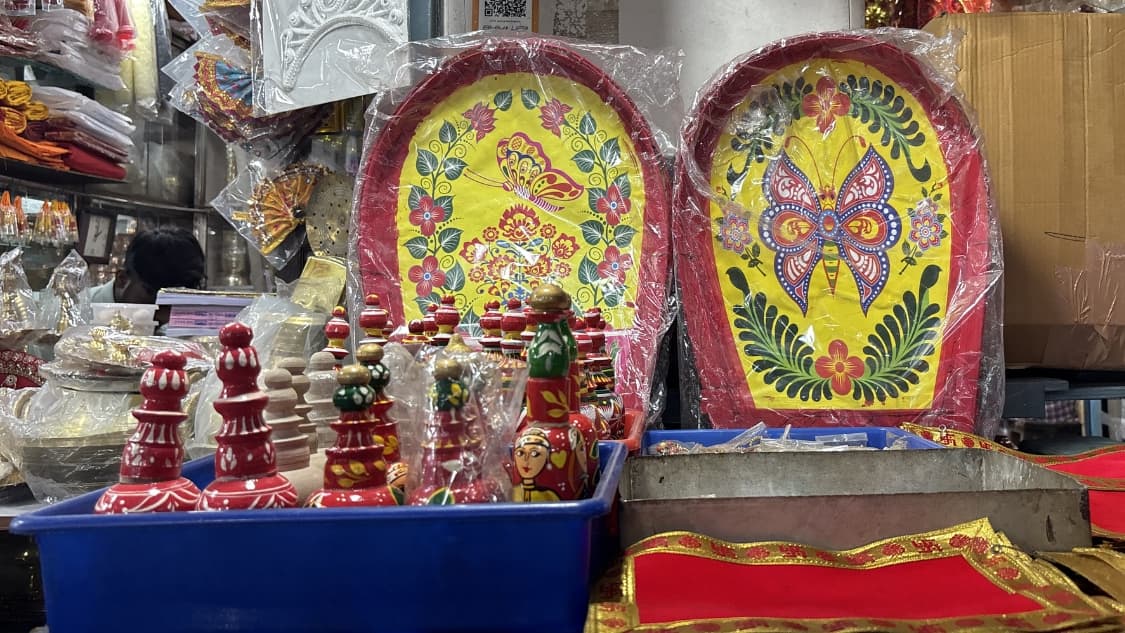
A display of traditional Bengali wedding and ritual items including brightly painted kulas (winnowing fans) adorned with butterfly motifs.
For those curious about Bengali culture, this section alone is worth the detour. One stall specialises in shankha and pola, the white conch shell and red coral bangles traditionally worn by married Bengali women, which make for beautiful and meaningful souvenirs. Next door, invitation card stalls draw steady streams of couples and mothers-in-law. Their glass cases display sample cards in gold foil, red silk, velvet finishes and traditional printed designs.
Nearby you will find the iconic topor and mukut, the white shola headgear worn by Bengali brides and grooms, stored carefully in protective plastic. Enormous decorative totto trays painted in red, yellow and green with bride-and-groom motifs, puja supply stalls with brass lamps, conch shells and fabric torans: it is a vivid all-in-one introduction to what a Bengali wedding and festive household actually looks like.
Pro tip: Shola is as light as air but fragile as a cracker. If you buy a decorative piece, do not check it in. Carry it in your hand luggage to ensure it arrives home in one piece.
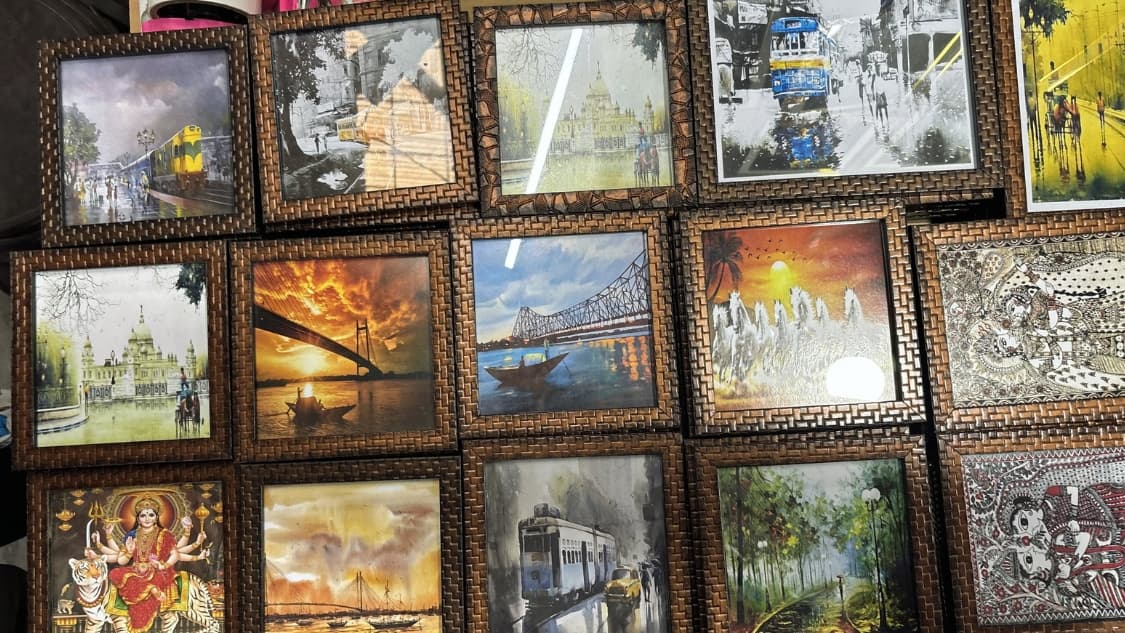
A collection of framed miniature artworks showcasing iconic Kolkata landmarks, including the Howrah Bridge, yellow taxis, trams and traditional Madhubani-style paintings.
As you head into the lower basement, the frame stalls are the first thing you encounter. Frames display watercolours of Kolkata trams, the Howrah bridge at sunset, the Victoria Memorial under monsoon skies and Durga Ma in her full gold and red. Reasonably priced and easy to pack, these prints make for far more considered souvenirs than anything you will find at an airport gift shop.
Often these stalls also sell mirrors, which stand leaning against the walls. They are framed in gold, dark wood and minimal black finishes. The vendors here will custom-cut mirrors to your specification. Prices start at around Rs 1,500 for a mirror sized 5 ft by 1.5 ft.
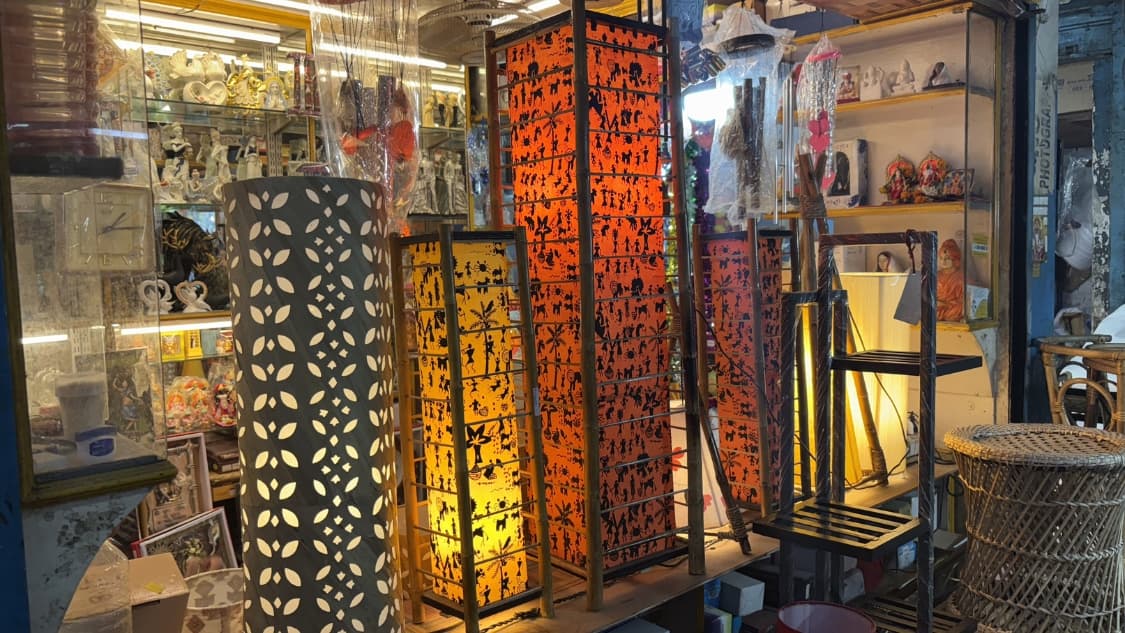
A warm display of handcrafted lamps made from bamboo and fabric, featuring traditional tribal-style (Warli) silhouettes and intricate cut-out patterns.
Deeper inside, the corridors dim and the lamp stalls begin to glow. The standout pieces are tall floor lamps with Warli-painted panels printed with silhouetted scenes of tribal life: dancers in a circle, grazing animals, trees and festival processions. Nearby, cylindrical table lamps filter light through delicate cutwork, casting a softer, steadier glow. Prices are a fraction of what you would pay in a design boutique.
Pro tip: Always ask to see a lamp switched on before buying. Instead of buying the whole lamp, ask the vendor if you can just buy the hand-painted shade. It’s easy to pack and you can fit it onto a local lamp base when you get home.
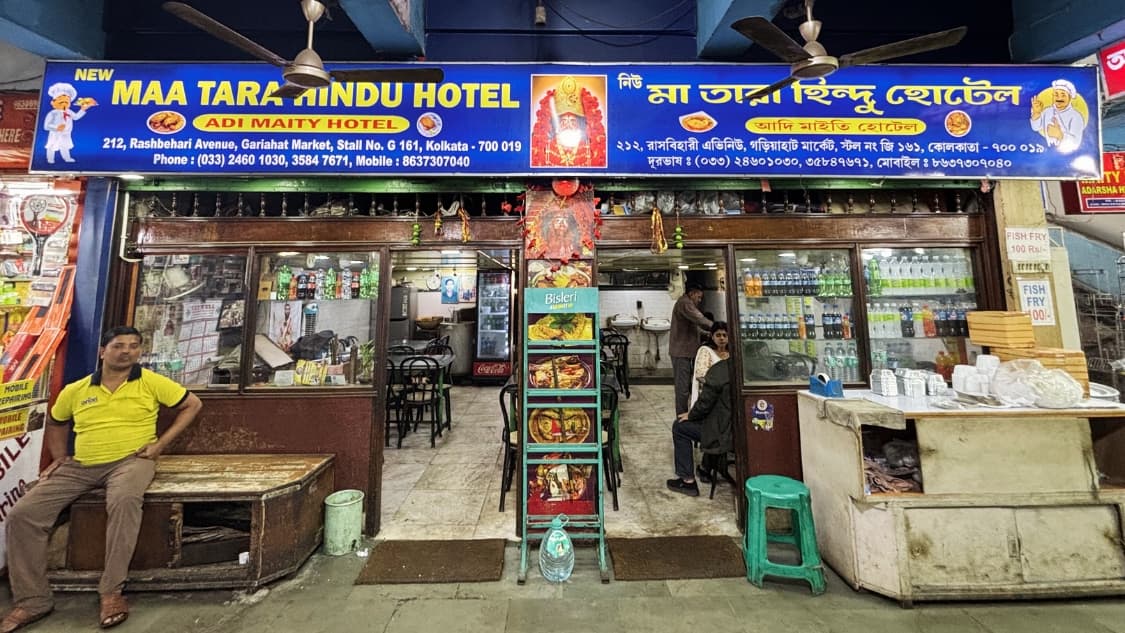
The New Maa Tara Hindu Hotel.
Somewhere between all this, hunger will find you. Gariahat Market has its own answer to this and it comes in the form of pice hotels, one of Kolkata's most cherished culinary traditions that most tourists never encounter.
Originating in the early 1900s when Kolkata was a bustling metropolis teeming with migrants, pice hotels are traditional Bengali eateries that take their name from the paisa, the lowest denomination of the Indian rupee. Designed to provide home-like nourishment to homesick clerks and traders, the format remains largely unchanged: you sit, eat what was freshly prepared that afternoon and leave satisfied, with a full meal typically costing between Rs 100 and 200.
Adarsh Hindu Hotel (Stall G 95) and New Maa Tara Hindu Hotel (Stall 161) are two such institutions found inside the market. Simple, busy and reliable for good reason, they serve classic Bengali fare such as rice, dal, alu bhaja (fried potatoes) and fish curry on banana leaves, with water arriving in cool clay bhanrs (clay cup) that carry a faint earthy scent. On good days you might find golda chingrir malaikari (prawn curry in coconut milk), creamy and fragrant.
Pro tip: These are not places to linger over a long meal. They are for eating well and efficiently, surrounded by vendors on their lunch break and shoppers who know exactly what they are doing. During rush hours you may be asked to share a table with strangers.
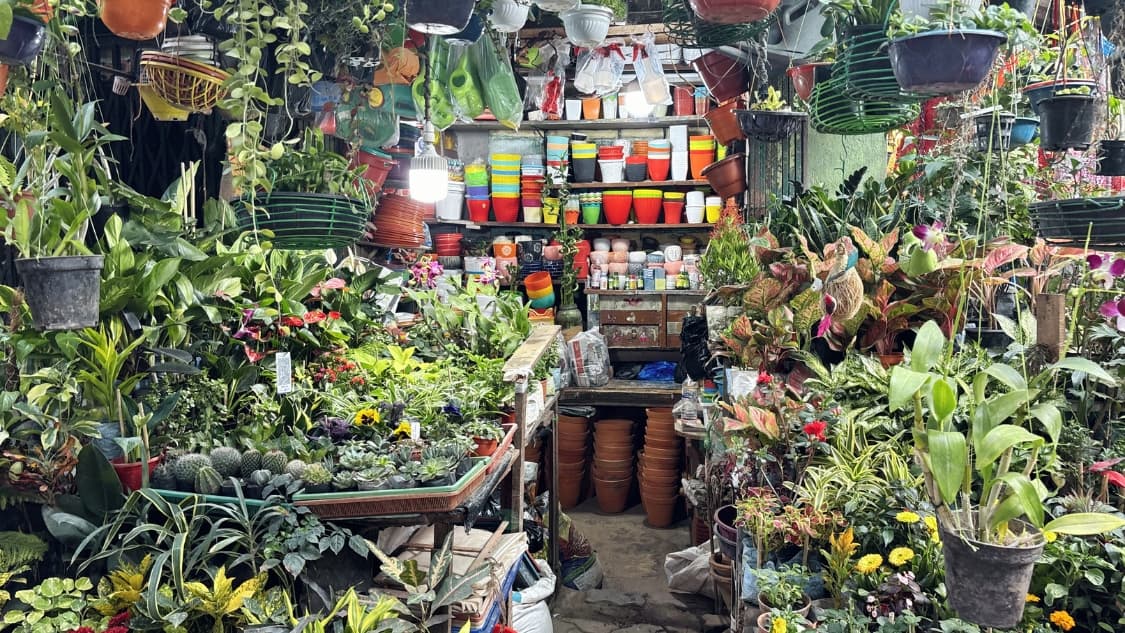
A lush and dense plant nursery stall, overflowing with various indoor and outdoor plants, hanging baskets and a colorful back wall of plastic and ceramic flower pots.
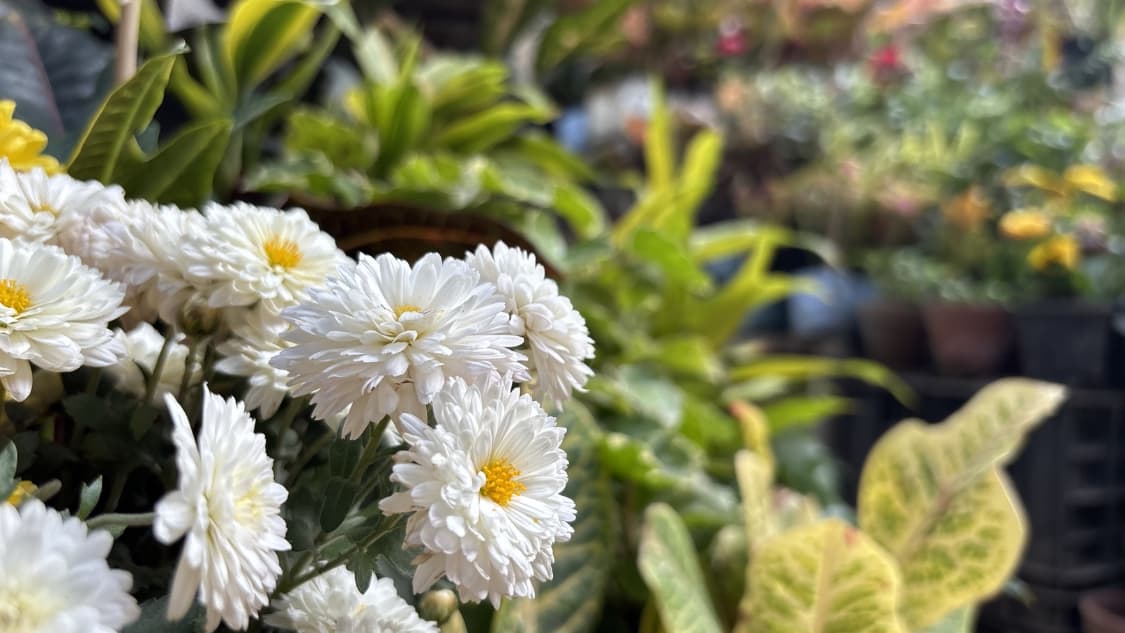
A beautiful close-up of white chrysanthemums in full bloom.
Step out the side exit and the market opens into air and colour.
The Plant and Flower section
The flower section is particularly photogenic: plant baskets in bright blue, red and orange hang overhead, while the tables below are crowded with dahlias, chrysanthemums, roses and a wide variety of flowering plants in clay and terracotta pots. At the edge of the flower section, vendors sit threading fresh marigolds into long garlands, their fingers moving quickly as the strands lengthen.
Pro tip: Come early in the morning for the freshest flowers and the widest selection. Early morning visits also offer softer light for photographs.
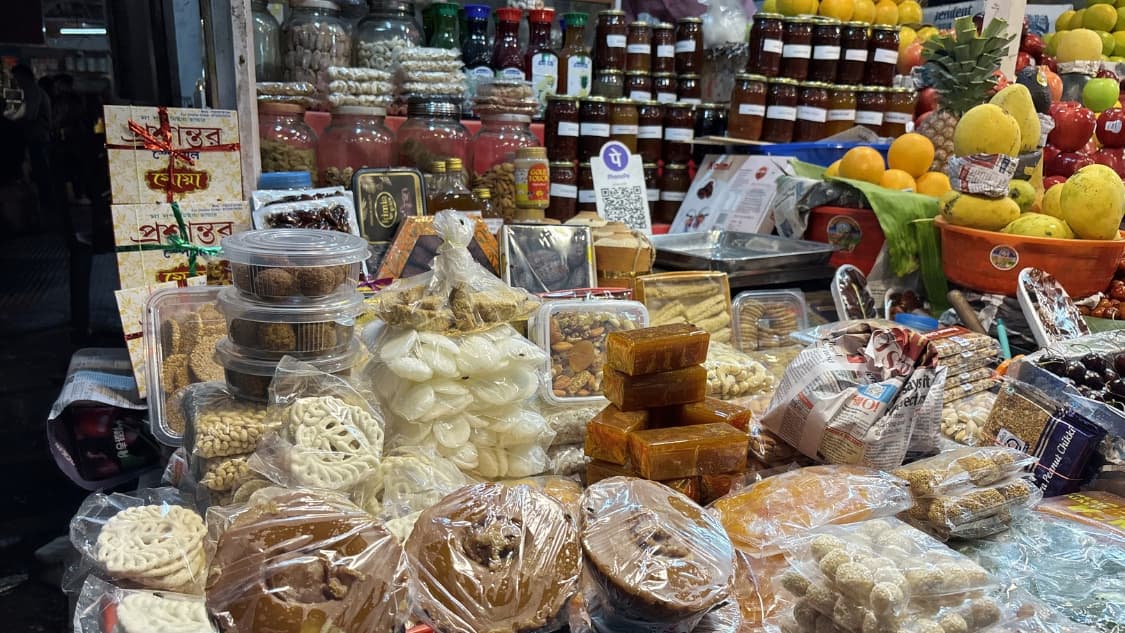
A variety of traditional Bengali sweets and preserves, including white batasa (sugar drops), aamshotto (dried mango pulp), patali gur and jars of pickles and honey, neatly arranged at a market vendor's stall.
Gur, sweets and dry goods
One of the most arresting displays is the gur counter, where you will find dark, burnished rounds of patali gur (solid date palm jaggery), each the size of a small wheel. Some are sliced open to reveal their dense, sticky centres, others wrapped loosely in paper or plastic. Smaller domes of khejur gur sit below, their surfaces matte and crumbly. Gur travels well in check-in baggage, along with hajmi (digestive) candy and dried paan (betel leaf).
Beside them are generous piles of muri (puffed rice) and chire (flattened rice) along with jars of honey and pickle. Blocks of aamshotto (dried mango pulp) are cut into tidy rectangles. Look closely and you will also find an entire world of traditional mishti and pithe: patishapta, naru (coconut balls) and other rice flour and jaggery confections wrapped carefully in plastic. Tucked among them are packets of goyna bori, sun-dried lentil wafers that resemble traditional Bengali jewellery and are named for exactly that reason. These pantry staples of the Bengali diet also make excellent, compact edible souvenirs.
Pro tip: Patali gur is seasonal and at its best between November and February, when fresh date palm sap is in season. Outside these months, most of what you find will be stored gur and the difference in flavour is noticeable.
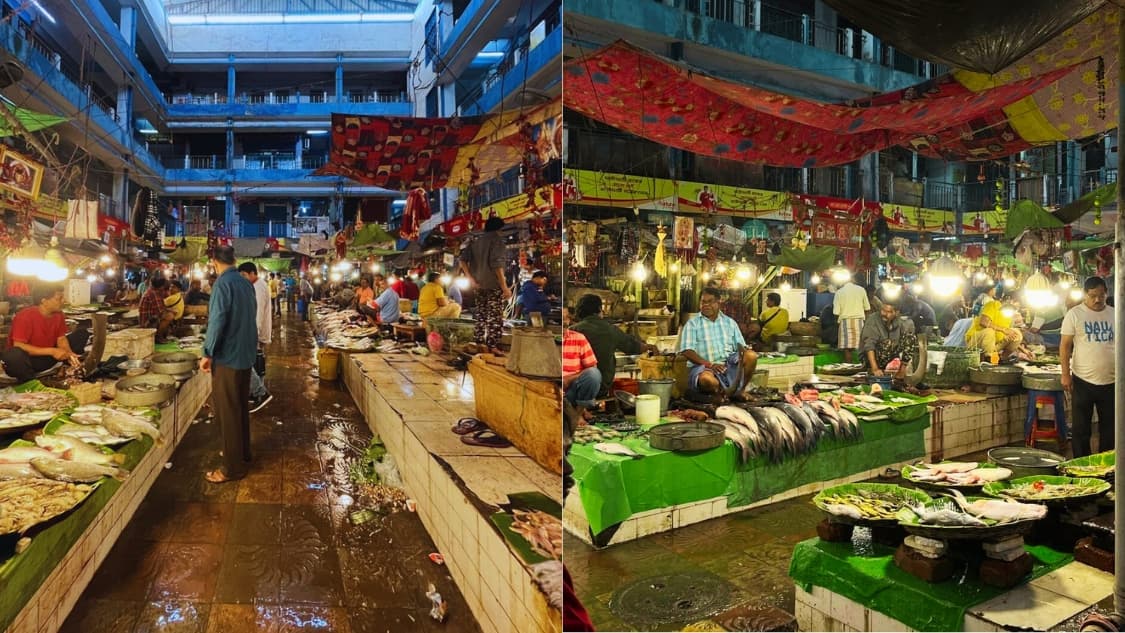
A two-part view of the busy fish market at Gariahat, where fishmongers display a wide variety of fresh fish. (Picture by Srishti Dasgupta Sensarma)
The fish market
Tucked along the outer stretch of the complex, the fish market is one of its busiest and most essential sections, especially in the early morning. It is one of the best places to understand why fish is central to Bengali identity.
Rows of rui, katla, bhetki, pabda and seasonal hilsa are laid out on banana leaves, while smaller varieties like mourala and tangra sit in shallow trays ready to be weighed and packed. Large freshwater prawns, including golda chingri, are displayed separately, their blue-grey shells glistening on beds of crushed ice, while smaller bagda chingri are heaped into metal bowls for everyday curries and malai preparations. Vendors clean and cut fish to order within minutes in an efficient choreography. There is a sharp scent of fresh catch, but regulars know this is where the day's cooking truly begins.
Pro tip: The fish market is best visited before 8.30am. The floors can be wet, so wear closed footwear.
Getting there: Kalighat Metro station is the nearest; from there, autos and buses connect directly to Gariahat.
Best time to visit: Mid-morning (10am to noon) for the market building. Early morning (before 8.30am) for the outdoor flower, plant and fresh produce section, including the fish market.
What to bring: Carry cash, especially small change. UPI is widely accepted but mobile signals inside the building can be unreliable. International cards are rarely accepted.
On bargaining: Negotiation is expected but should remain polite. Start at around 60 to 70 per cent of the quoted price if buying multiple items and meet in the middle.


