



Cycling through Bengal changed Shantanu Moitra
The music composer looks back on his ‘Anantha Yatra’ and the impact of its last leg in Bengal

 Published on 2025-08-26Updated on 2025-08-26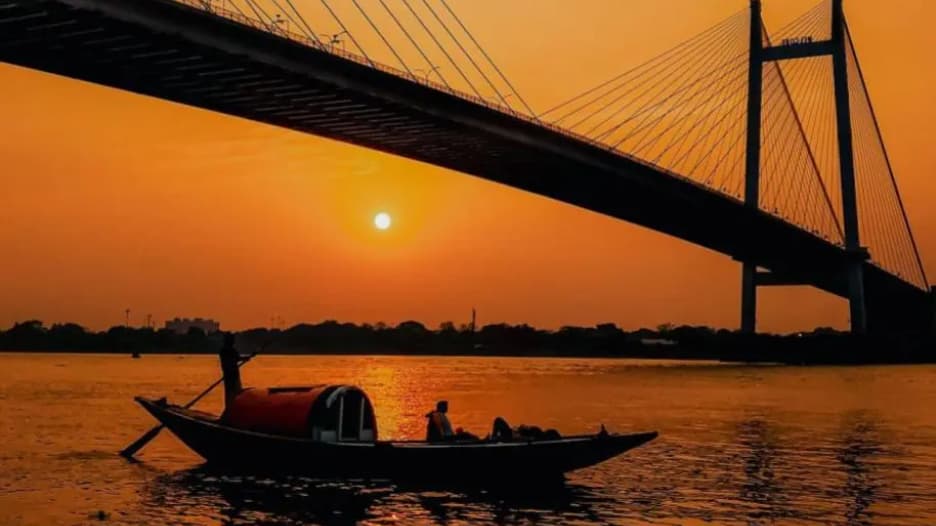
Shantanu Moitra’s ‘Anantha Yatra’ involved him cycling from Gomukh to Gangasagar, tracing the path of the Ganga across India. (Picture by Krishnungshu Gangopadhyay)
Summary
Music Composer Shantanu Moitra narrates his cycle journey in Bengal — passing through Murshidabad of the nawabi past, the former French colony of Chandannagar, Kolkata the soul and capital of Bengal, Diamond Harbour by the sea and culminating at the pilgrimage spot of Gangasagar. In Kolkata, he cycled across the city, from the Victoria Memorial and Prinsep Ghat to Babughat, the Eden Gardens and the Shahid Minar.
I had never thought that ending a journey could feel like starting one. Then again, I had never been to Gangasagar before. For over three months in 2021, I cycled from Gomukh to Gangasagar — tracing the path of the Ganga from its icy birthplace in the Himalayas to the point where it dissolves gently into the Bay of Bengal. I called this my 'Anantha Yatra' — a pilgrimage born out of grief and longing.
In May 2021, I had lost my father to COVID-19. Like so many others, whose loved ones were snatched away from them in a heartbeat, I never got to say goodbye. 'Anantha Yatra' was my way of honouring not just my dad, but all those who had passed in dehumanising isolation, whose families had been denied closure.
From Harsil to Patna, from Bhagalpur to Varanasi, every stretch of this 3,000 kilometre expedition left its mark on me. But it was Bengal — my home state and yet a place I had rarely known — that changed me.
In Bengal, the Ganga is not just a river. She is a rhythm
Bengal is not a state you simply inherit by birth. It’s one you grow into, through its silences, its storms, its songs.
When I entered Bengal on my bicycle as part of 'Anantha Yatra', I was exhausted, carrying not just the weight of the road but the weight of memory. As I passed through Murshidabad, Chandannagar and eventually Kolkata — before embarking on the final leg from New Market to Gangasagar — I began to understand just how much of Bengal I had carried inside me unknowingly. And just how much I had missed seeing until I arrived, not as a resident, but as a pilgrim.
In Bengal, the Ganga is not just a river. She is a rhythm. She seeps into daily life — not spoken about, but lived around. She flows through rituals, bhatiali songs sung by boatmen and the architecture of homes that tilt towards her in resignation.
In Murshidabad, I saw how the river gives and takes in equal measure. Villages are swallowed and reborn. People adapt to the river’s fickleness with dignity. As someone who composes music, this moved me deeply. We chase permanence in our notes, seeking meaning in our melodies. But in Bengal, I witnessed lives shaped around the acceptance of impermanence.
In Bengal, I began to understand that music doesn’t always come from sound. Sometimes, it’s in the stillness — the kind that settles over a place as evening falls, when everything quietens but nothing feels empty. The kind of quiet that doesn’t need embellishment. It simply asks you to notice it.
If I could cycle to the Howrah bridge, nothing could stop me from reaching Gangasagar
Together with Kaushiki Chakraborty and Ambi Subramaniam, I composed Bhagirathi — a piece on the many moods of the Ganga, that felt less like a creation and more like something uncovered. It was Murshidabad’s gift to us, shaped by its fading palaces, shifting riverbanks and the weight of forgotten stories.
Once I reached Kolkata, I cycled across the city, from the Victoria Memorial, Prinsep Ghat, Babughat, the Eden Gardens and the Shahid Minar, before looping back. Most of this was done when the city was still half-asleep, the streets silent witnesses to a journey nearing its close. The next day, I set off towards Gangasagar.
When I’m cycling, I’m usually in the zone. I’m painting pictures in my head, coming up with tunes and taking in everything around me. But during those last few hours from Diamond Harbour to Gangasagar, which involved colliding with another cyclist and getting my eyes stung by a bee, I acquired a sort of tunnel vision. I just wanted to reach the finish line.
I knew I was in the flow. I wasn’t able to move my right shoulder (because of the collision), but I somehow managed to ride faster than I had done before. Such is the power of faith. Faith not just in the divine, but in the people. In the land. In Bengal.
I remember telling myself in Gangotri that If I could cycle to the Howrah bridge, nothing could stop me from reaching Gangasagar. But when I finally did, I felt a strange emptiness. After all the months of visualising the road, imagining the weather, the encounters, the pain — it was done.
The process had ended. But something inside had only just begun.
I had promised myself I would carry sacred water from every significant point along the Ganga and merge it at the confluence. But what happened at Gangasagar went beyond ritual.
At Shridham Gangasagar Swami Kapilananda Vidyabhaban, a high school in Gangasagar, my family and I inaugurated a memorial for COVID-19 victims. Over 700 photos of loved ones taken too soon by the pandemic had been sent to me by followers on social media. We infused each image with tulsi seeds. And then, one by one, we planted the photographs in the soil as living memories, transformed into the future.
I don’t think there could have been a more appropriate way to sign off the 'Anantha Yatra'. This was as real as regeneration could be.
Songs of the River, the documentary we made during the journey of 'Anantha Yatra', is a testament to what happens when you abandon the controlled confines of a studio and let music breathe in the open. Our studio was nature. Our instruments included birdsong, water ripples and temple bells. Bengal was instrumental in this, inspiring us to improvise and innovate.
What I learned in Bengal cannot be measured
We live in a time obsessed with metrics. How far did you go? How many cities did you cross? How many people watched your documentary?
But what I learned in Bengal cannot be measured. It does not live on Google Maps or YouTube views. It lives on in the way I now sit at my harmonium and don’t rush to find a tune. It lives in the silence I allow between two notes. In the way I listen when someone speaks. There’s a different kind of rhythm I’ve come to value — one that isn’t driven by output or applause. It’s slower, more deliberate. The kind that lets ideas breathe before they form, that treats pauses not as voids but as part of the composition.
Bengal reminded me that presence has its own tempo. Whether I’m writing music or simply having a conversation, I find myself more comfortable with the in-between — the unfinished, the unspoken, the not-yet-decided. It’s in those spaces that the most interesting things begin to take shape.
There’s an unspoken generosity that runs through Bengal
I cried when I left Gangasagar.
Not because it was over. But because I wasn’t ready to stop feeling so alive.
I had begun this journey thinking I would honour others. But in the end, I was the one who had been honoured — with stories, silences, sunsets and strangers who treated me like kin.
There’s an unspoken generosity that runs through Bengal. It doesn’t announce itself, but you feel it — in the way someone offers you a place to sit, a glass of water, a moment of their time without needing to know your name. These gestures are small, almost unremarkable on the surface, but they stay with you.
Bengal’s landscape, too, seems to carry this temperament. Nothing shouts for attention. The river bends gently, the light filters through trees with a kind of softness and the days move at their own unhurried pace. Bengal teaches you to observe without reaching for interpretation. To absorb, rather than conclude. And in doing so, it changes the way you move through the world.
Now, every time I close my eyes and hear the tide at Gangasagar, I remind myself: some journeys are chosen and some journeys choose us. In Bengal, I found both.


